 Add to Chrome
 Add to Firefox
 Add to Edge
LUCID: Learning-Enabled Uncertainty-Aware Certification of Stochastic Dynamical Systems
Dec 12, 2025

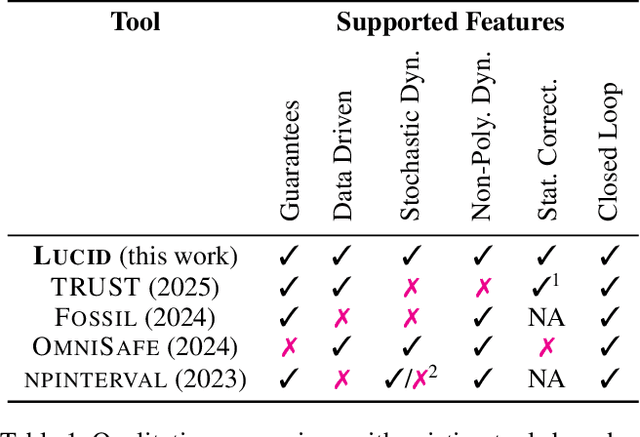
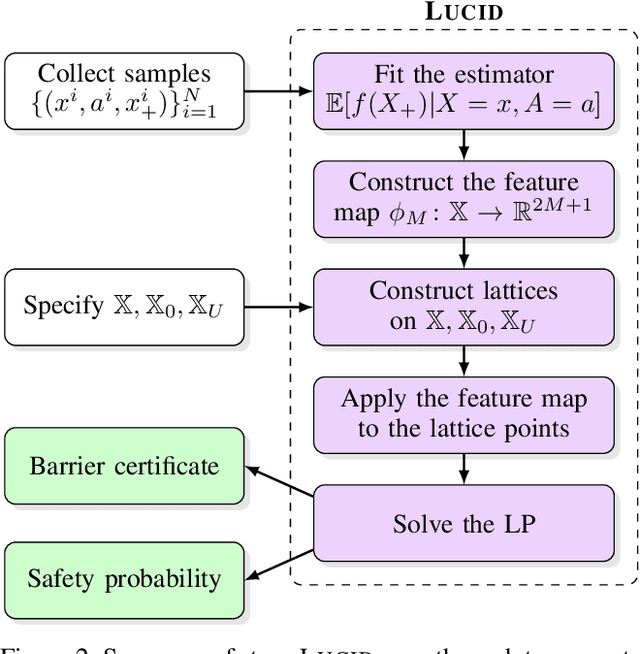
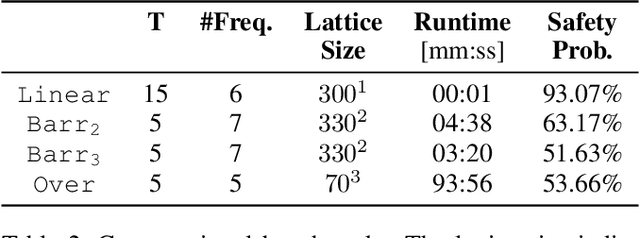
Ensuring the safety of AI-enabled systems, particularly in high-stakes domains such as autonomous driving and healthcare, has become increasingly critical. Traditional formal verification tools fall short when faced with systems that embed both opaque, black-box AI components and complex stochastic dynamics. To address these challenges, we introduce LUCID (Learning-enabled Uncertainty-aware Certification of stochastIc Dynamical systems), a verification engine for certifying safety of black-box stochastic dynamical systems from a finite dataset of random state transitions. As such, LUCID is the first known tool capable of establishing quantified safety guarantees for such systems. Thanks to its modular architecture and extensive documentation, LUCID is designed for easy extensibility. LUCID employs a data-driven methodology rooted in control barrier certificates, which are learned directly from system transition data, to ensure formal safety guarantees. We use conditional mean embeddings to embed data into a reproducing kernel Hilbert space (RKHS), where an RKHS ambiguity set is constructed that can be inflated to robustify the result to out-of-distribution behavior. A key innovation within LUCID is its use of a finite Fourier kernel expansion to reformulate a semi-infinite non-convex optimization problem into a tractable linear program. The resulting spectral barrier allows us to leverage the fast Fourier transform to generate the relaxed problem efficiently, offering a scalable yet distributionally robust framework for verifying safety. LUCID thus offers a robust and efficient verification framework, able to handle the complexities of modern black-box systems while providing formal guarantees of safety. These unique capabilities are demonstrated on challenging benchmarks.

Blending Participatory Design and Artificial Awareness for Trustworthy Autonomous Vehicles
Jun 09, 2025Current robotic agents, such as autonomous vehicles (AVs) and drones, need to deal with uncertain real-world environments with appropriate situational awareness (SA), risk awareness, coordination, and decision-making. The SymAware project strives to address this issue by designing an architecture for artificial awareness in multi-agent systems, enabling safe collaboration of autonomous vehicles and drones. However, these agents will also need to interact with human users (drivers, pedestrians, drone operators), which in turn requires an understanding of how to model the human in the interaction scenario, and how to foster trust and transparency between the agent and the human. In this work, we aim to create a data-driven model of a human driver to be integrated into our SA architecture, grounding our research in the principles of trustworthy human-agent interaction. To collect the data necessary for creating the model, we conducted a large-scale user-centered study on human-AV interaction, in which we investigate the interaction between the AV's transparency and the users' behavior. The contributions of this paper are twofold: First, we illustrate in detail our human-AV study and its findings, and second we present the resulting Markov chain models of the human driver computed from the study's data. Our results show that depending on the AV's transparency, the scenario's environment, and the users' demographics, we can obtain significant differences in the model's transitions.