 Add to Chrome
 Add to Firefox
 Add to Edge
Layered Safety: Enhancing Autonomous Collision Avoidance via Multistage CBF Safety Filters
Feb 27, 2026
This paper presents a general end-to-end framework for constructing robust and reliable layered safety filters that can be leveraged to perform dynamic collision avoidance over a broad range of applications using only local perception data. Given a robot-centric point cloud, we begin by constructing an occupancy map which is used to synthesize a Poisson safety function (PSF). The resultant PSF is employed as a control barrier function (CBF) within two distinct safety filtering stages. In the first stage, we propose a predictive safety filter to compute optimal safe trajectories based on nominal potentially-unsafe commands. The resultant short-term plans are constrained to satisfy the CBF condition along a finite prediction horizon. In the second stage, instantaneous velocity commands are further refined by a real-time CBF-based safety filter and tracked by the full-order low-level robot controller. Assuming accurate tracking of velocity commands, we obtain formal guarantees of safety for the full-order system. We validate the optimality and robustness of our multistage architecture, in comparison to traditional single-stage safety filters, via a detailed Pareto analysis. We further demonstrate the effectiveness and generality of our collision avoidance methodology on multiple legged robot platforms across a variety of real-world dynamic scenarios.

Multirotor Ensemble Model Predictive Control I: Simulation Experiments
May 22, 2023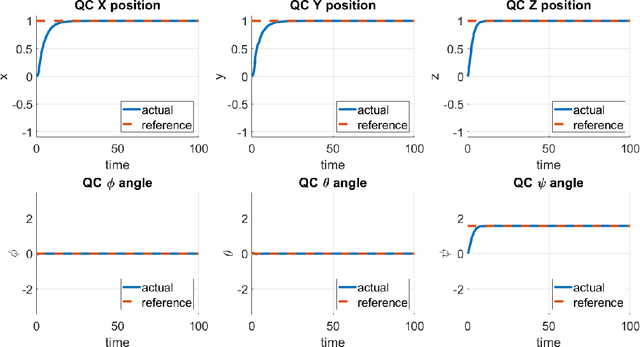
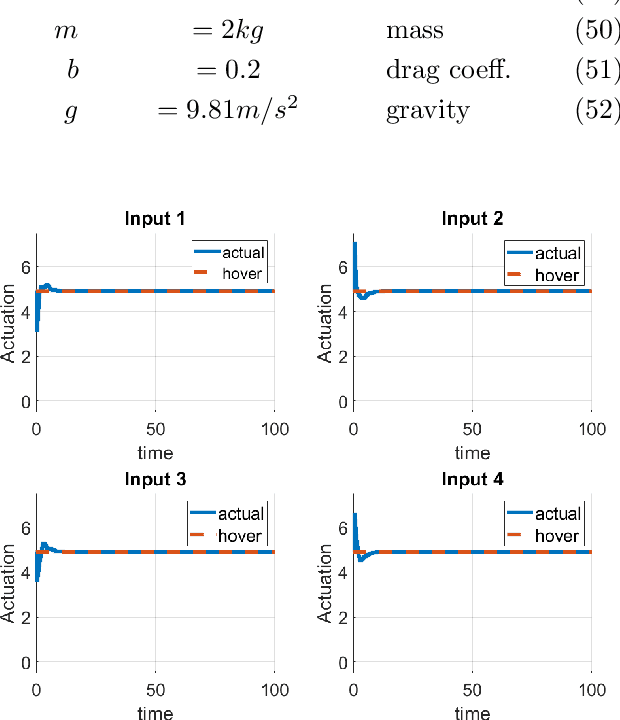
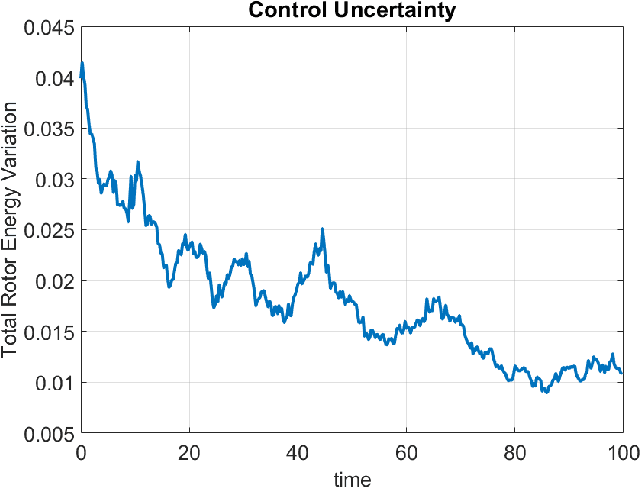
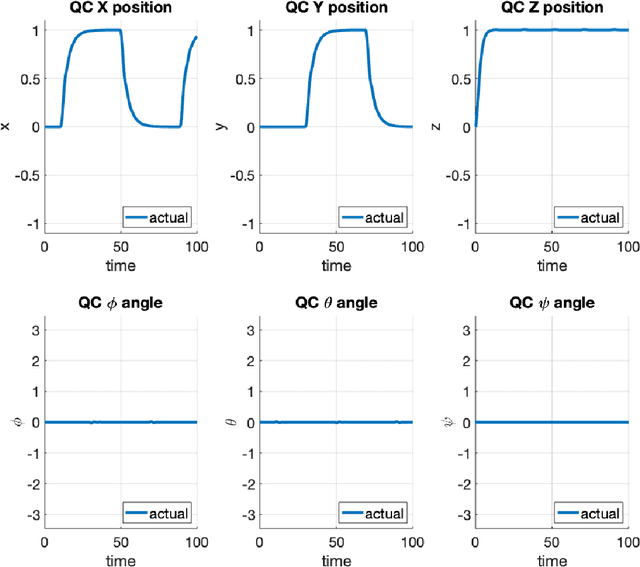
Nonlinear receding horizon model predictive control is a powerful approach to controlling nonlinear dynamical systems. However, typical approaches that use the Jacobian, adjoint, and forward-backward passes may lose fidelity and efficacy for highly nonlinear problems. Here, we develop an Ensemble Model Predictive Control (EMPC) approach wherein the forward model remains fully nonlinear, and an ensemble-represented Gaussian process performs the backward calculations to determine optimal gains for the initial time. EMPC admits black box, possible non-differentiable models, simulations are executable in parallel over long horizons, and control is uncertainty quantifying and applicable to stochastic settings. We construct the EMPC for terminal control and regulation problems and apply it to the control of a quadrotor in a simulated, identical-twin study. Results suggest that the easily implemented approach is promising and amenable to controlling autonomous robotic systems with added state/parameter estimation and parallel computing.