 Add to Chrome
 Add to Firefox
 Add to Edge
Applying Deep Learning for cockpit segmentation in the context of mixed reality
Jun 02, 2026
Computer vision is an area that has been growing continuously. With the advance of technologies with a first-person view, new development opportunities have emerged inside the area. Mixed reality promotes virtual environments with objects from the physical world shown in real time. For that, it's necessary to be concerned with the immersion of the user in this simulated environment, increasingly seeking to bring it closer to a possible desired reality. This paper proposes the development of image processing in order to perform the segmentation of images to identify what is foreground and background in order to facilitate the union of virtual and real images. Thus, the present work obtain real images of the user using the off-highway truck simulator CAT793F, through a camera, to be able to perform the segmentation of such images with artificial intelligence techniques.The convolutional neural network architectures "U-net" and "DeepLabV3+" are applied to perform image segmentation. As a result, metrics with around 90% accuracy were presented and and the best model was determined.

A Systematic Evaluation of Current Architectures in Wind Power Forecasting
Jun 01, 2026Interval wind speed forecasting is essential for the efficient integration of wind energy into power systems, as it accounts for the inherent uncertainty of wind resources. This study presents a systematic literature review focused on hybrid approaches to interval forecasting of wind generation, exploring the combination of deep learning, modal decomposition, and statistical methods. To guide the paper selection, Latent Dirichlet Allocation (LDA) was applied for topic modeling, enabling the identification of patterns and research trends. The findings emphasize that integrating hybrid models with decomposition techniques-such as Variational Mode Decomposition (VMD) and Ensemble Empirical Mode Decomposition (EEMD)-enhances forecast accuracy and reliability by narrowing prediction intervals without compromising coverage. Regarding interval construction, most studies adopt a dual-model strategy, independently forecasting the lower and upper bounds. Input data are commonly decomposed using techniques like EMD, EEMD, or VMD, which extract frequency-based components. These components serve as inputs to models such as LSTM or ELM, trained separately for each bound. This approach allows for targeted modeling of uncertainty, improving flexibility and precision, Interval quality is typically evaluated through metrics that balance coverage and interval width. The review also highlights challenges, including the lack of standardized evaluation metrics, computational complexity, and limited real-world validation. Overall, the study reinforces the value of interval forecasting for wind energy operations and offers insights for advancing model robustness and decision-making.
Iterative Framework For Data Augmentation Of Segmented Fingerprints
May 29, 2026Infant biometrics presents unique challenges due to the physiological differences between infants and adults, compounded by the scarcity of available data for research that limits the development of robust matching systems. This paper proposes a novel data augmentation method that uses iterative techniques to generate diverse variants of segmented fingerprints by inducing errors in a convolutional neural network trained to extract fingerprint ridges and valleys. Experiments on real infant fingerprints demonstrate the method's effectiveness in expanding fingerprint variability, with augmentations exhibiting significant fluctuations in minutiae counts while still retaining visual similarity to the originals. The study also highlights the method's customizable nature for applying varying levels of changes to fingerprint segmentations. Future research includes training segmentation and matching neural networks using datasets augmented by the proposed framework.
Mathematical Morphology in Machine Learning
May 29, 2026This work introduces mathematical morphology-an established visual computing theory-into machine learning to exploit shape and density aspects often overlooked by standard techniques. We propose a fast clustering algorithm based on morphological reconstruction that accurately preserves cluster shapes and density. This scheme offers unique features: an intrinsic sense of maximal clusters, cost-free noise removal, and diverse growth patterns controlled by structuring elements.Additionally, we propose a novel distance metric combining Minkowski and Chebyshev distances, highly efficient for morphological dilations. In $Z^2$ discrete neighbourhood iterations, it is roughly 1.3 times faster than Manhattan and 329.5 times faster than Euclidean distances. When evaluated using a k-Nearest Neighbours (k-NN) classifier across 33 UCI datasets against 14 other distances, our metric achieved above-average accuracies most frequently (26 of 33 cases) and the best overall accuracy in 9 cases.Finally, we introduce novel morphological classifiers. Unlike current literature, this proposal uniquely models shape, density, and fractal information in datasets.
Recursive Class Connectivity Classification (R3C) Applied to Binary Image Segmentation for Improved Infant Fingerprint Enhancement
May 25, 2026Image enhancement plays a crucial role in infant fingerprint matching, as child-specific characteristics such as smaller finger dimensions and thinner ridge structures often degrade image quality during acquisition. To address these limitations, enrollment typically depends on specialized highresolution scanners, which most existing enhancement methods are not designed to support. Consequently, identification rates for children remain significantly lower than those achieved with adult fingerprints. This study introduces Recursive Class Connectivity Classification (R3C), a novel framework that iteratively refines binary segmentation outputs from existing enhancement methods by extending ridge structures. R3C does not require modifications to the underlying classifier and operates without training data, which is not currently available for infant fingerprints. Instead, the method improves segmentation by repeatedly feeding the classified image back into the classification process, while combining each intermediate segmentation with the original input image. Experiments conducted on three fingerprint datasets using four different enhancement classifiers show that R3C can increase the True Acceptance Rate (TAR) by up to 4% for children and over 40% for newborns, compared to using the enhancement methods alone. A qualitative analysis further demonstrates that R3C reconnects fragmented ridge patterns, improving the visual quality of segmentation. Because it functions independently of the enhancement method used, R3C provides a flexible and broadly applicable solution for improving binary segmentation.
Cardiac fat segmentation using computed tomography and an image-to-image conditional generative adversarial neural network
May 19, 2026In recent years, research has highlighted the association between increased adipose tissue surrounding the human heart and elevated susceptibility to cardiovascular diseases such as atrial fibrillation and coronary heart disease. However, the manual segmentation of these fat deposits has not been widely implemented in clinical practice due to the substantial workload it entails for medical professionals and the associated costs. Consequently, the demand for more precise and time-efficient quantitative analysis has driven the emergence of novel computational methods for fat segmentation. This study presents a novel deep learning-based methodology that offers autonomous segmentation and quantification of two distinct types of cardiac fat deposits. The proposed approach leverages the pix2pix network, a generative conditional adversarial network primarily designed for image-to-image translation tasks. By applying this network architecture, we aim to investigate its efficacy in tackling the specific challenge of cardiac fat segmentation, despite not being originally tailored for this purpose. The two types of fat deposits of interest in this study are referred to as epicardial and mediastinal fats, which are spatially separated by the pericardium. The experimental results demonstrated an average accuracy of 99.08% and f1-score 98.73 for the segmentation of the epicardial fat and 97.90% of accuracy and f1-score of 98.40 for the mediastinal fat. These findings represent the high precision and overlap agreement achieved by the proposed methodology. In comparison to existing studies, our approach exhibited superior performance in terms of f1-score and run time, enabling the images to be segmented in real time.
Water and Electricity Consumption Forecasting at an Educational Institution using Machine Learning models with Metaheuristic Optimization
Oct 25, 2024
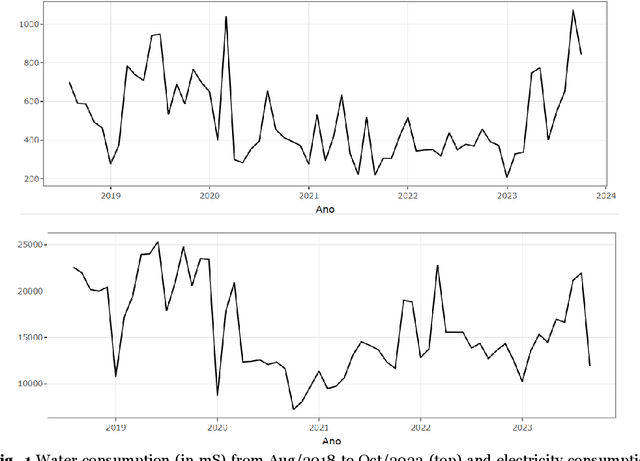
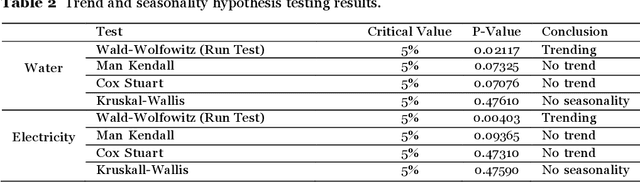
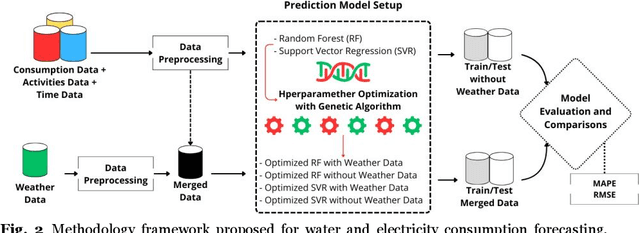
Educational institutions are essential for economic and social development. Budget cuts in Brazil in recent years have made it difficult to carry out their activities and projects. In the case of expenses with water and electricity, unexpected situations can occur, such as leaks and equipment failures, which make their management challenging. This study proposes a comparison between two machine learning models, Random Forest (RF) and Support Vector Regression (SVR), for water and electricity consumption forecasting at the Federal Institute of Paran\'a-Campus Palmas, with a 12-month forecasting horizon, as well as evaluating the influence of the application of climatic variables as exogenous features. The data were collected over the past five years, combining details pertaining to invoices with exogenous and endogenous variables. The two models had their hyperpa-rameters optimized using the Genetic Algorithm (GA) to select the individuals with the best fitness to perform the forecasting with and without climatic variables. The absolute percentage errors and root mean squared error were used as performance measures to evaluate the forecasting accuracy. The results suggest that in forecasting water and electricity consumption over a 12-step horizon, the Random Forest model exhibited the most superior performance. The integration of climatic variables often led to diminished forecasting accuracy, resulting in higher errors. Both models still had certain difficulties in predicting water consumption, indicating that new studies with different models or variables are welcome.
Line Art Colorization of Fakemon using Generative Adversarial Neural Networks
Jul 11, 2023This work proposes a complete methodology to colorize images of Fakemon, anime-style monster-like creatures. In addition, we propose algorithms to extract the line art from colorized images as well as to extract color hints. Our work is the first in the literature to use automatic color hint extraction, to train the networks specifically with anime-styled creatures and to combine the Pix2Pix and CycleGAN approaches, two different generative adversarial networks that create a single final result. Visual results of the colorizations are feasible but there is still room for improvement.
* art generation, lineart colorization, image colorization, generative adversarial networks, stable diffusion, pokemon, fakemon, digimon