 Add to Chrome
 Add to Firefox
 Add to Edge
Learning Gaussian Graphical Models from a Glauber Trajectory Without Mixing
Jun 30, 2026
We study the task of learning the structure of a $d$-sparse Gaussian graphical model on $n$ variables from a single trajectory of Glauber dynamics. Beyond algorithmic considerations, many applications present temporally correlated observations rather than i.i.d.\ samples. In the classical i.i.d.\ setting, under comparably general sparsity and minimum edge-strength assumptions, sublinear-in-$n$ sample guarantees are known, but achieving them in polynomial-time remains open. Motivated in part by this gap, we give a polynomial-time algorithm that recovers the conditional-independence graph from a single Glauber trajectory, with a trajectory-length guarantee that does not depend on the mixing time. Technically, our algorithm has three components. First, we estimate the conditional variances and rescale the trajectory to reduce to the unit-diagonal case, without changing the underlying graph. Second, we design a local edge test that extracts adjacency information from short update windows by isolating pairwise influence. Third, we aggregate these local statistics using a robust median-based estimator, and prove accuracy despite temporal dependence arising from a single trajectory.

Probabilistic Model-Based Approach for Heart Beat Detection
Dec 24, 2015
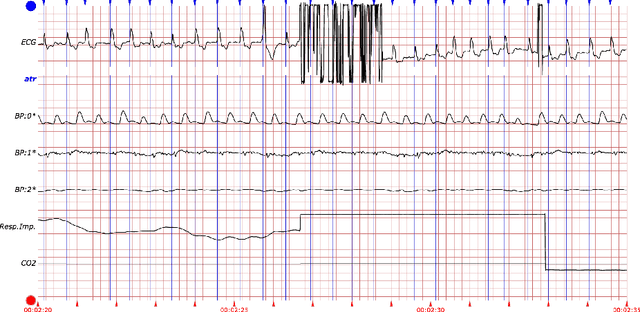
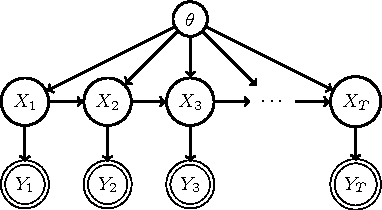
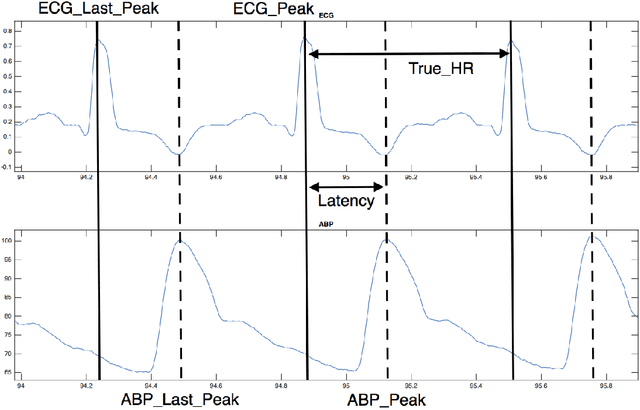
Nowadays, hospitals are ubiquitous and integral to modern society. Patients flow in and out of a veritable whirlwind of paperwork, consultations, and potential inpatient admissions, through an abstracted system that is not without flaws. One of the biggest flaws in the medical system is perhaps an unexpected one: the patient alarm system. One longitudinal study reported an 88.8% rate of false alarms, with other studies reporting numbers of similar magnitudes. These false alarm rates lead to a number of deleterious effects that manifest in a significantly lower standard of care across clinics. This paper discusses a model-based probabilistic inference approach to identifying variables at a detection level. We design a generative model that complies with an overview of human physiology and perform approximate Bayesian inference. One primary goal of this paper is to justify a Bayesian modeling approach to increasing robustness in a physiological domain. We use three data sets provided by Physionet, a research resource for complex physiological signals, in the form of the Physionet 2014 Challenge set-p1 and set-p2, as well as the MGH/MF Waveform Database. On the extended data set our algorithm is on par with the other top six submissions to the Physionet 2014 challenge.