 Add to Chrome
 Add to Firefox
 Add to Edge
D-SafeMPC: Diffusion-Driven Safe Model Predictive Control with Discrete-Time Control Barrier Functions
Jul 12, 2026
A key limitation on the use of diffusion models in robotic planning is their inability to inherently enforce safety or dynamical constraints, which often results in physically infeasible or unsafe outputs. Hybrid approaches that employ model predictive control (MPC) to address this problem can be unstable, as poor trajectory initializations from the diffusion model prevent the MPC from converging to a safe and feasible solution. To overcome these challenges, we propose D-SafeMPC, which enhances the interaction between diffusion and control. Our method guides the reverse diffusion process with control barrier functions (CBFs) and control Lyapunov functions (CLFs) and employs an iterative-projection scheme where an MPC refines the trajectory at each denoising step. This steers sampling toward safe, goal-directed regions and provides reliable MPC warm starts. In simulations on a Franka manipulator across four scenarios (one static-obstacle and three dynamic-obstacle settings) and in a sim-to-real experiment on a physical Franka robot, D-SafeMPC improves safety, task success rates, and planning efficiency over state-of-the-art baselines. To facilitate reproducibility, our source code and experimental configurations are available in a repository at https://github.com/erdiphd/D-SafeMPC

Exp2VLA: Enabling Vision-Language-Action for Drone Navigation from Expert Demonstrations
Jul 03, 2026Vision-language-action (VLA) models open a new path toward intuitive robot control by directly linking perception, language, and action in a single end-to-end framework. Yet for UAVs, practical adoption remains difficult because existing solutions are either computationally heavy or insufficiently capable in complex environments. In this work, we propose a practical expert-distillation pipeline (Exp2VLA) for language-conditioned drone navigation. The core idea is to distill expert behavior, obtained from reinforcement learning, teleoperation, or other controllers, into training data that can be used to fine-tune compact VLA models. This allows existing control strategies to be transferred into a unified language-guided navigation model, reducing manual system integration and lowering the barrier for deploying new robot behaviors. Experiments in both sim-to-sim and simulation-in-the-loop settings across multi-object scenes show that the fine-tuned models can handle varied semantic commands and generalize to unseen target compositions. The proposed framework demonstrates how expert-policy distillation can help mechatronic systems move from specialized control modules toward more flexible and reusable robot intelligence.
Contact Energy Based Hindsight Experience Prioritization
Dec 05, 2023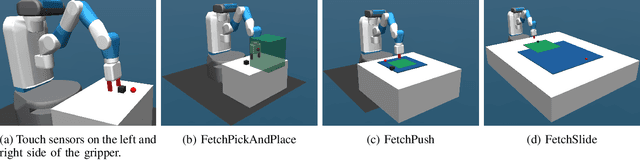
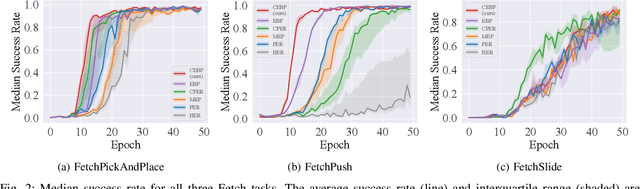
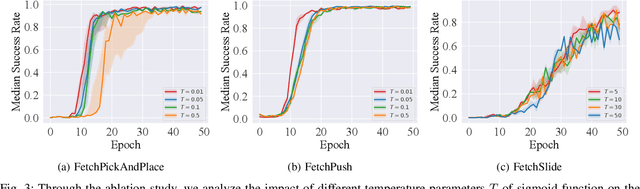
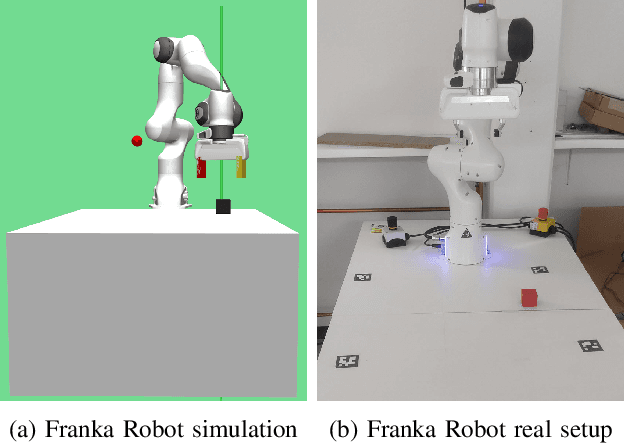
Multi-goal robot manipulation tasks with sparse rewards are difficult for reinforcement learning (RL) algorithms due to the inefficiency in collecting successful experiences. Recent algorithms such as Hindsight Experience Replay (HER) expedite learning by taking advantage of failed trajectories and replacing the desired goal with one of the achieved states so that any failed trajectory can be utilized as a contribution to learning. However, HER uniformly chooses failed trajectories, without taking into account which ones might be the most valuable for learning. In this paper, we address this problem and propose a novel approach Contact Energy Based Prioritization~(CEBP) to select the samples from the replay buffer based on rich information due to contact, leveraging the touch sensors in the gripper of the robot and object displacement. Our prioritization scheme favors sampling of contact-rich experiences, which are arguably the ones providing the largest amount of information. We evaluate our proposed approach on various sparse reward robotic tasks and compare them with the state-of-the-art methods. We show that our method surpasses or performs on par with those methods on robot manipulation tasks. Finally, we deploy the trained policy from our method to a real Franka robot for a pick-and-place task. We observe that the robot can solve the task successfully. The videos and code are publicly available at: https://erdiphd.github.io/HER_force