 Add to Chrome
 Add to Firefox
 Add to Edge
Evaluating LLM-Driven Summarisation of Parliamentary Debates with Computational Argumentation
Apr 21, 2026
Understanding how policy is debated and justified in parliament is a fundamental aspect of the democratic process. However, the volume and complexity of such debates mean that outside audiences struggle to engage. Meanwhile, Large Language Models (LLMs) have been shown to enable automated summarisation at scale. While summaries of debates can make parliamentary procedures more accessible, evaluating whether these summaries faithfully communicate argumentative content remains challenging. Existing automated summarisation metrics have been shown to correlate poorly with human judgements of consistency (i.e., faithfulness or alignment between summary and source). In this work, we propose a formal framework for evaluating parliamentary debate summaries that grounds argument structures in the contested proposals up for debate. Our novel approach, driven by computational argumentation, focuses the evaluation on formal properties concerning the faithful preservation of the reasoning presented to justify or oppose policy outcomes. We demonstrate our methods using a case-study of debates from the European Parliament and associated LLM-driven summaries.

The Role of Document Embedding in Research Paper Recommender Systems: To Breakdown or to Bolster Disciplinary Borders?
Sep 26, 2023
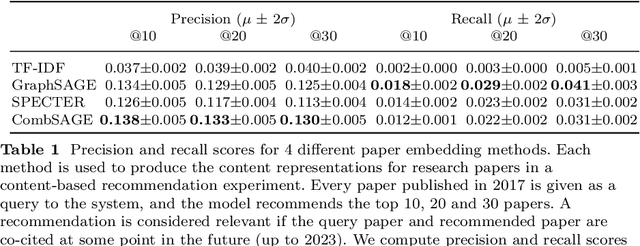
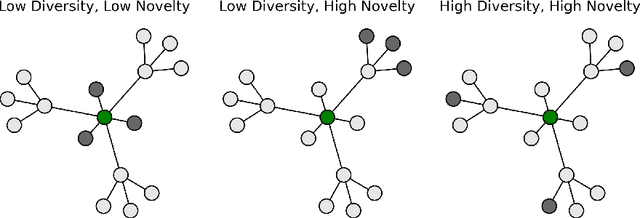
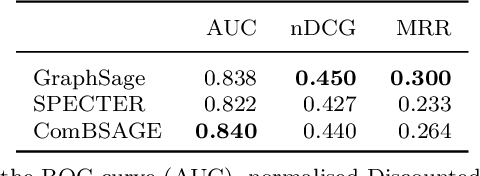
In the extensive recommender systems literature, novelty and diversity have been identified as key properties of useful recommendations. However, these properties have received limited attention in the specific sub-field of research paper recommender systems. In this work, we argue for the importance of offering novel and diverse research paper recommendations to scientists. This approach aims to reduce siloed reading, break down filter bubbles, and promote interdisciplinary research. We propose a novel framework for evaluating the novelty and diversity of research paper recommendations that leverages methods from network analysis and natural language processing. Using this framework, we show that the choice of representational method within a larger research paper recommendation system can have a measurable impact on the nature of downstream recommendations, specifically on their novelty and diversity. We introduce a novel paper embedding method, which we demonstrate offers more innovative and diverse recommendations without sacrificing precision, compared to other state-of-the-art baselines.