 Add to Chrome
 Add to Firefox
 Add to Edge
Teleodynamic Learning a new Paradigm For Interpretable AI
Mar 11, 2026
We introduce Teleodynamic Learning, a new paradigm for machine learning in which learning is not the minimization of a fixed objective, but the emergence and stabilization of functional organization under constraint. Inspired by living systems, this framework treats intelligence as the coupled evolution of three quantities: what a system can represent, how it adapts its parameters, and which changes its internal resources can sustain. We formalize learning as a constrained dynamical process with two interacting timescales: inner dynamics for continuous parameter adaptation and outer dynamics for discrete structural change, linked by an endogenous resource variable that both shapes and is shaped by the trajectory. This perspective reveals three phenomena that standard optimization does not naturally capture: self-stabilization without externally imposed stopping rules, phase-structured learning dynamics that move from under-structuring through teleodynamic growth to over-structuring, and convergence guarantees grounded in information geometry rather than convexity. We instantiate the framework in the Distinction Engine (DE11), a teleodynamic learner grounded in Spencer-Brown's Laws of Form, information geometry, and tropical optimization. On standard benchmarks, DE11 achieves 93.3 percent test accuracy on IRIS, 92.6 percent on WINE, and 94.7 percent on Breast Cancer, while producing interpretable logical rules that arise endogenously from the learning dynamics rather than being imposed by hand. More broadly, Teleodynamic Learning unifies regularization, architecture search, and resource-bounded inference within a single principle: learning as the co-evolution of structure, parameters, and resources under constraint. This opens a thermodynamically grounded route to adaptive, interpretable, and self-organizing AI.

Categorical Belief Propagation: Sheaf-Theoretic Inference via Descent and Holonomy
Jan 08, 2026We develop a categorical foundation for belief propagation on factor graphs. We construct the free hypergraph category \(\Syn_Σ\) on a typed signature and prove its universal property, yielding compositional semantics via a unique functor to the matrix category \(\cat{Mat}_R\). Message-passing is formulated using a Grothendieck fibration \(\int\Msg \to \cat{FG}_Σ\) over polarized factor graphs, with schedule-indexed endomorphisms defining BP updates. We characterize exact inference as effective descent: local beliefs form a descent datum when compatibility conditions hold on overlaps. This framework unifies tree exactness, junction tree algorithms, and loopy BP failures under sheaf-theoretic obstructions. We introduce HATCC (Holonomy-Aware Tree Compilation), an algorithm that detects descent obstructions via holonomy computation on the factor nerve, compiles non-trivial holonomy into mode variables, and reduces to tree BP on an augmented graph. Complexity is \(O(n^2 d_{\max} + c \cdot k_{\max} \cdot δ_{\max}^3 + n \cdot δ_{\max}^2)\) for \(n\) factors and \(c\) fundamental cycles. Experimental results demonstrate exact inference with significant speedup over junction trees on grid MRFs and random graphs, along with UNSAT detection on satisfiability instances.
Filtering Additive Measurement Noise with Maximum Entropy in the Mean
Sep 04, 2007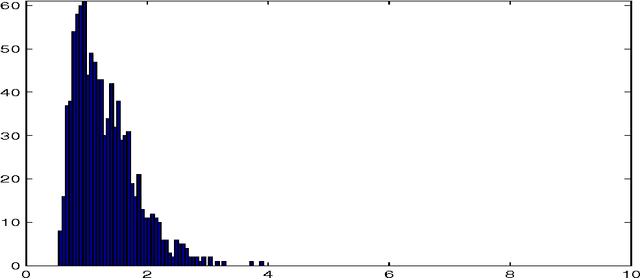
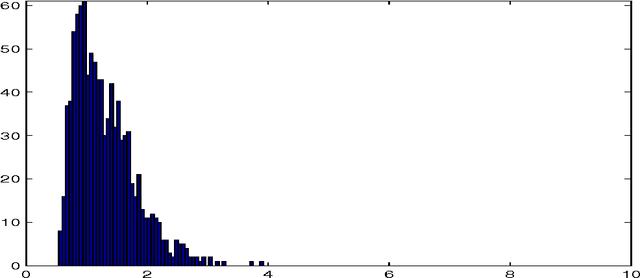
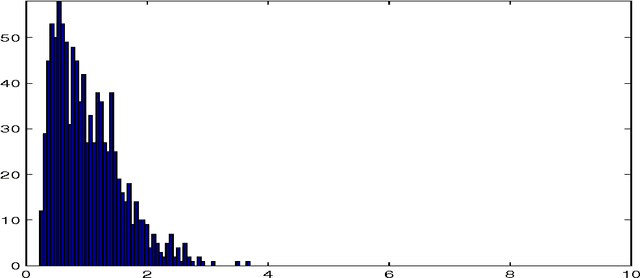
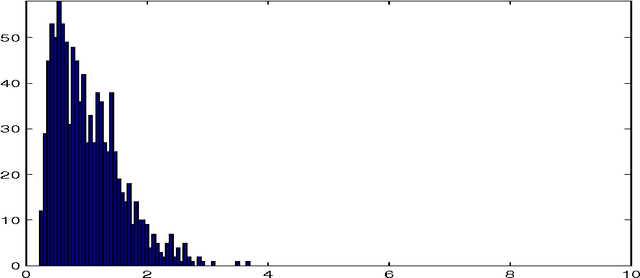
The purpose of this note is to show how the method of maximum entropy in the mean (MEM) may be used to improve parametric estimation when the measurements are corrupted by large level of noise. The method is developed in the context on a concrete example: that of estimation of the parameter in an exponential distribution. We compare the performance of our method with the bayesian and maximum likelihood approaches.