 Add to Chrome
 Add to Firefox
 Add to Edge
Concept frustration: Aligning human concepts and machine representations
Mar 31, 2026
Aligning human-interpretable concepts with the internal representations learned by modern machine learning systems remains a central challenge for interpretable AI. We introduce a geometric framework for comparing supervised human concepts with unsupervised intermediate representations extracted from foundation model embeddings. Motivated by the role of conceptual leaps in scientific discovery, we formalise the notion of concept frustration: a contradiction that arises when an unobserved concept induces relationships between known concepts that cannot be made consistent within an existing ontology. We develop task-aligned similarity measures that detect concept frustration between supervised concept-based models and unsupervised representations derived from foundation models, and show that the phenomenon is detectable in task-aligned geometry while conventional Euclidean comparisons fail. Under a linear-Gaussian generative model we derive a closed-form expression for Bayes-optimal concept-based classifier accuracy, decomposing predictive signal into known-known, known-unknown and unknown-unknown contributions and identifying analytically where frustration affects performance. Experiments on synthetic data and real language and vision tasks demonstrate that frustration can be detected in foundation model representations and that incorporating a frustrating concept into an interpretable model reorganises the geometry of learned concept representations, to better align human and machine reasoning. These results suggest a principled framework for diagnosing incomplete concept ontologies and aligning human and machine conceptual reasoning, with implications for the development and validation of safe interpretable AI for high-risk applications.

PySlyde: A Lightweight, Open-Source Toolkit for Pathology Preprocessing
Nov 07, 2025The integration of artificial intelligence (AI) into pathology is advancing precision medicine by improving diagnosis, treatment planning, and patient outcomes. Digitised whole-slide images (WSIs) capture rich spatial and morphological information vital for understanding disease biology, yet their gigapixel scale and variability pose major challenges for standardisation and analysis. Robust preprocessing, covering tissue detection, tessellation, stain normalisation, and annotation parsing is critical but often limited by fragmented and inconsistent workflows. We present PySlyde, a lightweight, open-source Python toolkit built on OpenSlide to simplify and standardise WSI preprocessing. PySlyde provides an intuitive API for slide loading, annotation management, tissue detection, tiling, and feature extraction, compatible with modern pathology foundation models. By unifying these processes, it streamlines WSI preprocessing, enhances reproducibility, and accelerates the generation of AI-ready datasets, enabling researchers to focus on model development and downstream analysis.
Leakage and Interpretability in Concept-Based Models
Apr 18, 2025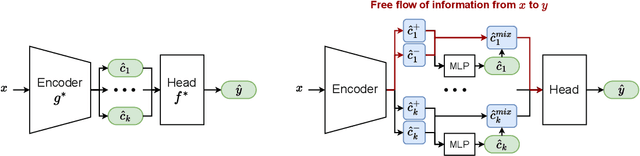
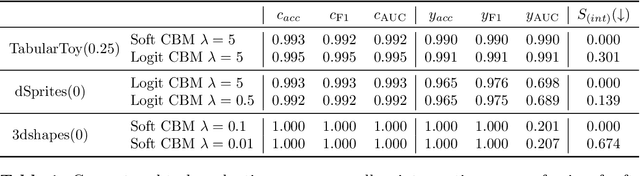
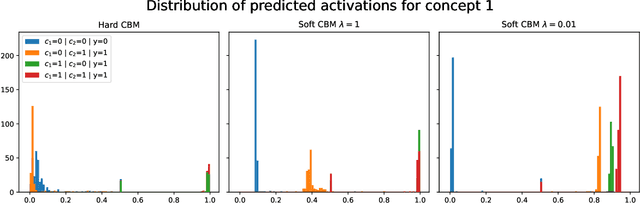
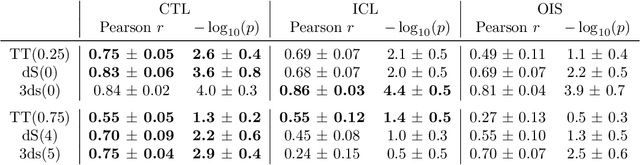
Concept Bottleneck Models aim to improve interpretability by predicting high-level intermediate concepts, representing a promising approach for deployment in high-risk scenarios. However, they are known to suffer from information leakage, whereby models exploit unintended information encoded within the learned concepts. We introduce an information-theoretic framework to rigorously characterise and quantify leakage, and define two complementary measures: the concepts-task leakage (CTL) and interconcept leakage (ICL) scores. We show that these measures are strongly predictive of model behaviour under interventions and outperform existing alternatives in robustness and reliability. Using this framework, we identify the primary causes of leakage and provide strong evidence that Concept Embedding Models exhibit substantial leakage regardless of the hyperparameters choice. Finally, we propose practical guidelines for designing concept-based models to reduce leakage and ensure interpretability.