 Add to Chrome
 Add to Firefox
 Add to Edge
Concept frustration: Aligning human concepts and machine representations
Mar 31, 2026
Aligning human-interpretable concepts with the internal representations learned by modern machine learning systems remains a central challenge for interpretable AI. We introduce a geometric framework for comparing supervised human concepts with unsupervised intermediate representations extracted from foundation model embeddings. Motivated by the role of conceptual leaps in scientific discovery, we formalise the notion of concept frustration: a contradiction that arises when an unobserved concept induces relationships between known concepts that cannot be made consistent within an existing ontology. We develop task-aligned similarity measures that detect concept frustration between supervised concept-based models and unsupervised representations derived from foundation models, and show that the phenomenon is detectable in task-aligned geometry while conventional Euclidean comparisons fail. Under a linear-Gaussian generative model we derive a closed-form expression for Bayes-optimal concept-based classifier accuracy, decomposing predictive signal into known-known, known-unknown and unknown-unknown contributions and identifying analytically where frustration affects performance. Experiments on synthetic data and real language and vision tasks demonstrate that frustration can be detected in foundation model representations and that incorporating a frustrating concept into an interpretable model reorganises the geometry of learned concept representations, to better align human and machine reasoning. These results suggest a principled framework for diagnosing incomplete concept ontologies and aligning human and machine conceptual reasoning, with implications for the development and validation of safe interpretable AI for high-risk applications.

Discovering interpretable models of scientific image data with deep learning
Feb 05, 2024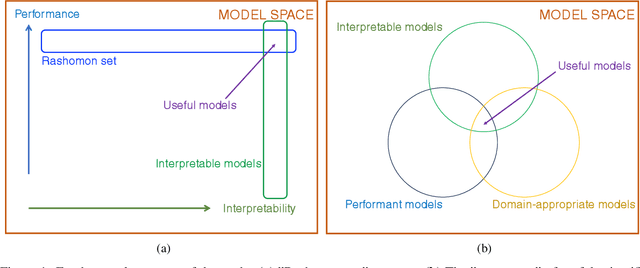

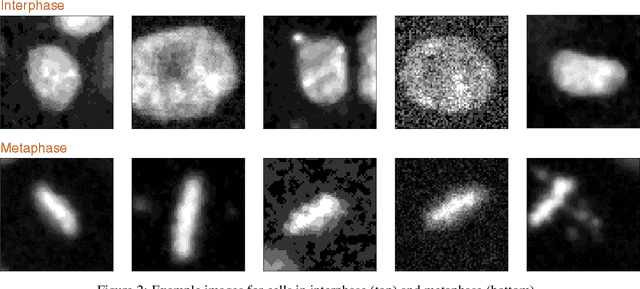
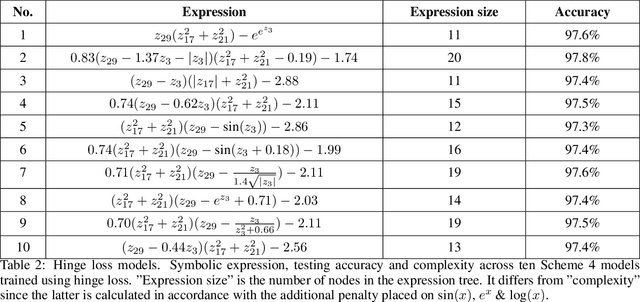
How can we find interpretable, domain-appropriate models of natural phenomena given some complex, raw data such as images? Can we use such models to derive scientific insight from the data? In this paper, we propose some methods for achieving this. In particular, we implement disentangled representation learning, sparse deep neural network training and symbolic regression, and assess their usefulness in forming interpretable models of complex image data. We demonstrate their relevance to the field of bioimaging using a well-studied test problem of classifying cell states in microscopy data. We find that such methods can produce highly parsimonious models that achieve $\sim98\%$ of the accuracy of black-box benchmark models, with a tiny fraction of the complexity. We explore the utility of such interpretable models in producing scientific explanations of the underlying biological phenomenon.