 Add to Chrome
 Add to Firefox
 Add to Edge
Concept frustration: Aligning human concepts and machine representations
Mar 31, 2026
Aligning human-interpretable concepts with the internal representations learned by modern machine learning systems remains a central challenge for interpretable AI. We introduce a geometric framework for comparing supervised human concepts with unsupervised intermediate representations extracted from foundation model embeddings. Motivated by the role of conceptual leaps in scientific discovery, we formalise the notion of concept frustration: a contradiction that arises when an unobserved concept induces relationships between known concepts that cannot be made consistent within an existing ontology. We develop task-aligned similarity measures that detect concept frustration between supervised concept-based models and unsupervised representations derived from foundation models, and show that the phenomenon is detectable in task-aligned geometry while conventional Euclidean comparisons fail. Under a linear-Gaussian generative model we derive a closed-form expression for Bayes-optimal concept-based classifier accuracy, decomposing predictive signal into known-known, known-unknown and unknown-unknown contributions and identifying analytically where frustration affects performance. Experiments on synthetic data and real language and vision tasks demonstrate that frustration can be detected in foundation model representations and that incorporating a frustrating concept into an interpretable model reorganises the geometry of learned concept representations, to better align human and machine reasoning. These results suggest a principled framework for diagnosing incomplete concept ontologies and aligning human and machine conceptual reasoning, with implications for the development and validation of safe interpretable AI for high-risk applications.

Leakage and Interpretability in Concept-Based Models
Apr 18, 2025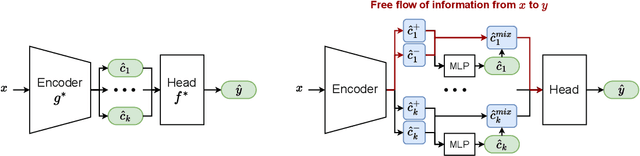
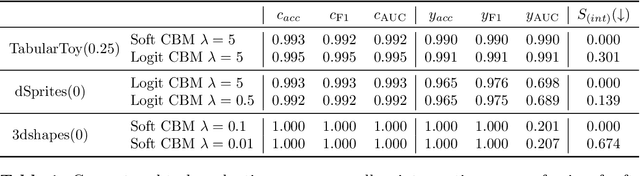
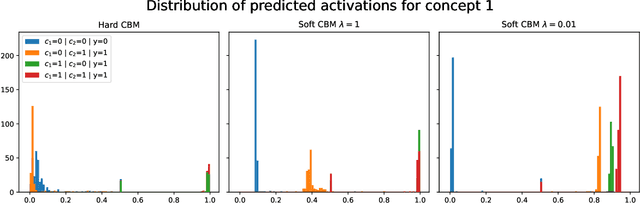
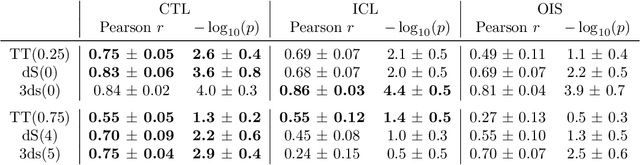
Concept Bottleneck Models aim to improve interpretability by predicting high-level intermediate concepts, representing a promising approach for deployment in high-risk scenarios. However, they are known to suffer from information leakage, whereby models exploit unintended information encoded within the learned concepts. We introduce an information-theoretic framework to rigorously characterise and quantify leakage, and define two complementary measures: the concepts-task leakage (CTL) and interconcept leakage (ICL) scores. We show that these measures are strongly predictive of model behaviour under interventions and outperform existing alternatives in robustness and reliability. Using this framework, we identify the primary causes of leakage and provide strong evidence that Concept Embedding Models exhibit substantial leakage regardless of the hyperparameters choice. Finally, we propose practical guidelines for designing concept-based models to reduce leakage and ensure interpretability.
Deep Learning as Ricci Flow
Apr 22, 2024Deep neural networks (DNNs) are powerful tools for approximating the distribution of complex data. It is known that data passing through a trained DNN classifier undergoes a series of geometric and topological simplifications. While some progress has been made toward understanding these transformations in neural networks with smooth activation functions, an understanding in the more general setting of non-smooth activation functions, such as the rectified linear unit (ReLU), which tend to perform better, is required. Here we propose that the geometric transformations performed by DNNs during classification tasks have parallels to those expected under Hamilton's Ricci flow - a tool from differential geometry that evolves a manifold by smoothing its curvature, in order to identify its topology. To illustrate this idea, we present a computational framework to quantify the geometric changes that occur as data passes through successive layers of a DNN, and use this framework to motivate a notion of `global Ricci network flow' that can be used to assess a DNN's ability to disentangle complex data geometries to solve classification problems. By training more than $1,500$ DNN classifiers of different widths and depths on synthetic and real-world data, we show that the strength of global Ricci network flow-like behaviour correlates with accuracy for well-trained DNNs, independently of depth, width and data set. Our findings motivate the use of tools from differential and discrete geometry to the problem of explainability in deep learning.