 Add to Chrome
 Add to Firefox
 Add to Edge
Knowledge Graph Re-engineering Along the Ontological Continuum (extended version)
May 21, 2026
Knowledge graphs have become the primary vehicle for data integration and are critical to the success of modern AI, but the diversity of KG modelling practices, from lightweight vocabularies to richly axiomatised ontologies, makes integration and reuse expensive and brittle. This challenge is particularly acute in neuro-symbolic AI, where bridging neural and symbolic components depends on the ability to reengineer KGs to fit new requirements; GenAI now offers unprecedented automation capability, but without a principled understanding of the KG space, such automation remains conceptually ungrounded. We introduce the ontological continuum as that missing conceptualisation, a theoretical construct a theoretical construct whose characterisation framework is defined by two orthogonal distinctions: semantics vs pragmatics, and properties vs affordances; together these define a vocabulary to describe, compare, navigate, and transform KGs across the full range of modelling practices. The methodological stance is empirical: rather than prescribing how KGs should be modelled, the continuum aims to define a theory of the existent, derived from observation of real-world KG engineering practices and whose structure can be made formally explicit, for example, through Formal Concept Analysis (FCA). We ground the vision through a case study on provenance knowledge, showing how a single concern manifests differently across the continuum. We articulate five open research challenges and invite the community to develop the ontological continuum as a shared research agenda.

Discoverable Agent Knowledge -- A Formal Framework for Agentic KG Affordances (Extended Version)
May 18, 2026Two decades ago, the Semantic Web Services community was asked how agents with different ontological commitments could discover, compose, and invoke web services coherently. The response was OWL-S and WSMO: formally grounded capability descriptions specifying what a service could do, what the agent must already know for invocation to be epistemically sound, and how ontological mismatches could be formally bridged. Current Knowledge Graph (KG) metadata standards such as VoID and DCAT describe what a KG contains yet say nothing about what a specific agent can prove from it, what closure assumptions govern empty results, or whether the agent's task vocabulary is grounded in the schema. Furthermore, in deployed KGs the governing schema DL and the operative entailment regime can diverge: an epistemic failure mode invisible to current metadata. We revisit and extend these insights for the KG setting with a four-dimensional formal framework from which we derive the Agentic Affordance Profile (AAP): a semantic layer above VoID and DCAT enabling principled KG selection, composition, and failure diagnosis at agent planning time. A five-point research agenda identifies the formal, computational, and engineering work needed to realise AAP-based affordance matching at scale.
Facade-X: an opinionated approach to SPARQL anything
Jun 04, 2021

The Semantic Web research community understood since its beginning how crucial it is to equip practitioners with methods to transform non-RDF resources into RDF. Proposals focus on either engineering content transformations or accessing non-RDF resources with SPARQL. Existing solutions require users to learn specific mapping languages (e.g. RML), to know how to query and manipulate a variety of source formats (e.g. XPATH, JSON-Path), or to combine multiple languages (e.g. SPARQL Generate). In this paper, we explore an alternative solution and contribute a general-purpose meta-model for converting non-RDF resources into RDF: Facade-X. Our approach can be implemented by overriding the SERVICE operator and does not require to extend the SPARQL syntax. We compare our approach with the state of art methods RML and SPARQL Generate and show how our solution has lower learning demands and cognitive complexity, and it is cheaper to implement and maintain, while having comparable extensibility and efficiency.
Commonsense Spatial Reasoning for Visually Intelligent Agents
Apr 01, 2021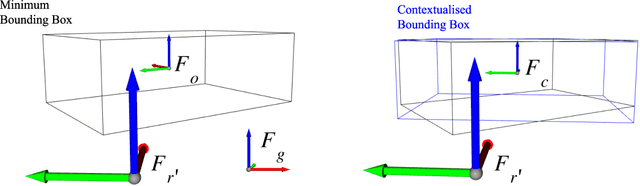
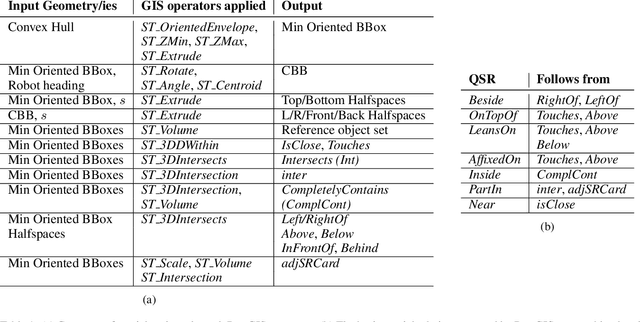
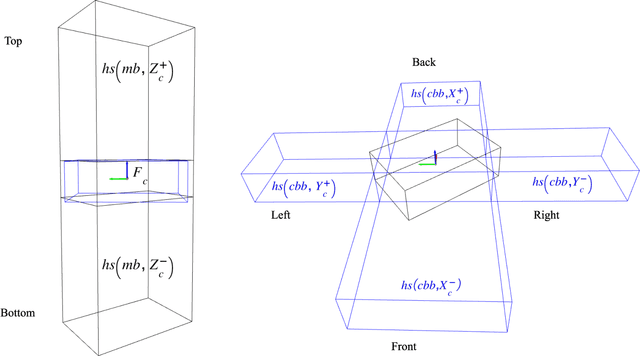
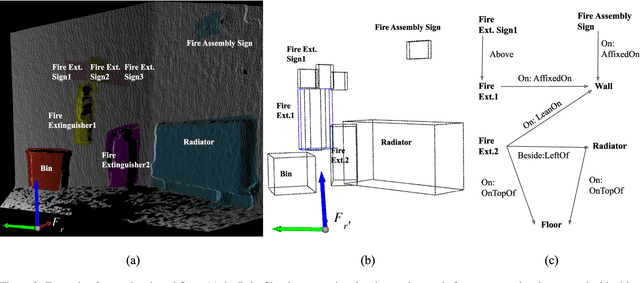
Service robots are expected to reliably make sense of complex, fast-changing environments. From a cognitive standpoint, they need the appropriate reasoning capabilities and background knowledge required to exhibit human-like Visual Intelligence. In particular, our prior work has shown that the ability to reason about spatial relations between objects in the world is a key requirement for the development of Visually Intelligent Agents. In this paper, we present a framework for commonsense spatial reasoning which is tailored to real-world robotic applications. Differently from prior approaches to qualitative spatial reasoning, the proposed framework is robust to variations in the robot's viewpoint and object orientation. The spatial relations in the proposed framework are also mapped to the types of commonsense predicates used to describe typical object configurations in English. In addition, we also show how this formally-defined framework can be implemented in a concrete spatial database.
Fit to Measure: Reasoning about Sizes for Robust Object Recognition
Oct 27, 2020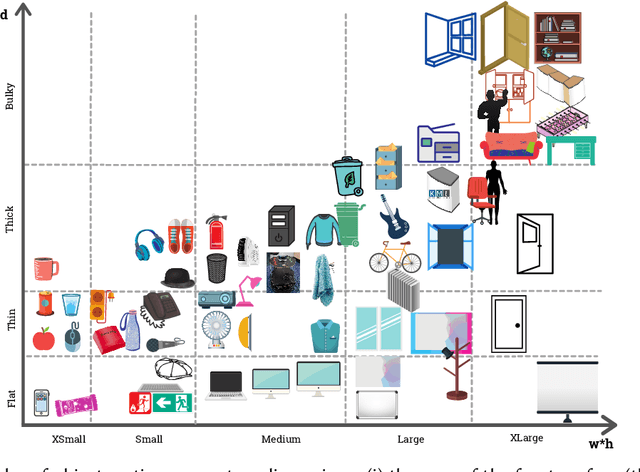

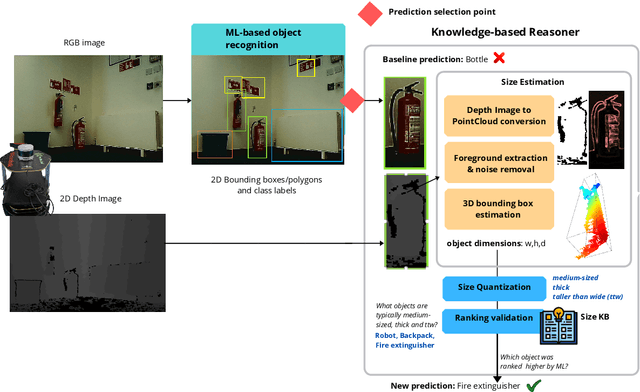
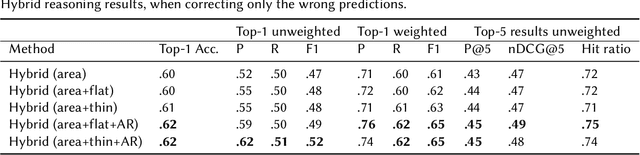
Service robots can help with many of our daily tasks, especially in those cases where it is inconvenient or unsafe for us to intervene: e.g., under extreme weather conditions or when social distance needs to be maintained. However, before we can successfully delegate complex tasks to robots, we need to enhance their ability to make sense of dynamic, real world environments. In this context, the first prerequisite to improving the Visual Intelligence of a robot is building robust and reliable object recognition systems. While object recognition solutions are traditionally based on Machine Learning methods, augmenting them with knowledge based reasoners has been shown to improve their performance. In particular, based on our prior work on identifying the epistemic requirements of Visual Intelligence, we hypothesise that knowledge of the typical size of objects could significantly improve the accuracy of an object recognition system. To verify this hypothesis, in this paper we present an approach to integrating knowledge about object sizes in a ML based architecture. Our experiments in a real world robotic scenario show that this combined approach ensures a significant performance increase over state of the art Machine Learning methods.
Towards a Framework for Visual Intelligence in Service Robotics: Epistemic Requirements and Gap Analysis
Mar 13, 2020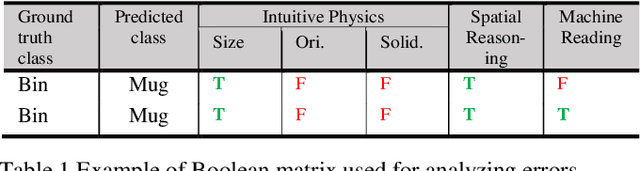
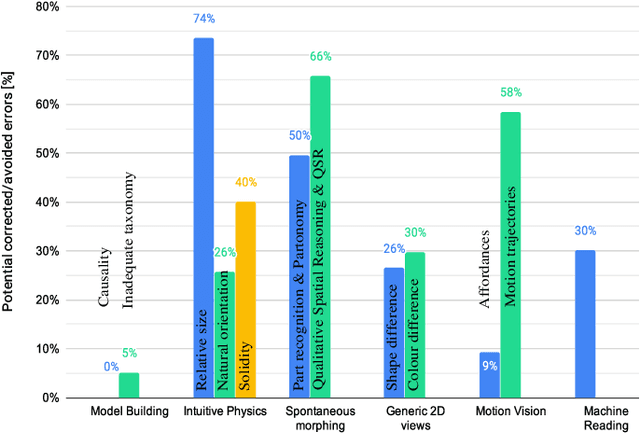
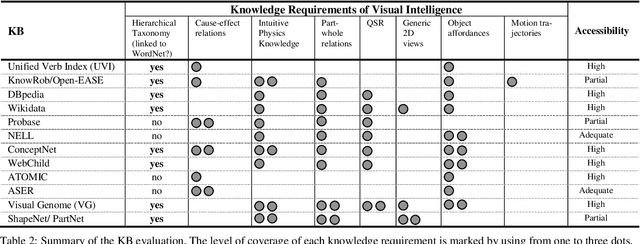
A key capability required by service robots operating in real-world, dynamic environments is that of Visual Intelligence, i.e., the ability to use their vision system, reasoning components and background knowledge to make sense of their environment. In this paper, we analyze the epistemic requirements for Visual Intelligence, both in a top-down fashion, using existing frameworks for human-like Visual Intelligence in the literature, and from the bottom up, based on the errors emerging from object recognition trials in a real-world robotic scenario. Finally, we use these requirements to evaluate current knowledge bases for Service Robotics and to identify gaps in the support they provide for Visual Intelligence. These gaps provide the basis of a research agenda for developing more effective knowledge representations for Visual Intelligence.