 Add to Chrome
 Add to Firefox
 Add to Edge
Where A Small Language Model Helps in Invoice Categorisation, Understood Through Embedding Geometry
Aug 18, 2026
Categorising invoices into the correct General Ledger (GL) code underpins financial reporting and tax compliance. This is a skilled accounting judgement rather than a routine task: the correct category depends subtly on the nature of the purchasing business, the vendor and the invoice text. Whilst AI is increasingly being adopted across industries to automate tasks, including invoice categorisation, implementations built on in-house small language models (SLMs) can simultaneously reduce cost and improve data security, confidentiality, and interpretability. We investigate this approach by first analysing the pre-trained embedding geometry of a small sentence transformer (SBERT) and classic SLM (DeBERTa). The sentence-embedding space of this financial corpus is globally anisotropic but composed of locally isotropic clusters, extending prior token-level findings to sentence embeddings in a financial setting, and these clusters are strongly correlated with the vendor identity. SBERT fine-tuned on a single GPU reaches 0.96 accuracy on invoice classification, above both a zero-shot LLM and a vendor identity baseline, increasing performance for smaller, challenging categories and new clients. For this important generalisation problem, SBERT reaches 0.9 F1 with roughly 100 client-specific invoices, showing that an in-house SLM implementation is promising. Combining these results with geometric analysis shows that pre-trained embedding geometry is associated with classification performance and reveals a counterintuitive finding that a structured input that would help a human reader does not improve the SLM performance.

Unsupervised Attributed Dynamic Network Embedding with Stability Guarantees
Mar 04, 2025Stability for dynamic network embeddings ensures that nodes behaving the same at different times receive the same embedding, allowing comparison of nodes in the network across time. We present attributed unfolded adjacency spectral embedding (AUASE), a stable unsupervised representation learning framework for dynamic networks in which nodes are attributed with time-varying covariate information. To establish stability, we prove uniform convergence to an associated latent position model. We quantify the benefits of our dynamic embedding by comparing with state-of-the-art network representation learning methods on three real attributed networks. To the best of our knowledge, AUASE is the only attributed dynamic embedding that satisfies stability guarantees without the need for ground truth labels, which we demonstrate provides significant improvements for link prediction and node classification.
Intensity Profile Projection: A Framework for Continuous-Time Representation Learning for Dynamic Networks
Jun 09, 2023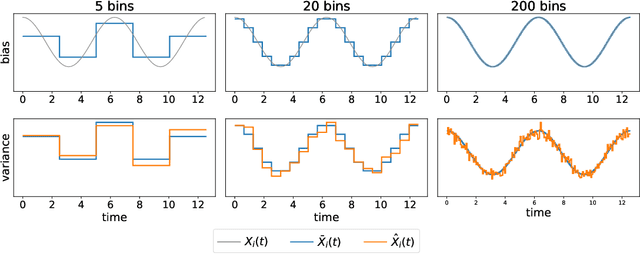
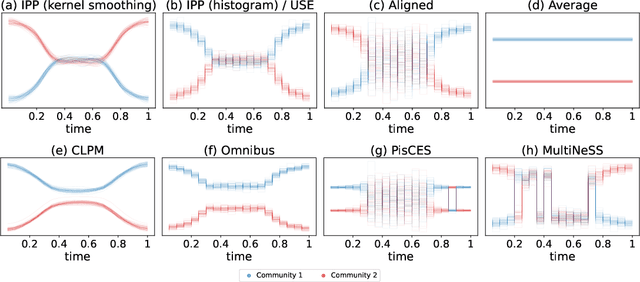
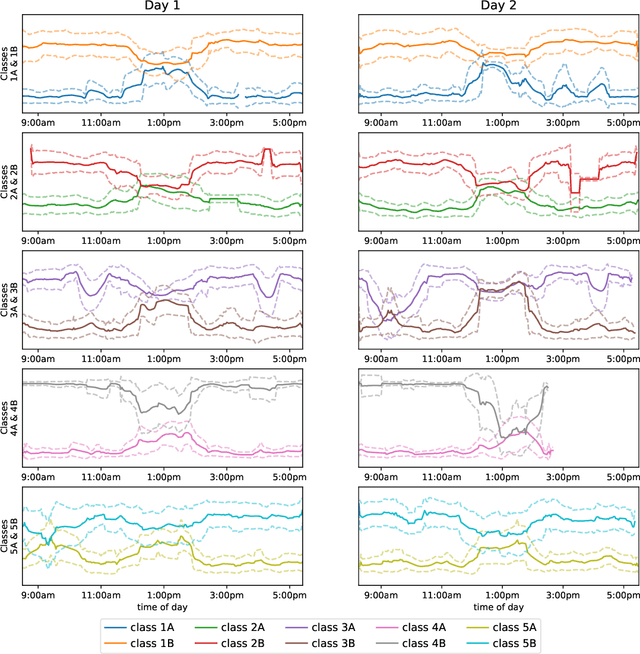
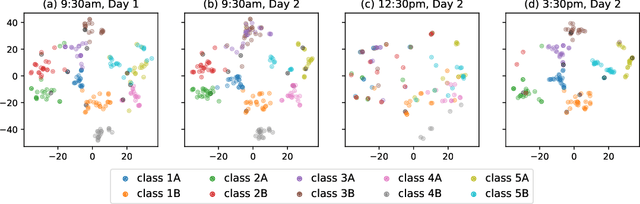
We present a new algorithmic framework, Intensity Profile Projection, for learning continuous-time representations of the nodes of a dynamic network, characterised by a node set and a collection of instantaneous interaction events which occur in continuous time. Our framework consists of three stages: estimating the intensity functions underlying the interactions between pairs of nodes, e.g. via kernel smoothing; learning a projection which minimises a notion of intensity reconstruction error; and inductively constructing evolving node representations via the learned projection. We show that our representations preserve the underlying structure of the network, and are temporally coherent, meaning that node representations can be meaningfully compared at different points in time. We develop estimation theory which elucidates the role of smoothing as a bias-variance trade-off, and shows how we can reduce smoothing as the signal-to-noise ratio increases on account of the algorithm `borrowing strength' across the network.