 Add to Chrome
 Add to Firefox
 Add to Edge
Assessing AI-generated music detection in real-world broadcast monitoring
Aug 07, 2026
The proliferation of AI-generated music in broadcast media raises concerns about transparency and fair compensation, but reliable detection under real broadcast conditions remains unresolved. Existing studies report substantial performance degradation in this domain, yet their evaluations are limited to synthetic broadcast data. To address this gap, we introduce BAMM (Broadcast AI-Music Monitoring), a 40-hour dataset of real-world television recordings containing AI-generated and human-made music. We compare clean-trained and broadcast-trained CNN variants across three progressively more challenging scenarios: Clean Foreground Music (CFM), Synthetic TV Broadcast (STB), and Real TV Broadcast (RTB). Both models achieve near-perfect performance on CFM but degrade substantially under synthetic broadcast conditions. Broadcast-oriented training improves robustness compared with clean training, although performance remains limited. On RTB, evaluated using BAMM, both models degrade further and show substantial score overlap between AI-generated and human-made music. These results expose a critical domain gap and show that current training approaches on CNN-based detectors remain insufficient for reliable AI-generated music detection in broadcast monitoring.

How Much AI Is in This Track? Quantifying the Proportion of AI-Generated Stems in Hybrid Music Mixtures
Aug 07, 2026AI-generated music is increasingly used at the stem level, with producers integrating synthetic drums, basslines, or vocals alongside human-performed instruments. However, current AI music detection systems are binary, treating tracks as either fully AI or fully human. In this paper, we reformulate AI music detection as a regression problem on a continuous AI energy ratio, alpha in [0, 1]. We propose a methodology that leverages a multi-track music dataset to assemble mixtures of human-performed and AI-reconstructed stems (obtained using a neural audio codec) with known proportions of each content type. Using this approach, we first show that a CNN-based model trained on fully AI-generated or human-performed tracks, which achieves >99% accuracy as a binary detector, when faced with mixed content, yields an output that rises with the AI stems' energy contribution, acting as a noisy and miscalibrated estimator. Our analysis of the influence of different stems shows that detection sensitivity depends on the instrument and reflects its frequency content: drums and guitar carry strong codec-artifact signatures, while vocals and bass are less detectable. Based on these insights, we train a similar CNN-based model for regression of alpha, achieving MAE = 0.076 and R^2 = 0.85 on held-out mixtures from the same pipeline. These results suggest that the regression formulation is an initial promising step towards AI-music detection in realistic music production workflows.
AI-Generated Music Detection in Broadcast Monitoring
Feb 06, 2026AI music generators have advanced to the point where their outputs are often indistinguishable from human compositions. While detection methods have emerged, they are typically designed and validated in music streaming contexts with clean, full-length tracks. Broadcast audio, however, poses a different challenge: music appears as short excerpts, often masked by dominant speech, conditions under which existing detectors fail. In this work, we introduce AI-OpenBMAT, the first dataset tailored to broadcast-style AI-music detection. It contains 3,294 one-minute audio excerpts (54.9 hours) that follow the duration patterns and loudness relations of real television audio, combining human-made production music with stylistically matched continuations generated with Suno v3.5. We benchmark a CNN baseline and state-of-the-art SpectTTTra models to assess SNR and duration robustness, and evaluate on a full broadcast scenario. Across all settings, models that excel in streaming scenarios suffer substantial degradation, with F1-scores dropping below 60% when music is in the background or has a short duration. These results highlight speech masking and short music length as critical open challenges for AI music detection, and position AI-OpenBMAT as a benchmark for developing detectors capable of meeting industrial broadcast requirements.
Investigating the efficacy of music version retrieval systems for setlist identification
Jan 06, 2021
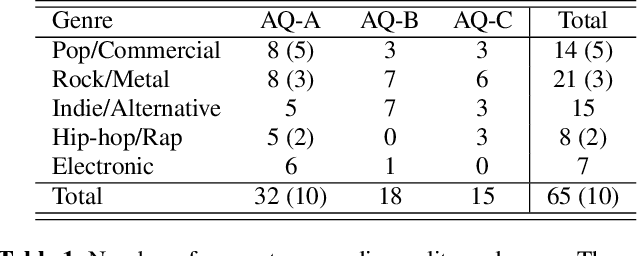
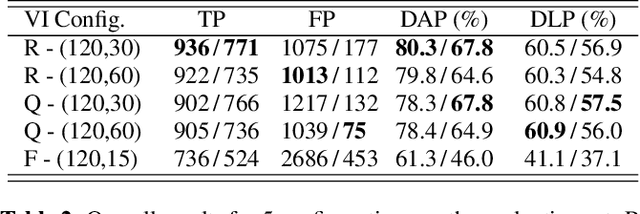
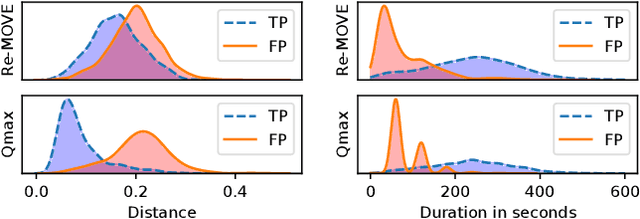
The setlist identification (SLI) task addresses a music recognition use case where the goal is to retrieve the metadata and timestamps for all the tracks played in live music events. Due to various musical and non-musical changes in live performances, developing automatic SLI systems is still a challenging task that, despite its industrial relevance, has been under-explored in the academic literature. In this paper, we propose an end-to-end workflow that identifies relevant metadata and timestamps of live music performances using a version identification system. We compare 3 of such systems to investigate their suitability for this particular task. For developing and evaluating SLI systems, we also contribute a new dataset that contains 99.5h of concerts with annotated metadata and timestamps, along with the corresponding reference set. The dataset is categorized by audio qualities and genres to analyze the performance of SLI systems in different use cases. Our approach can identify 68% of the annotated segments, with values ranging from 35% to 77% based on the genre. Finally, we evaluate our approach against a database of 56.8k songs to illustrate the effect of expanding the reference set, where we can still identify 56% of the annotated segments.