 Add to Chrome
 Add to Firefox
 Add to Edge
ltzGLUE: Luxembourgish General Language Understanding Evaluation
Apr 20, 2026
This paper presents ltzGLUE, the first Natural Language Understanding (NLU) benchmark for Luxembourgish (LTZ) based on the popular GLUE benchmark for English. Although NLU tasks are available for many European languages nowadays, LTZ is one of the official national languages that is often overlooked. We construct new tasks and reuse existing ones to introduce the first official NLU benchmark and accompanying evaluation of encoder models for the language. Our tasks include common natural language processing tasks in binary and multi-class classification settings, including named entity recognition, topic classification, and intent classification. We evaluate various pre-trained language models for LTZ to present an overview of the current capabilities of these models on the LTZ language.

LuxBank: The First Universal Dependency Treebank for Luxembourgish
Nov 07, 2024


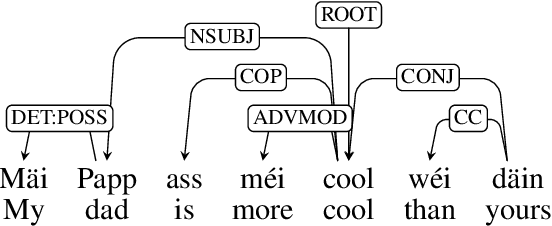
The Universal Dependencies (UD) project has significantly expanded linguistic coverage across 161 languages, yet Luxembourgish, a West Germanic language spoken by approximately 400,000 people, has remained absent until now. In this paper, we introduce LuxBank, the first UD Treebank for Luxembourgish, addressing the gap in syntactic annotation and analysis for this `low-research' language. We establish formal guidelines for Luxembourgish language annotation, providing the foundation for the first large-scale quantitative analysis of its syntax. LuxBank serves not only as a resource for linguists and language learners but also as a tool for developing spell checkers and grammar checkers, organising existing text archives and even training large language models. By incorporating Luxembourgish into the UD framework, we aim to enhance the understanding of syntactic variation within West Germanic languages and offer a model for documenting smaller, semi-standardised languages. This work positions Luxembourgish as a valuable resource in the broader linguistic and NLP communities, contributing to the study of languages with limited research and resources.