 Add to Chrome
 Add to Firefox
 Add to Edge
KM-Speaker: Keypoint-Based Style Control for High-Quality Speech-Driven 3D Facial Animation and Dialogue Localization
Jun 26, 2026
Speech-driven 3D facial animation methods face significant challenges in simultaneously achieving high-fidelity motion and precise artistic control at production quality. Existing controllable models typically learn global style control by relying on large-scale, low-quality \emph{in-the-wild} datasets that compromise overall animation realism. Furthermore, these frameworks often lack the fine-grained temporal precision required for demanding tasks such as dialogue localization (e.g., dubbing), where matching specific facial expressions is as critical as lip synchronization. We present KM-Speaker (Keypoint-Matching Speaker), a novel keypoint-conditioned flow-based generative framework that provides both global style guidance and frame-level temporal control from reference performances. We propose a disentanglement strategy that separates audio-driven lip motion from keypoint-driven upper-face dynamics, together with a global style context preservation mechanism to ensure coherent full-face expressiveness. KM-Speaker advances example-based 3D facial animation by achieving high-fidelity motion and flexible controllability in a data-constrained setting, consistently outperforming state-of-the-art methods in lip-sync accuracy, style adherence, and expressive temporal control.

Skullptor: High Fidelity 3D Head Reconstruction in Seconds with Multi-View Normal Prediction
Feb 24, 2026Reconstructing high-fidelity 3D head geometry from images is critical for a wide range of applications, yet existing methods face fundamental limitations. Traditional photogrammetry achieves exceptional detail but requires extensive camera arrays (25-200+ views), substantial computation, and manual cleanup in challenging areas like facial hair. Recent alternatives present a fundamental trade-off: foundation models enable efficient single-image reconstruction but lack fine geometric detail, while optimization-based methods achieve higher fidelity but require dense views and expensive computation. We bridge this gap with a hybrid approach that combines the strengths of both paradigms. Our method introduces a multi-view surface normal prediction model that extends monocular foundation models with cross-view attention to produce geometrically consistent normals in a feed-forward pass. We then leverage these predictions as strong geometric priors within an inverse rendering optimization framework to recover high-frequency surface details. Our approach outperforms state-of-the-art single-image and multi-view methods, achieving high-fidelity reconstruction on par with dense-view photogrammetry while reducing camera requirements and computational cost. The code and model will be released.
Geometry-Aware Texture Generation for 3D Head Modeling with Artist-driven Control
May 07, 2025Creating realistic 3D head assets for virtual characters that match a precise artistic vision remains labor-intensive. We present a novel framework that streamlines this process by providing artists with intuitive control over generated 3D heads. Our approach uses a geometry-aware texture synthesis pipeline that learns correlations between head geometry and skin texture maps across different demographics. The framework offers three levels of artistic control: manipulation of overall head geometry, adjustment of skin tone while preserving facial characteristics, and fine-grained editing of details such as wrinkles or facial hair. Our pipeline allows artists to make edits to a single texture map using familiar tools, with our system automatically propagating these changes coherently across the remaining texture maps needed for realistic rendering. Experiments demonstrate that our method produces diverse results with clean geometries. We showcase practical applications focusing on intuitive control for artists, including skin tone adjustments and simplified editing workflows for adding age-related details or removing unwanted features from scanned models. This integrated approach aims to streamline the artistic workflow in virtual character creation.
SEREP: Semantic Facial Expression Representation for Robust In-the-Wild Capture and Retargeting
Dec 18, 2024Monocular facial performance capture in-the-wild is challenging due to varied capture conditions, face shapes, and expressions. Most current methods rely on linear 3D Morphable Models, which represent facial expressions independently of identity at the vertex displacement level. We propose SEREP (Semantic Expression Representation), a model that disentangles expression from identity at the semantic level. It first learns an expression representation from unpaired 3D facial expressions using a cycle consistency loss. Then we train a model to predict expression from monocular images using a novel semi-supervised scheme that relies on domain adaptation. In addition, we introduce MultiREX, a benchmark addressing the lack of evaluation resources for the expression capture task. Our experiments show that SEREP outperforms state-of-the-art methods, capturing challenging expressions and transferring them to novel identities.
MoSAR: Monocular Semi-Supervised Model for Avatar Reconstruction using Differentiable Shading
Dec 22, 2023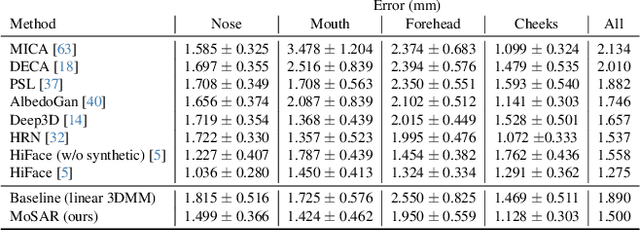
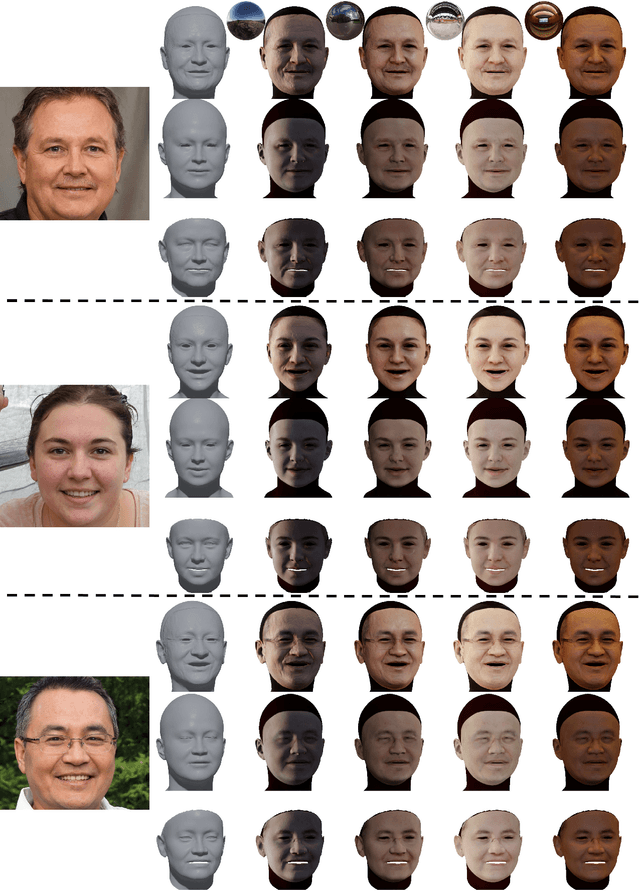
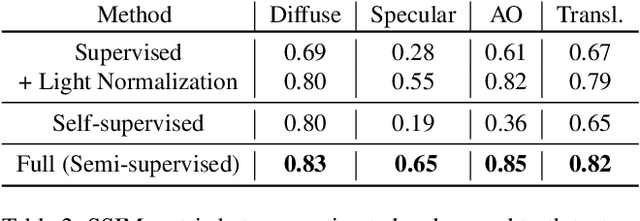
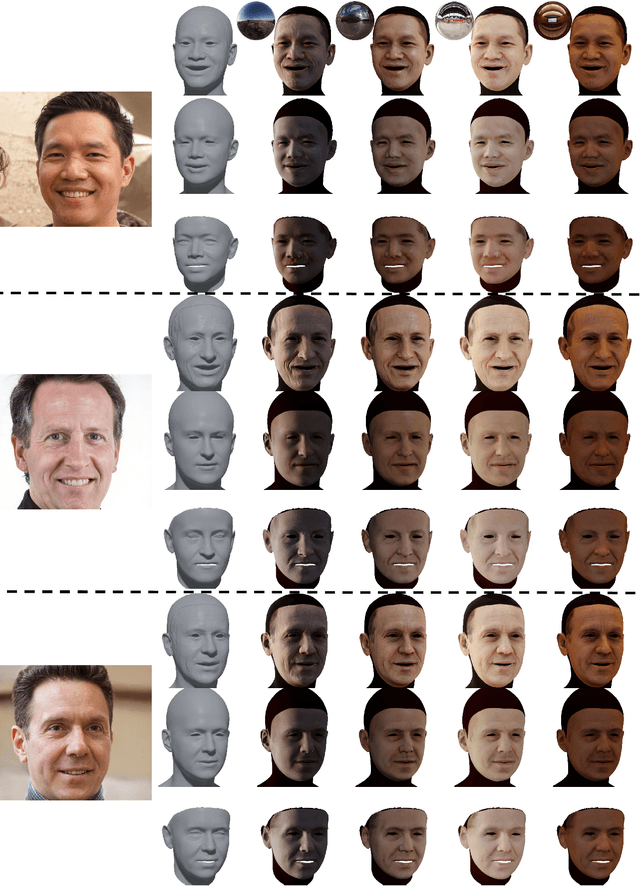
Reconstructing an avatar from a portrait image has many applications in multimedia, but remains a challenging research problem. Extracting reflectance maps and geometry from one image is ill-posed: recovering geometry is a one-to-many mapping problem and reflectance and light are difficult to disentangle. Accurate geometry and reflectance can be captured under the controlled conditions of a light stage, but it is costly to acquire large datasets in this fashion. Moreover, training solely with this type of data leads to poor generalization with in-the-wild images. This motivates the introduction of MoSAR, a method for 3D avatar generation from monocular images. We propose a semi-supervised training scheme that improves generalization by learning from both light stage and in-the-wild datasets. This is achieved using a novel differentiable shading formulation. We show that our approach effectively disentangles the intrinsic face parameters, producing relightable avatars. As a result, MoSAR estimates a richer set of skin reflectance maps, and generates more realistic avatars than existing state-of-the-art methods. We also introduce a new dataset, named FFHQ-UV-Intrinsics, the first public dataset providing intrinsic face attributes at scale (diffuse, specular, ambient occlusion and translucency maps) for a total of 10k subjects. The project website and the dataset are available on the following link: https://ubisoft-laforge.github.io/character/mosar/