 Add to Chrome
 Add to Firefox
 Add to Edge
CalibBEV: LiDAR-Camera Calibration via BEV Alignment
Aug 03, 2026
We present CalibBEV, a novel Bird's Eye View (BEV) alignment approach for LiDAR-camera calibration. Our method unifies LiDAR and camera data into a shared 3D spatial representation, enabling accurate and robust cross-modal calibration. CalibBEV extracts sensor-wise BEV features from each modality using domain-specific architectures and estimates the calibration matrix through a two-step alignment process. First, we perform an implicit alignment by regressing a coarse calibration matrix directly from the BEV features. To ease this alignment, we enforce semantic consistency between BEV representations across modalities using a contrastive loss inspired by CLIP, guiding both networks toward a unified feature space. In the second step, we leverage our BEV formulation to explicitly align the features of one modality with the other, refining the initial coarse estimate into a final, more accurate calibration matrix. CalibBEV significantly outperforms prior point-to-pixel matching methods, achieving state-of-the-art calibration accuracy. On the KITTI and nuScenes benchmarks, our method reduces the Relative Rotation Error (RRE) by 51% and 68%, and the Relative Translation Error (RTE) by 80% and 91%, respectively, compared to previous methods.

Adversarial Pixel-Level Generation of Semantic Images
Jun 27, 2019

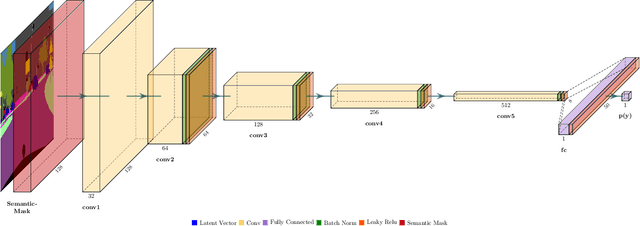

Generative Adversarial Networks (GANs) have obtained extraordinary success in the generation of realistic images, a domain where a lower pixel-level accuracy is acceptable. We study the problem, not yet tackled in the literature, of generating semantic images starting from a prior distribution. Intuitively this problem can be approached using standard methods and architectures. However, a better-suited approach is needed to avoid generating blurry, hallucinated and thus unusable images since tasks like semantic segmentation require pixel-level exactness. In this work, we present a novel architecture for learning to generate pixel-level accurate semantic images, namely Semantic Generative Adversarial Networks (SemGANs). The experimental evaluation shows that our architecture outperforms standard ones from both a quantitative and a qualitative point of view in many semantic image generation tasks.
A Survey on GANs for Anomaly Detection
Jun 27, 2019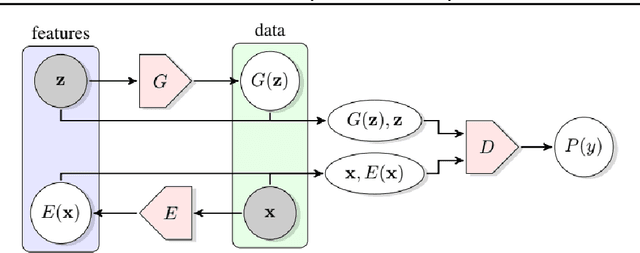

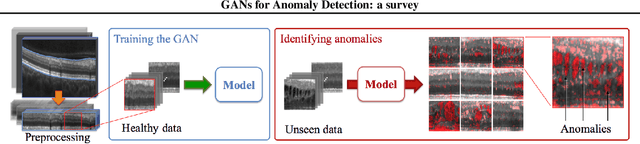

Anomaly detection is a significant problem faced in several research areas. Detecting and correctly classifying something unseen as anomalous is a challenging problem that has been tackled in many different manners over the years. Generative Adversarial Networks (GANs) and the adversarial training process have been recently employed to face this task yielding remarkable results. In this paper we survey the principal GAN-based anomaly detection methods, highlighting their pros and cons. Our contributions are the empirical validation of the main GAN models for anomaly detection, the increase of the experimental results on different datasets and the public release of a complete Open Source toolbox for Anomaly Detection using GANs.