 Add to Chrome
 Add to Firefox
 Add to Edge
CalibBEV: LiDAR-Camera Calibration via BEV Alignment
Aug 03, 2026
We present CalibBEV, a novel Bird's Eye View (BEV) alignment approach for LiDAR-camera calibration. Our method unifies LiDAR and camera data into a shared 3D spatial representation, enabling accurate and robust cross-modal calibration. CalibBEV extracts sensor-wise BEV features from each modality using domain-specific architectures and estimates the calibration matrix through a two-step alignment process. First, we perform an implicit alignment by regressing a coarse calibration matrix directly from the BEV features. To ease this alignment, we enforce semantic consistency between BEV representations across modalities using a contrastive loss inspired by CLIP, guiding both networks toward a unified feature space. In the second step, we leverage our BEV formulation to explicitly align the features of one modality with the other, refining the initial coarse estimate into a final, more accurate calibration matrix. CalibBEV significantly outperforms prior point-to-pixel matching methods, achieving state-of-the-art calibration accuracy. On the KITTI and nuScenes benchmarks, our method reduces the Relative Rotation Error (RRE) by 51% and 68%, and the Relative Translation Error (RTE) by 80% and 91%, respectively, compared to previous methods.

Semantically Adaptive Image-to-image Translation for Domain Adaptation of Semantic Segmentation
Sep 02, 2020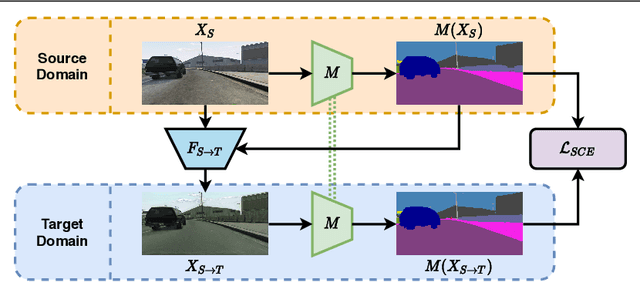
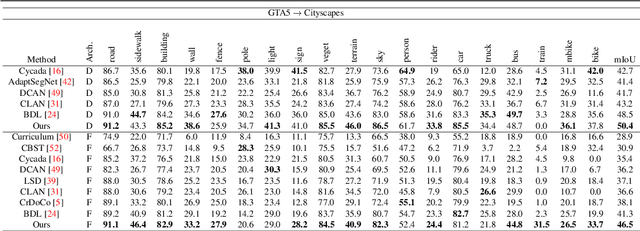
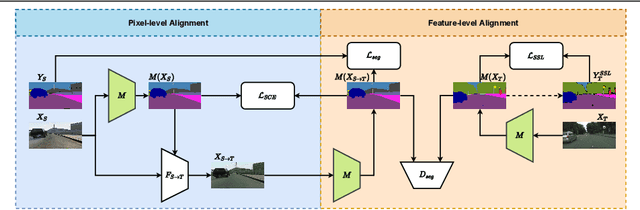
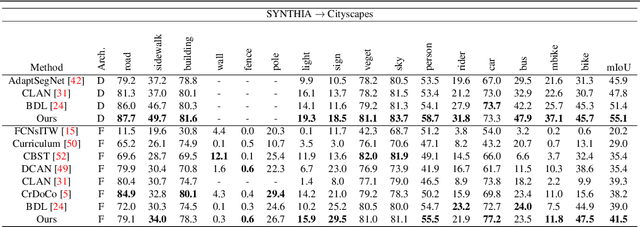
Domain shift is a very challenging problem for semantic segmentation. Any model can be easily trained on synthetic data, where images and labels are artificially generated, but it will perform poorly when deployed on real environments. In this paper, we address the problem of domain adaptation for semantic segmentation of street scenes. Many state-of-the-art approaches focus on translating the source image while imposing that the result should be semantically consistent with the input. However, we advocate that the image semantics can also be exploited to guide the translation algorithm. To this end, we rethink the generative model to enforce this assumption and strengthen the connection between pixel-level and feature-level domain alignment. We conduct extensive experiments by training common semantic segmentation models with our method and show that the results we obtain on the synthetic-to-real benchmarks surpass the state-of-the-art.