 Add to Chrome
 Add to Firefox
 Add to Edge
PDE foundation models are skillful AI weather emulators for the Martian atmosphere
Feb 16, 2026
We show that AI foundation models that are pretrained on numerical solutions to a diverse corpus of partial differential equations can be adapted and fine-tuned to obtain skillful predictive weather emulators for the Martian atmosphere. We base our work on the Poseidon PDE foundation model for two-dimensional systems. We develop a method to extend Poseidon from two to three dimensions while keeping the pretraining information. Moreover, we investigate the performance of the model in the presence of sparse initial conditions. Our results make use of four Martian years (approx.~34 GB) of training data and a median compute budget of 13 GPU hours. We find that the combination of pretraining and model extension yields a performance increase of 34.4\% on a held-out year. This shows that PDEs-FMs can not only approximate solutions to (other) PDEs but also anchor models for real-world problems with complex interactions that lack a sufficient amount of training data or a suitable compute budget.

Physics-Informed Neural Network Super Resolution for Advection-Diffusion Models
Nov 04, 2020
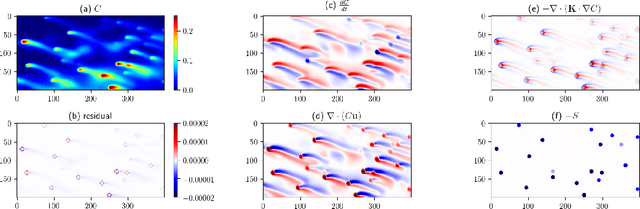
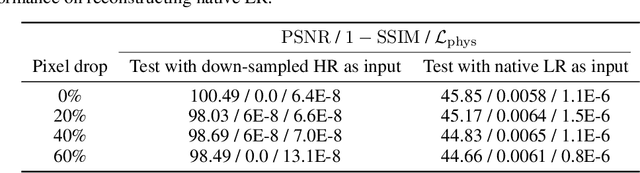
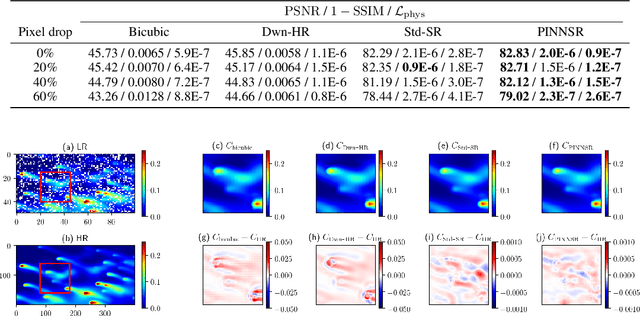
Physics-informed neural networks (NN) are an emerging technique to improve spatial resolution and enforce physical consistency of data from physics models or satellite observations. A super-resolution (SR) technique is explored to reconstruct high-resolution images ($4\times$) from lower resolution images in an advection-diffusion model of atmospheric pollution plumes. SR performance is generally increased when the advection-diffusion equation constrains the NN in addition to conventional pixel-based constraints. The ability of SR techniques to also reconstruct missing data is investigated by randomly removing image pixels from the simulations and allowing the system to learn the content of missing data. Improvements in S/N of $11\%$ are demonstrated when physics equations are included in SR with $40\%$ pixel loss. Physics-informed NNs accurately reconstruct corrupted images and generate better results compared to the standard SR approaches.