 Add to Chrome
 Add to Firefox
 Add to Edge
Machine Can Automatically Discover Parametric Functions to Model HEP Data
Jul 22, 2026
In HEP data analyses, finding an adequate function to model binned data has largely relied on a manual process: guess a functional form by intuition, fit, examine, then repeat until successful. We show that this iterative process can be automated by a machine using symbolic regression, which performs a data-driven search over function space without requiring prior knowledge of what an adequate function should look like. We present the SymbolFit package, which pairs symbolic regression with uncertainty modeling to target HEP analysis use cases, and demonstrate it on the CMS and ATLAS Run 2 dijet spectra: 560 independent seeded runs across seven simple fit configurations generated over 1000 functions fitting the spectra with $χ^2/\text{NDF}\approx 1$, and 111 of the runs rediscovered the very dijet and UA2 functions used in published dijet searches.

SymbolFit: Automatic Parametric Modeling with Symbolic Regression
Nov 15, 2024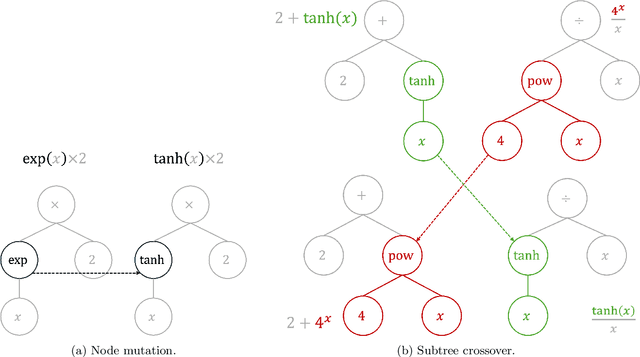
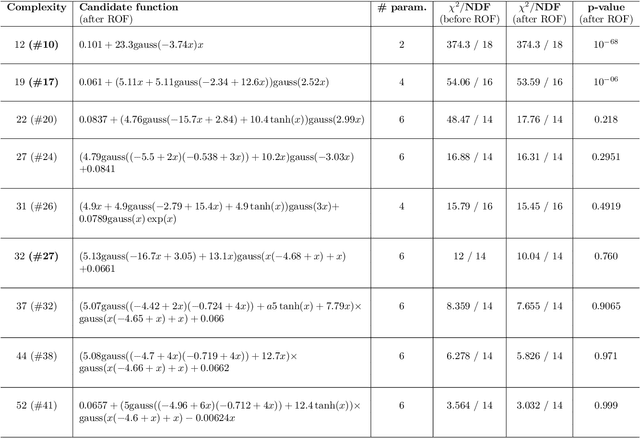
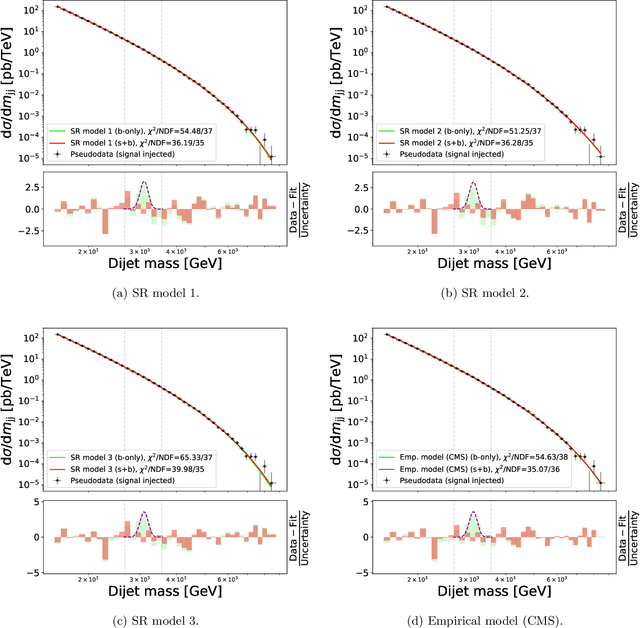
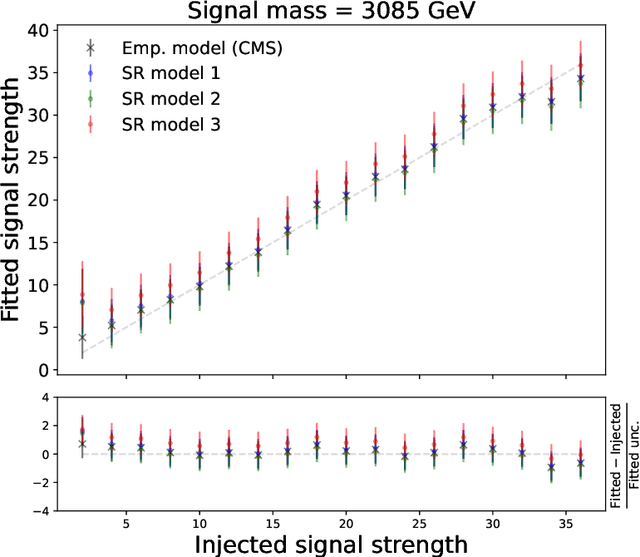
We introduce SymbolFit, a framework that automates parametric modeling by using symbolic regression to perform a machine-search for functions that fit the data, while simultaneously providing uncertainty estimates in a single run. Traditionally, constructing a parametric model to accurately describe binned data has been a manual and iterative process, requiring an adequate functional form to be determined before the fit can be performed. The main challenge arises when the appropriate functional forms cannot be derived from first principles, especially when there is no underlying true closed-form function for the distribution. In this work, we address this problem by utilizing symbolic regression, a machine learning technique that explores a vast space of candidate functions without needing a predefined functional form, treating the functional form itself as a trainable parameter. Our approach is demonstrated in data analysis applications in high-energy physics experiments at the CERN Large Hadron Collider (LHC). We demonstrate its effectiveness and efficiency using five real proton-proton collision datasets from new physics searches at the LHC, namely the background modeling in resonance searches for high-mass dijet, trijet, paired-dijet, diphoton, and dimuon events. We also validate the framework using several toy datasets with one and more variables.