 Add to Chrome
 Add to Firefox
 Add to Edge
Outrigger local polynomial regression
Mar 11, 2026
Standard local polynomial estimators of a nonparametric regression function employ a weighted least squares loss function that is tailored to the setting of homoscedastic Gaussian errors. We introduce the outrigger local polynomial estimator, which is designed to achieve distributional adaptivity across different conditional error distributions. It modifies a standard local polynomial estimator by employing an estimate of the conditional score function of the errors and an 'outrigger' that draws on the data in a broader local window to stabilise the influence of the conditional score estimate. Subject to smoothness and moment conditions, and only requiring consistency of the conditional score estimate, we first establish that even under the least favourable settings for the outrigger estimator, the asymptotic ratio of the worst-case local risks of the two estimators is at most $1$, with equality if and only if the conditional error distribution is Gaussian. Moreover, we prove that the outrigger estimator is minimax optimal over Hölder classes up to a multiplicative factor $A_{β,d}$, depending only on the smoothness $β\in (0,\infty)$ of the regression function and the dimension~$d$ of the covariates. When $β\in (0,1]$, we find that $A_{β,d} \leq 1.69$, with $\lim_{β\searrow 0} A_{β,d} = 1$. A further attraction of our proposal is that we do not require structural assumptions such as independence of errors and covariates, or symmetry of the conditional error distribution. Numerical results on simulated and real data validate our theoretical findings; our methodology is implemented in R and available at https://github.com/elliot-young/outrigger.

Clustered random forests with correlated data for optimal estimation and inference under potential covariate shift
Mar 16, 2025
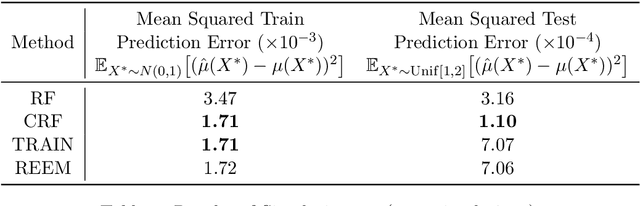
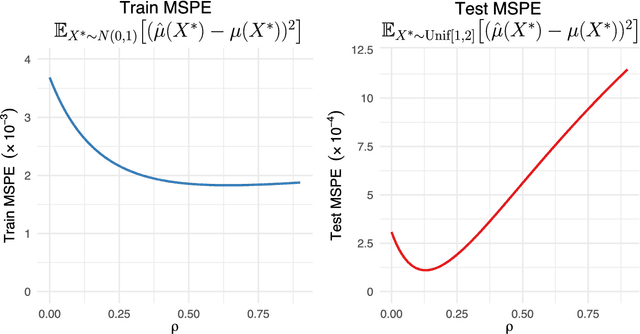
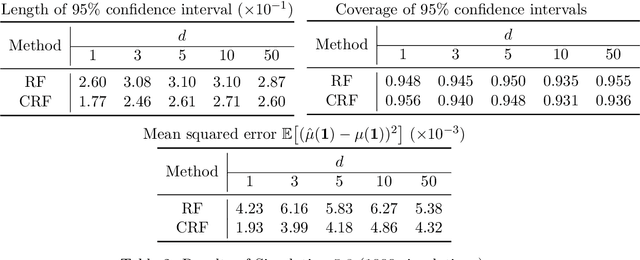
We develop Clustered Random Forests, a random forests algorithm for clustered data, arising from independent groups that exhibit within-cluster dependence. The leaf-wise predictions for each decision tree making up clustered random forests takes the form of a weighted least squares estimator, which leverage correlations between observations for improved prediction accuracy. Clustered random forests are shown for certain tree splitting criteria to be minimax rate optimal for pointwise conditional mean estimation, while being computationally competitive with standard random forests. Further, we observe that the optimality of a clustered random forest, with regards to how (population level) optimal weights are chosen within this framework i.e. those that minimise mean squared prediction error, vary under covariate distribution shift. In light of this, we advocate weight estimation to be determined by a user-chosen covariate distribution with respect to which optimal prediction or inference is desired. This highlights a key difference in behaviour, between correlated and independent data, with regards to nonparametric conditional mean estimation under covariate shift. We demonstrate our theoretical findings numerically in a number of simulated and real-world settings.