 Add to Chrome
 Add to Firefox
 Add to Edge
Epiplexity Guided Data Selection and Generation for Out-of-Distribution Generalization
Aug 12, 2026
Modern systems are increasingly expected to transfer across tasks not specified during training. What data facilitates generalization in these new, unanticipated settings? One hypothesis is that data with more structural information could contain shared circuits and subprograms that could be recycled in a wider array of downstream settings. Epiplexity, a recently proposed measure of the structural information a compute-bounded learner can extract from data, provides a mechanism to reason about this relationship. In this paper, we show how to operationalize epiplexity as an online training signal for data selection and synthetic data generation. For selection, we fit scaling laws to the training loss curves of natural data domains to predict the expected epiplexity gain as a function of training tokens, and use this signal to adaptively determine the sampling weights over domains during training. For synthetic data generation, we define a generator's reward as the change in learner epiplexity over a buffer of previously generated data and use REINFORCE policy gradients to guide the generator toward an epiplexity-maximizing distribution. In both cases, higher epiplexity predicts improved downstream performance on zero-shot and fine-tuning based tasks, supporting the hypothesis that data rich in structural information yield representations that transfer across domains.

MOTI$\mathcal{VE}$: A Drug-Target Interaction Graph For Inductive Link Prediction
Jun 12, 2024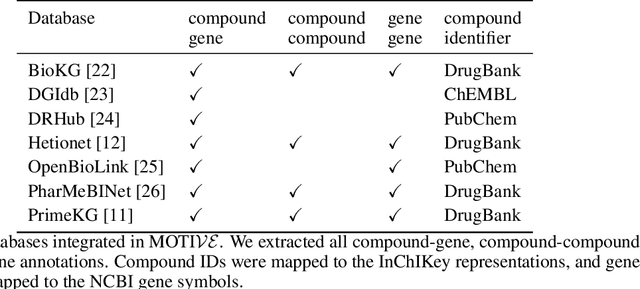

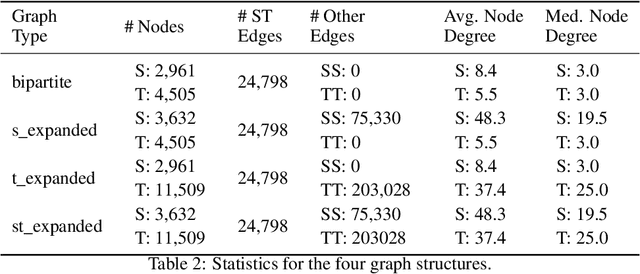
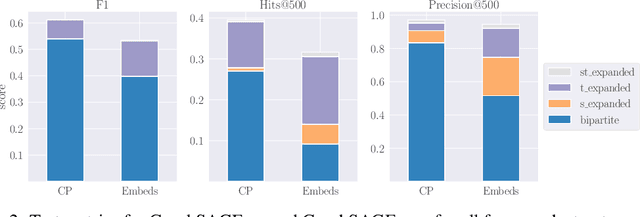
Drug-target interaction (DTI) prediction is crucial for identifying new therapeutics and detecting mechanisms of action. While structure-based methods accurately model physical interactions between a drug and its protein target, cell-based assays such as Cell Painting can better capture complex DTI interactions. This paper introduces MOTI$\mathcal{VE}$, a Morphological cOmpound Target Interaction Graph dataset that comprises Cell Painting features for $11,000$ genes and $3,600$ compounds along with their relationships extracted from seven publicly available databases. We provide random, cold-source (new drugs), and cold-target (new genes) data splits to enable rigorous evaluation under realistic use cases. Our benchmark results show that graph neural networks that use Cell Painting features consistently outperform those that learn from graph structure alone, feature-based models, and topological heuristics. MOTI$\mathcal{VE}$ accelerates both graph ML research and drug discovery by promoting the development of more reliable DTI prediction models. MOTI$\mathcal{VE}$ resources are available at https://github.com/carpenter-singh-lab/motive.