 Add to Chrome
 Add to Firefox
 Add to Edge
CritiSense: Critical Digital Literacy and Resilience Against Misinformation
Mar 17, 2026
Misinformation on social media undermines informed decision-making and public trust. Prebunking offers a proactive complement by helping users recognize manipulation tactics before they encounter them in the wild. We present CritiSense, a mobile media-literacy app that builds these skills through short, interactive challenges with instant feedback. It is the first multilingual (supporting nine languages) and modular platform, designed for rapid updates across topics and domains. We report a usability study with 93 users: 83.9% expressed overall satisfaction and 90.1% rated the app as easy to use. Qualitative feedback indicates that CritiSense helps improve digital literacy skills. Overall, it provides a multilingual prebunking platform and a testbed for measuring the impact of microlearning on misinformation resilience. Over 3+ months, we have reached 300+ active users. It is freely available to all users on the Apple App Store (https://apps.apple.com/us/app/critisense/id6749675792) and Google Play Store (https://play.google.com/store/apps/details?id=com.critisense&hl=en). Demo Video: https://shorturl.at/CDcdc

MALicious INTent Dataset and Inoculating LLMs for Enhanced Disinformation Detection
Mar 15, 2026The intentional creation and spread of disinformation poses a significant threat to public discourse. However, existing English datasets and research rarely address the intentionality behind the disinformation. This work presents MALINT, the first human-annotated English corpus developed in collaboration with expert fact-checkers to capture disinformation and its malicious intent. We utilize our novel corpus to benchmark 12 language models, including small language models (SLMs) such as BERT and large language models (LLMs) like Llama 3.3, on binary and multilabel intent classification tasks. Moreover, inspired by inoculation theory from psychology and communication studies, we investigate whether incorporating knowledge of malicious intent can improve disinformation detection. To this end, we propose intent-based inoculation, an intent-augmented reasoning for LLMs that integrates intent analysis to mitigate the persuasive impact of disinformation. Analysis on six disinformation datasets, five LLMs, and seven languages shows that intent-augmented reasoning improves zero-shot disinformation detection. To support research in intent-aware disinformation detection, we release the MALINT dataset with annotations from each annotation step.
FRaN-X: FRaming and Narratives-eXplorer
Jul 09, 2025We present FRaN-X, a Framing and Narratives Explorer that automatically detects entity mentions and classifies their narrative roles directly from raw text. FRaN-X comprises a two-stage system that combines sequence labeling with fine-grained role classification to reveal how entities are portrayed as protagonists, antagonists, or innocents, using a unique taxonomy of 22 fine-grained roles nested under these three main categories. The system supports five languages (Bulgarian, English, Hindi, Russian, and Portuguese) and two domains (the Russia-Ukraine Conflict and Climate Change). It provides an interactive web interface for media analysts to explore and compare framing across different sources, tackling the challenge of automatically detecting and labeling how entities are framed. Our system allows end users to focus on a single article as well as analyze up to four articles simultaneously. We provide aggregate level analysis including an intuitive graph visualization that highlights the narrative a group of articles are pushing. Our system includes a search feature for users to look up entities of interest, along with a timeline view that allows analysts to track an entity's role transitions across different contexts within the article. The FRaN-X system and the trained models are licensed under an MIT License. FRaN-X is publicly accessible at https://fran-x.streamlit.app/ and a video demonstration is available at https://youtu.be/VZVi-1B6yYk.
Reasoning About Persuasion: Can LLMs Enable Explainable Propaganda Detection?
Feb 23, 2025There has been significant research on propagandistic content detection across different modalities and languages. However, most studies have primarily focused on detection, with little attention given to explanations justifying the predicted label. This is largely due to the lack of resources that provide explanations alongside annotated labels. To address this issue, we propose a multilingual (i.e., Arabic and English) explanation-enhanced dataset, the first of its kind. Additionally, we introduce an explanation-enhanced LLM for both label detection and rationale-based explanation generation. Our findings indicate that the model performs comparably while also generating explanations. We will make the dataset and experimental resources publicly available for the research community.
Entity Framing and Role Portrayal in the News
Feb 20, 2025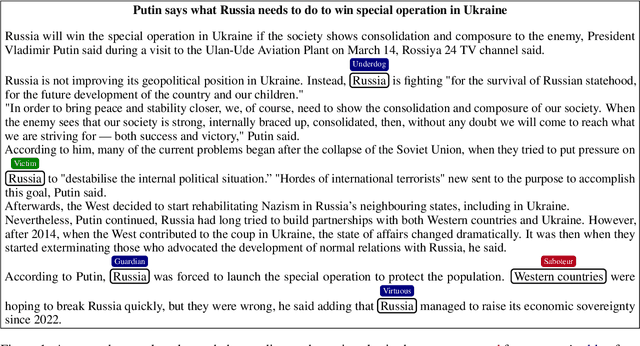

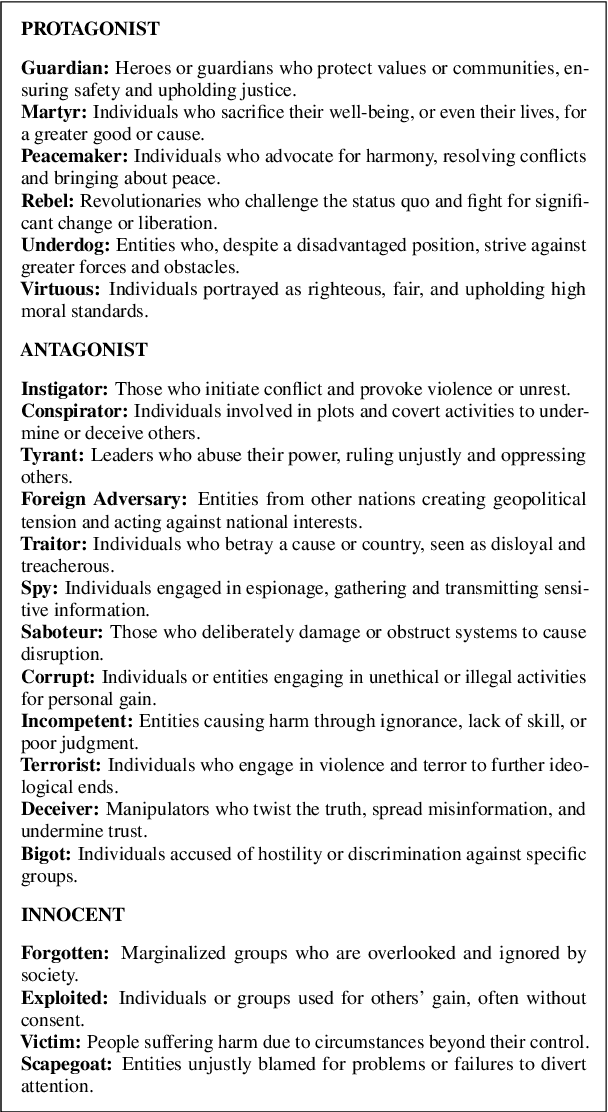

We introduce a novel multilingual hierarchical corpus annotated for entity framing and role portrayal in news articles. The dataset uses a unique taxonomy inspired by storytelling elements, comprising 22 fine-grained roles, or archetypes, nested within three main categories: protagonist, antagonist, and innocent. Each archetype is carefully defined, capturing nuanced portrayals of entities such as guardian, martyr, and underdog for protagonists; tyrant, deceiver, and bigot for antagonists; and victim, scapegoat, and exploited for innocents. The dataset includes 1,378 recent news articles in five languages (Bulgarian, English, Hindi, European Portuguese, and Russian) focusing on two critical domains of global significance: the Ukraine-Russia War and Climate Change. Over 5,800 entity mentions have been annotated with role labels. This dataset serves as a valuable resource for research into role portrayal and has broader implications for news analysis. We describe the characteristics of the dataset and the annotation process, and we report evaluation results on fine-tuned state-of-the-art multilingual transformers and hierarchical zero-shot learning using LLMs at the level of a document, a paragraph, and a sentence.