 Add to Chrome
 Add to Firefox
 Add to Edge
Computational Analysis of Semantic Connections Between Herman Melville Reading and Writing
Mar 15, 2026
This study investigates the potential influence of Herman Melville reading on his own writings through computational semantic similarity analysis. Using documented records of books known to have been owned or read by Melville, we compare selected passages from his works with texts from his library. The methodology involves segmenting texts at both sentence level and non-overlapping 5-gram level, followed by similarity computation using BERTScore. Rather than applying fixed thresholds to determine reuse, we interpret precision, recall, and F1 scores as indicators of possible semantic alignment that may suggest literary influence. Experimental results demonstrate that the approach successfully captures expert-identified instances of similarity and highlights additional passages warranting further qualitative examination. The findings suggest that semantic similarity methods provide a useful computational framework for supporting source and influence studies in literary scholarship.

WordStylist: Styled Verbatim Handwritten Text Generation with Latent Diffusion Models
Mar 29, 2023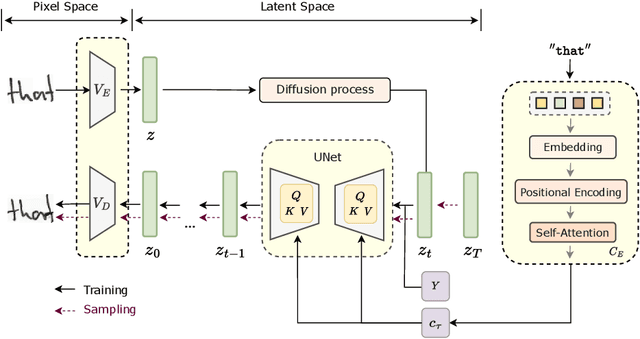
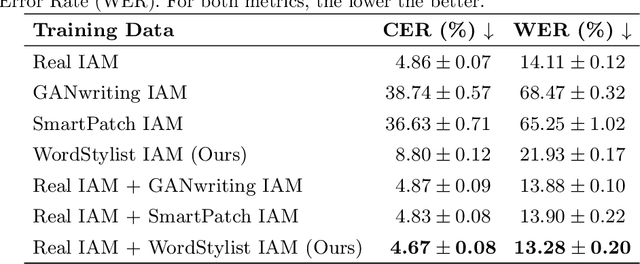


Text-to-Image synthesis is the task of generating an image according to a specific text description. Generative Adversarial Networks have been considered the standard method for image synthesis virtually since their introduction; today, Denoising Diffusion Probabilistic Models are recently setting a new baseline, with remarkable results in Text-to-Image synthesis, among other fields. Aside its usefulness per se, it can also be particularly relevant as a tool for data augmentation to aid training models for other document image processing tasks. In this work, we present a latent diffusion-based method for styled text-to-text-content-image generation on word-level. Our proposed method manages to generate realistic word image samples from different writer styles, by using class index styles and text content prompts without the need of adversarial training, writer recognition, or text recognition. We gauge system performance with Frechet Inception Distance, writer recognition accuracy, and writer retrieval. We show that the proposed model produces samples that are aesthetically pleasing, help boosting text recognition performance, and gets similar writer retrieval score as real data.