 Add to Chrome
 Add to Firefox
 Add to Edge
CACTO-BIC: Scalable Actor-Critic Learning via Biased Sampling and GPU-Accelerated Trajectory Optimization
Feb 23, 2026
Trajectory Optimization (TO) and Reinforcement Learning (RL) offer complementary strengths for solving optimal control problems. TO efficiently computes locally optimal solutions but can struggle with non-convexity, while RL is more robust to non-convexity at the cost of significantly higher computational demands. CACTO (Continuous Actor-Critic with Trajectory Optimization) was introduced to combine these advantages by learning a warm-start policy that guides the TO solver towards low-cost trajectories. However, scalability remains a key limitation, as increasing system complexity significantly raises the computational cost of TO. This work introduces CACTO-BIC to address these challenges. CACTO-BIC improves data efficiency by biasing initial-state sampling leveraging a property of the value function associated with locally optimal policies; moreover, it reduces computation time by exploiting GPU acceleration. Empirical evaluations show improved sample efficiency and faster computation compared to CACTO. Comparisons with PPO demonstrate that our approach can achieve similar solutions in less time. Finally, experiments on the AlienGO quadruped robot demonstrate that CACTO-BIC can scale to high-dimensional systems and is suitable for real-time applications.

CACTO-SL: Using Sobolev Learning to improve Continuous Actor-Critic with Trajectory Optimization
Dec 17, 2023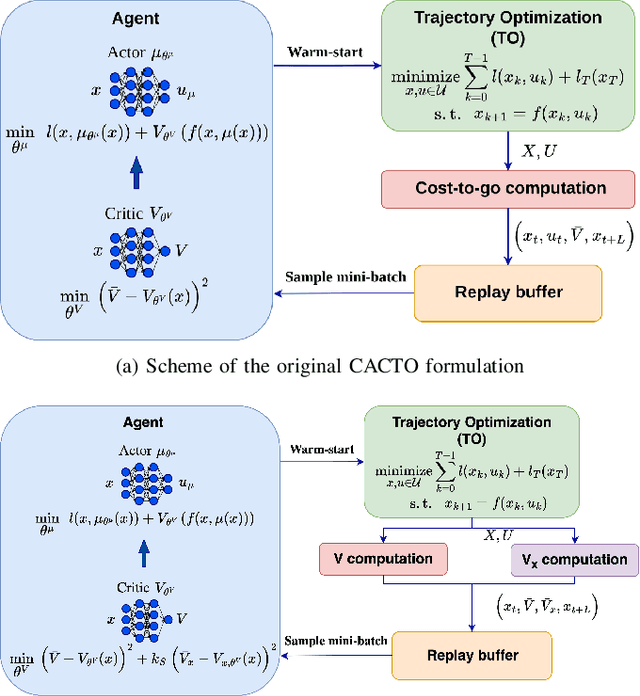
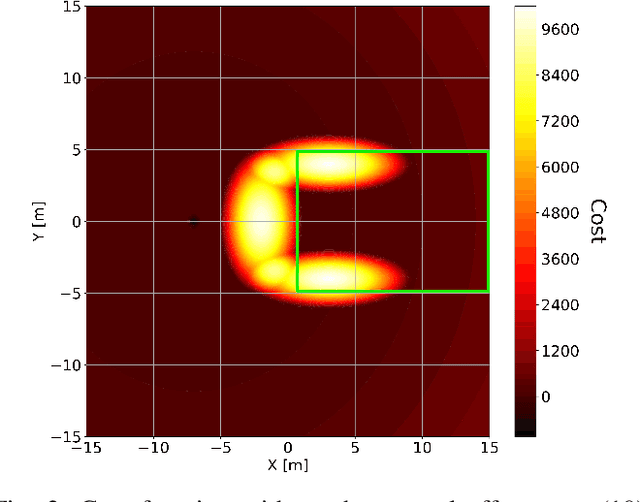
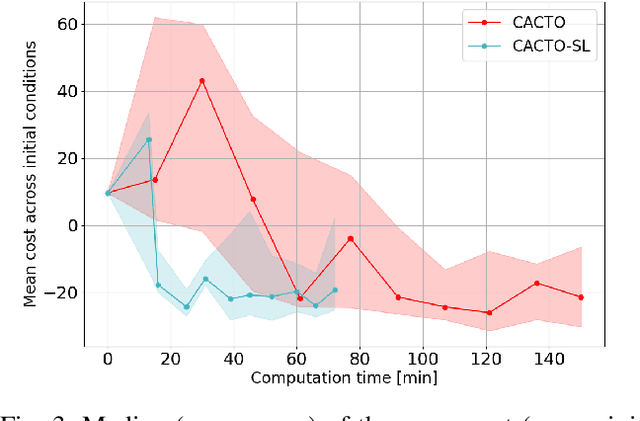
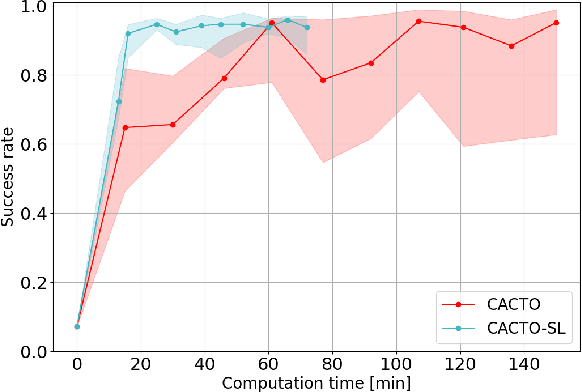
Trajectory Optimization (TO) and Reinforcement Learning (RL) are powerful and complementary tools to solve optimal control problems. On the one hand, TO can efficiently compute locally-optimal solutions, but it tends to get stuck in local minima if the problem is not convex. On the other hand, RL is typically less sensitive to non-convexity, but it requires a much higher computational effort. Recently, we have proposed CACTO (Continuous Actor-Critic with Trajectory Optimization), an algorithm that uses TO to guide the exploration of an actor-critic RL algorithm. In turns, the policy encoded by the actor is used to warm-start TO, closing the loop between TO and RL. In this work, we present an extension of CACTO exploiting the idea of Sobolev learning. To make the training of the critic network faster and more data efficient, we enrich it with the gradient of the Value function, computed via a backward pass of the differential dynamic programming algorithm. Our results show that the new algorithm is more efficient than the original CACTO, reducing the number of TO episodes by a factor ranging from 3 to 10, and consequently the computation time. Moreover, we show that CACTO-SL helps TO to find better minima and to produce more consistent results.