 Add to Chrome
 Add to Firefox
 Add to Edge
Simple LLM Baselines are Competitive for Model Diffing
Feb 10, 2026
Standard LLM evaluations only test capabilities or dispositions that evaluators designed them for, missing unexpected differences such as behavioral shifts between model revisions or emergent misaligned tendencies. Model diffing addresses this limitation by automatically surfacing systematic behavioral differences. Recent approaches include LLM-based methods that generate natural language descriptions and sparse autoencoder (SAE)-based methods that identify interpretable features. However, no systematic comparison of these approaches exists nor are there established evaluation criteria. We address this gap by proposing evaluation metrics for key desiderata (generalization, interestingness, and abstraction level) and use these to compare existing methods. Our results show that an improved LLM-based baseline performs comparably to the SAE-based method while typically surfacing more abstract behavioral differences.

When and How Does CLIP Enable Domain and Compositional Generalization?
Feb 13, 2025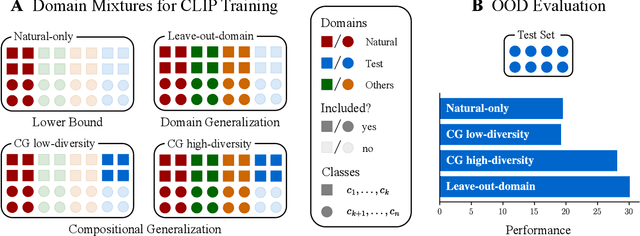
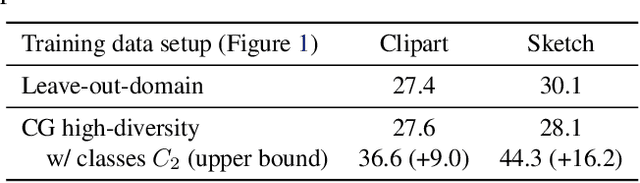
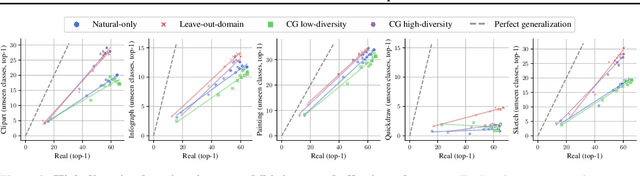
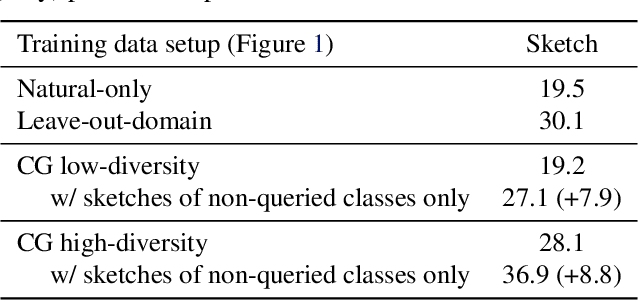
The remarkable generalization performance of contrastive vision-language models like CLIP is often attributed to the diversity of their training distributions. However, key questions remain unanswered: Can CLIP generalize to an entirely unseen domain when trained on a diverse mixture of domains (domain generalization)? Can it generalize to unseen classes within partially seen domains (compositional generalization)? What factors affect such generalization? To answer these questions, we trained CLIP models on systematically constructed training distributions with controlled domain diversity and object class exposure. Our experiments show that domain diversity is essential for both domain and compositional generalization, yet compositional generalization can be surprisingly weaker than domain generalization when the training distribution contains a suboptimal subset of the test domain. Through data-centric and mechanistic analyses, we find that successful generalization requires learning of shared representations already in intermediate layers and shared circuitry.