 Add to Chrome
 Add to Firefox
 Add to Edge
The Proxy Benders Decomposition
Jun 05, 2026
Benders decomposition is a fundamental framework for solving large-scale mixed-integer optimization problems with complicating variables that, when fixed, yield significantly easier subproblems. However, classical Benders decomposition repeatedly solves highly similar subproblems and often exhibits zigzagging behavior across iterations, leading to slow convergence in large-scale settings. Motivated by the repetitive structure and parametric nature of Benders subproblems, this paper introduces the proxy Benders decomposition (Proxy-BD), a new decomposition framework in which subproblem optimization is replaced by certified optimization proxies rather than repeated exact solves. The proposed proxy follows a self-supervised predict-project-and-complete mechanism that produces dual-feasible solutions for generating provably valid Benders cuts. The framework preserves the theoretical validity of the decomposition independently of prediction quality through a projection-and-completion certification layer. A formal characterization of proxy-induced cuts is established, and the framework naturally extends to modern decomposition schemes, including branch-and-Benders-cut algorithms. Computational experiments on large-scale facility location and network design problems demonstrate that Proxy-BD substantially reduces the computational effort of subproblems while maintaining near-optimal solution quality. On large-scale uncapacitated facility location instances up to 2000x2000, Proxy-BD achieves median optimality gaps below 0.5%, yields up to 161x median speedups, and reduces the number of generated cuts by more than 240x on the largest instances. The computational gains consistently increase with recourse complexity, indicating that proxy-based inference scales substantially more favorably than repeated exact subproblem optimization in large-scale decomposition settings.

Democratizing Large-Scale Re-Optimization with LLM-Guided Model Patches
May 18, 2026Optimization models developed by operations research (OR) experts are often deployed as decision-support systems in industrial settings. However, real-world environments are dynamic, with evolving business rules, previously overlooked constraints, and unforeseen perturbations. In such contexts, end users must rapidly re-optimize models to recover feasible and implementable solutions. This paper introduces an agentic re-optimization framework in which a large language model (LLM) acts as an OR expert, dynamically supporting end users through natural-language interaction. The LLM translates user prompts into structured updates of the underlying optimization model, selects suitable re-optimization techniques from an optimization toolbox, and solves the resulting instance to return implementable solutions. The toolbox leverages primal information, including historical solutions, valid inequalities, solver configurations, and metaheuristics, to accelerate re-optimization while preserving solution quality. The proposed framework enables interactive and continuous adaptation of deployed optimization models, reducing dependence on OR experts and improving the sustainability of decision-support systems. Extensive experiments on two complementary large-scale real-world case studies demonstrate the effectiveness and scalability of the proposed framework. The first considers online supply chain re-optimization, where solutions must be generated rapidly while remaining close to the deployed plan, whereas the second focuses on offline university exam scheduling, where solution quality is prioritized over runtime. Results show that the toolbox-driven architecture significantly improves computational efficiency through primal-based and solver-aware re-optimization techniques, while the structured patch-based updates improve interpretability and traceability of model modifications.
A Rolling-Space Branch-and-Price Algorithm for the Multi-Compartment Vehicle Routing Problem with Multiple Time Windows
Jan 22, 2026This paper investigates the multi-compartment vehicle routing problem with multiple time windows (MCVRPMTW), an extension of the classical vehicle routing problem with time windows that considers vehicles equipped with multiple compartments and customers requiring service across several delivery time windows. The problem incorporates three key compartment-related features: (i) compartment flexibility in the number of compartments, (ii) item-to-compartment compatibility, and (iii) item-to-item compatibility. The problem also accommodates practical operational requirements such as driver breaks. To solve the MCVRPMTW, we develop an exact branch-and-price (B&P) algorithm in which the pricing problem is solved using a labeling algorithm. Several acceleration strategies are introduced to limit symmetry during label extensions, improve the stability of dual solutions in column generation, and enhance the branching process. To handle large-scale instances, we propose a rolling-space B&P algorithm that integrates clustering techniques into the solution framework. Extensive computational experiments on instances inspired by a real-world industrial application demonstrate the effectiveness of the proposed approach and provide useful managerial insights for practical implementation.
ID-PaS : Identity-Aware Predict-and-Search for General Mixed-Integer Linear Programs
Dec 11, 2025Mixed-Integer Linear Programs (MIPs) are powerful and flexible tools for modeling a wide range of real-world combinatorial optimization problems. Predict-and-Search methods operate by using a predictive model to estimate promising variable assignments and then guiding a search procedure toward high-quality solutions. Recent research has demonstrated that incorporating machine learning (ML) into the Predict-and-Search framework significantly enhances its performance. Still, it is restricted to binary problems and overlooks the presence of fixed variables that commonly arise in practical settings. This work extends the Predict-and-Search (PaS) framework to parametric MIPs and introduces ID-PaS, an identity-aware learning framework that enables the ML model to handle heterogeneous variables more effectively. Experiments on several real-world large-scale problems demonstrate that ID-PaS consistently achieves superior performance compared to the state-of-the-art solver Gurobi and PaS.
A Column Generation based Heuristic for the Tail Assignment Problem
Sep 25, 2020

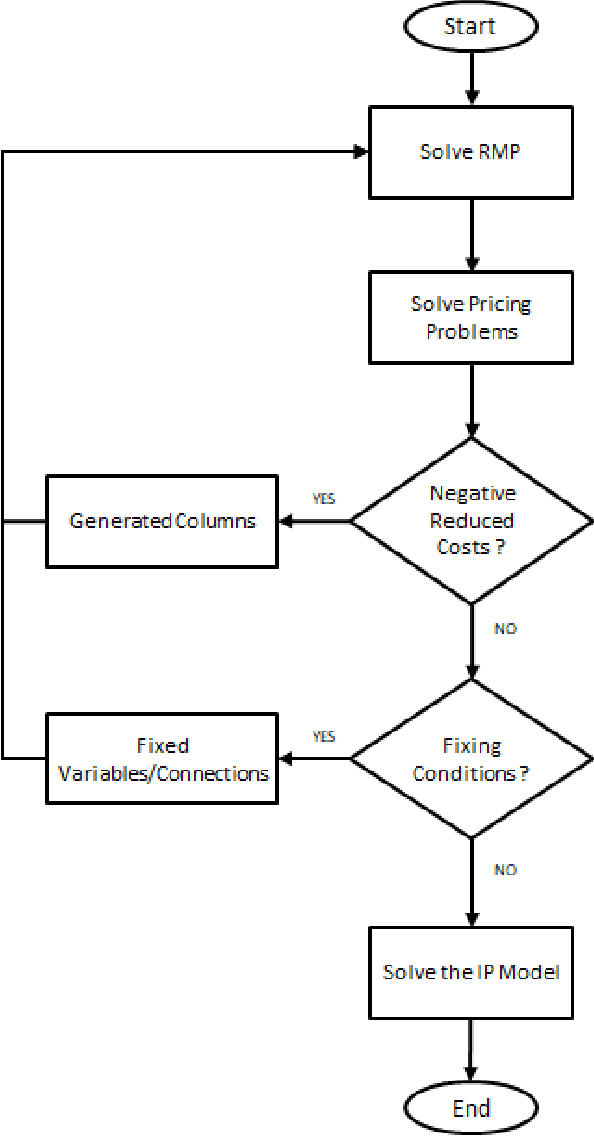
This article proposes an efficient heuristic in accelerating the column generation by parallel resolution of pricing problems for aircrafts in the tail assignment problem (TAP). The approach is able to achieve considerable improvement in resolution time for real life test instances from two major Indian air carriers. The different restrictions on individual aircraft for maintenance routing as per aviation regulatory bodies are considered in this paper. We also present a variable fixing heuristic to improve the integrality of the solution. The hybridization of constraint programming and column generation was substantial in accelerating the resolution process.