 Add to Chrome
 Add to Firefox
 Add to Edge
STC-Net: Electroluminescence-Based Solar Cell Crack Segmentation for Power Loss Estimation
Aug 03, 2026
Accurate crack assessment in electroluminescence (EL) images is important for photovoltaic (PV) reliability analysis, yet existing segmentation methods often fail to capture the thin, elongated, and structurally constrained nature of crack defects. This paper proposes a Solar Topology Crack Network (STC-Net) that incorporates edge priors, spectral priors, and a boundary-topology refinement module to improve crack continuity and boundary preservation. The framework further extends segmentation to power-loss estimation by deriving a crack-associated inactive-area proxy from the predicted masks. Experiments on the PVEL-S dataset show that STC-Net achieves 95.98 MIoU, 98.01 MDice, and 98.00 MAcc during training, and 72.52 MIoU and 80.16 MDice on unseen test samples. These results demonstrate that STC-Net provides accurate crack localization while offering a practical link between EL-based defect segmentation and PV degradation assessment.

In-process 3D Deviation Mapping and Defect Monitoring (3D-DM2) in High Production-rate Robotic Additive Manufacturing
Nov 06, 2025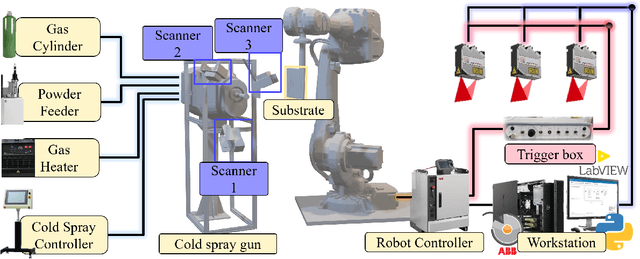
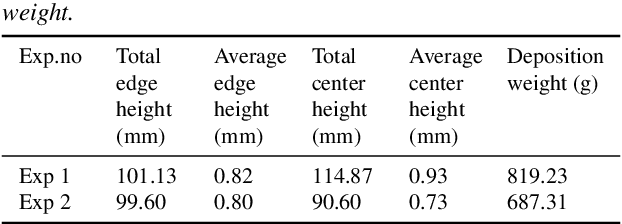
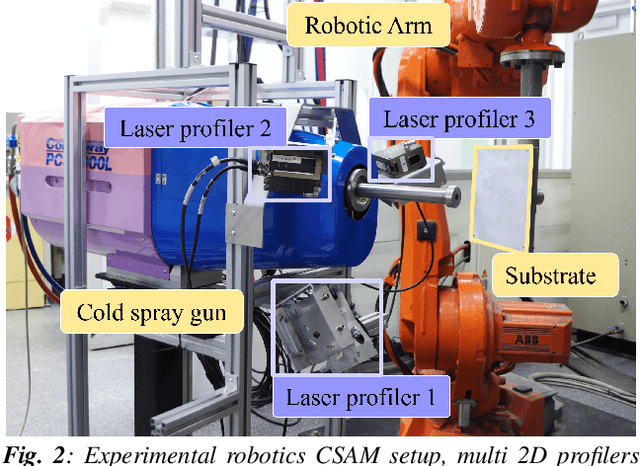
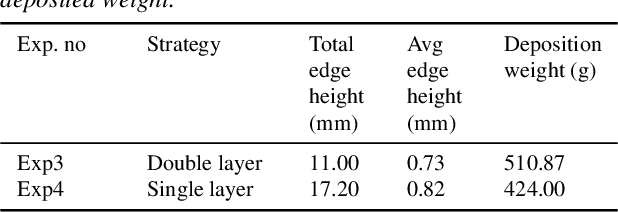
Additive manufacturing (AM) is an emerging digital manufacturing technology to produce complex and freeform objects through a layer-wise deposition. High deposition rate robotic AM (HDRRAM) processes, such as cold spray additive manufacturing (CSAM), offer significantly increased build speeds by delivering large volumes of material per unit time. However, maintaining shape accuracy remains a critical challenge, particularly due to process instabilities in current open-loop systems. Detecting these deviations as they occur is essential to prevent error propagation, ensure part quality, and minimize post-processing requirements. This study presents a real-time monitoring system to acquire and reconstruct the growing part and directly compares it with a near-net reference model to detect the shape deviation during the manufacturing process. The early identification of shape inconsistencies, followed by segmenting and tracking each deviation region, paves the way for timely intervention and compensation to achieve consistent part quality.
Cable Driven Rehabilitation Robots: Comparison of Applications and Control Strategies
Aug 05, 2021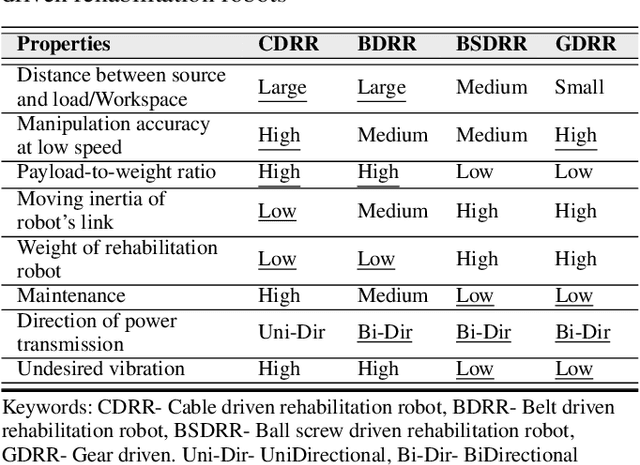
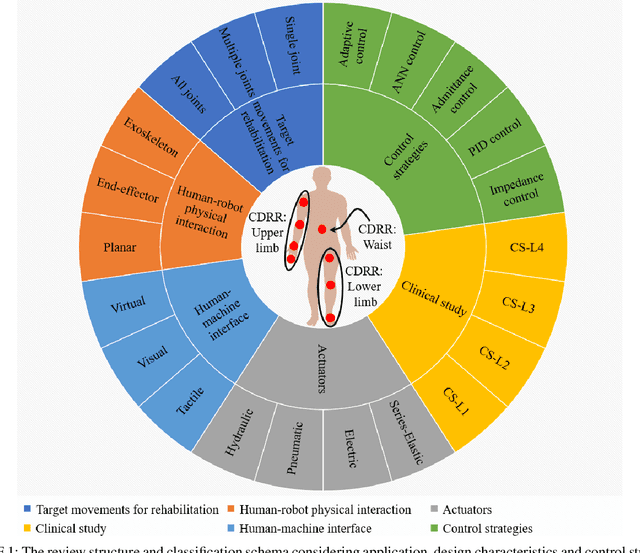
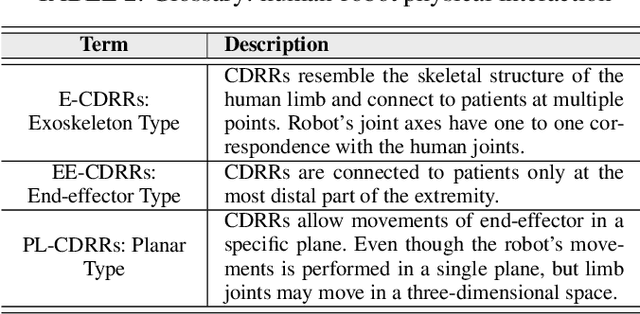
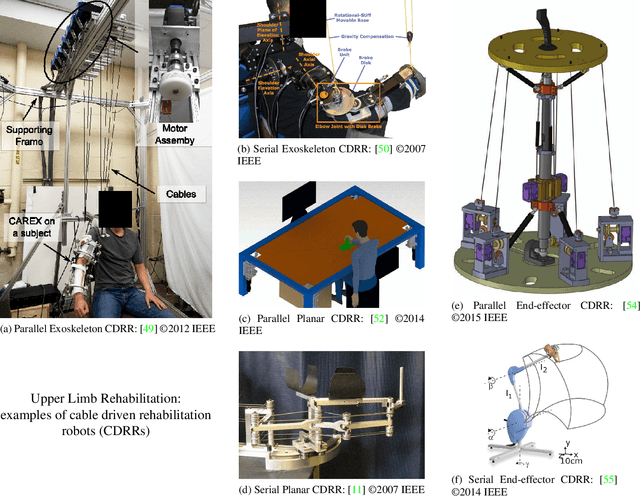
Significant attention has been paid to robotic rehabilitation using various types of actuator and power transmission. Amongst those, cable-driven rehabilitation robots (CDRRs) are relatively newer and their control strategies have been evolving in recent years. CDRRs offer several promising features, such as low inertia, lightweight, high payload-to-weight ratio, large work-space and configurability. In this paper, we categorize and review the cable-driven rehabilitation robots in three main groups concerning their applications for upper limb, lower limb, and waist rehabilitation. For each group, target movements are identified, and promising designs of CDRRs are analyzed in terms of types of actuators, controllers and their interactions with humans. Particular attention has been given to robots with verified clinical performance in actual rehabilitation settings. A large part of this paper is dedicated to comparing the control strategies and techniques of CDRRs under five main categories of: Impedance-based, PID-based, Admittance-based, Assist-as-needed (AAN) and Adaptive controllers. We have carefully contrasted the advantages and disadvantages of those methods with the aim of assisting the design of future CDRRs