 Add to Chrome
 Add to Firefox
 Add to Edge
Fast Functionally Redundant Inverse Kinematics for Robotic Toolpath Optimisation in Manufacturing Tasks
Dec 10, 2025
Industrial automation with six-axis robotic arms is critical for many manufacturing tasks, including welding and additive manufacturing applications; however, many of these operations are functionally redundant due to the symmetrical tool axis, which effectively makes the operation a five-axis task. Exploiting this redundancy is crucial for achieving the desired workspace and dexterity required for the feasibility and optimisation of toolpath planning. Inverse kinematics algorithms can solve this in a fast, reactive framework, but these techniques are underutilised over the more computationally expensive offline planning methods. We propose a novel algorithm to solve functionally redundant inverse kinematics for robotic manipulation utilising a task space decomposition approach, the damped least-squares method and Halley's method to achieve fast and robust solutions with reduced joint motion. We evaluate our methodology in the case of toolpath optimisation in a cold spray coating application on a non-planar surface. The functionally redundant inverse kinematics algorithm can quickly solve motion plans that minimise joint motion, expanding the feasible operating space of the complex toolpath. We validate our approach on an industrial ABB manipulator and cold-spray gun executing the computed toolpath.

In-process 3D Deviation Mapping and Defect Monitoring (3D-DM2) in High Production-rate Robotic Additive Manufacturing
Nov 06, 2025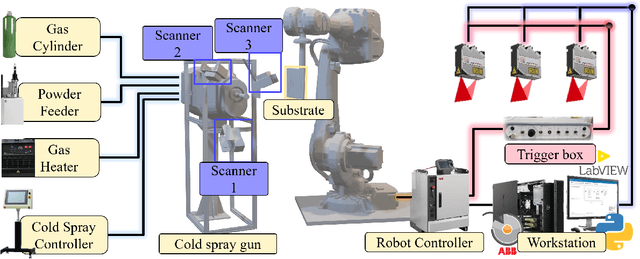
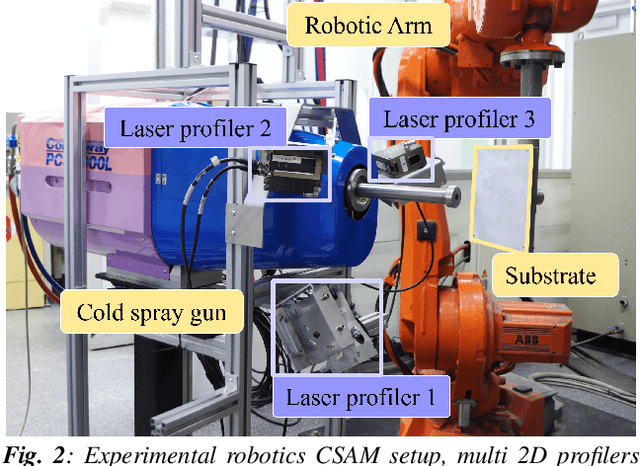
Additive manufacturing (AM) is an emerging digital manufacturing technology to produce complex and freeform objects through a layer-wise deposition. High deposition rate robotic AM (HDRRAM) processes, such as cold spray additive manufacturing (CSAM), offer significantly increased build speeds by delivering large volumes of material per unit time. However, maintaining shape accuracy remains a critical challenge, particularly due to process instabilities in current open-loop systems. Detecting these deviations as they occur is essential to prevent error propagation, ensure part quality, and minimize post-processing requirements. This study presents a real-time monitoring system to acquire and reconstruct the growing part and directly compares it with a near-net reference model to detect the shape deviation during the manufacturing process. The early identification of shape inconsistencies, followed by segmenting and tracking each deviation region, paves the way for timely intervention and compensation to achieve consistent part quality.