 Add to Chrome
 Add to Firefox
 Add to Edge
Concurrence: A dependence criterion for time series, applied to biological data
Dec 17, 2025
Measuring the statistical dependence between observed signals is a primary tool for scientific discovery. However, biological systems often exhibit complex non-linear interactions that currently cannot be captured without a priori knowledge or large datasets. We introduce a criterion for dependence, whereby two time series are deemed dependent if one can construct a classifier that distinguishes between temporally aligned vs. misaligned segments extracted from them. We show that this criterion, concurrence, is theoretically linked with dependence, and can become a standard approach for scientific analyses across disciplines, as it can expose relationships across a wide spectrum of signals (fMRI, physiological and behavioral data) without ad-hoc parameter tuning or large amounts of data.

On the estimation of the number of components in multivariate functional principal component analysis
Nov 08, 2023

Happ and Greven (2018) developed a methodology for principal components analysis of multivariate functional data for data observed on different dimensional domains. Their approach relies on an estimation of univariate functional principal components for each univariate functional feature. In this paper, we present extensive simulations to investigate choosing the number of principal components to retain. We show empirically that the conventional approach of using a percentage of variance explained threshold for each univariate functional feature may be unreliable when aiming to explain an overall percentage of variance in the multivariate functional data, and thus we advise practitioners to be careful when using it.
On the use of the Gram matrix for multivariate functional principal components analysis
Jun 22, 2023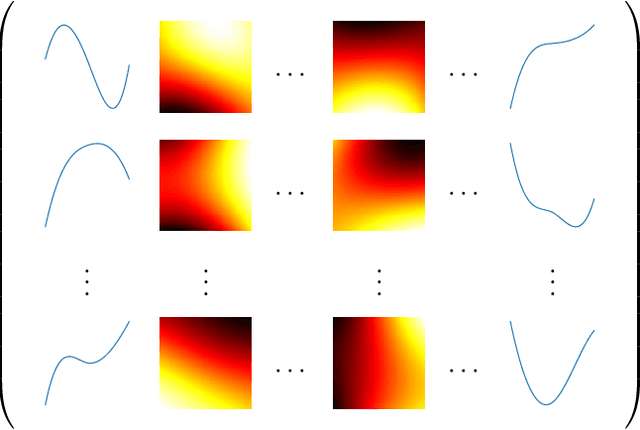

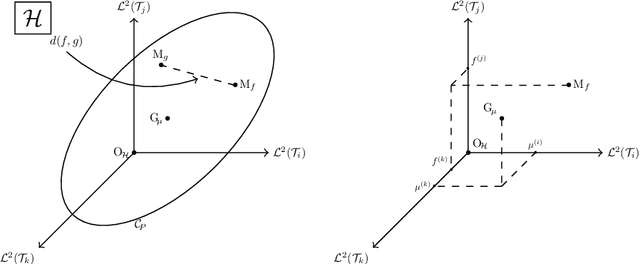

Dimension reduction is crucial in functional data analysis (FDA). The key tool to reduce the dimension of the data is functional principal component analysis. Existing approaches for functional principal component analysis usually involve the diagonalization of the covariance operator. With the increasing size and complexity of functional datasets, estimating the covariance operator has become more challenging. Therefore, there is a growing need for efficient methodologies to estimate the eigencomponents. Using the duality of the space of observations and the space of functional features, we propose to use the inner-product between the curves to estimate the eigenelements of multivariate and multidimensional functional datasets. The relationship between the eigenelements of the covariance operator and those of the inner-product matrix is established. We explore the application of these methodologies in several FDA settings and provide general guidance on their usability.