 Add to Chrome
 Add to Firefox
 Add to Edge
Introducing multiplex semantic networks as multifaceted representations of creative associative knowledge across multilingual samples
Jun 08, 2026
Creativity is a complex cognitive ability that relies on knowledge organisation and retrieval from semantic memory. Yet most research uses a single task to measure it, capturing only a fraction of this complexity. This study investigates multiplex networks - layered semantic networks obtained from six cognitive tasks - as a more comprehensive approach to modelling the associative knowledge underlying creativity. We collected data from N=518 individuals from four countries (Austria, USA, Singapore, Italy). From their responses to verbal fluency, sentence-chain, free association, and narrative writing tasks, we constructed semantic networks and assembled them in a multiplex structure. AI persona-based responses provided a comparison baseline. Structural reducibility analyses showed that different task layers captured distinct, non-redundant information about semantic organisation, supporting the use of multiple tasks over any single one. The networks from high- and low-creative groups remained structurally distinct, while AI-generated networks showed near-identical structures regardless of creativity group. Finally, we used 12 features (network measures, emotional scores, and spreading activation simulations) in a machine learning model using ridge regression to predict individual creativity scores. The combination of structurally similar layers, as identified in the previous stage, improved a proof-of-concept prediction accuracy by 50%. Structural measures showed the highest feature importance, with spreading activation dynamics providing additional predictive power. Together, these findings indicate that multiplex semantic networks capture a richer, cross-cultural picture of associative knowledge underlying creativity. We also release our diverse dataset and code to foster diverse computational approaches within the creativity community.

Cognitive networks reconstruct mindsets about STEM subjects and educational contexts in almost 1000 high-schoolers, University students and LLM-based digital twins
Feb 16, 2026Attitudes toward STEM develop from the interaction of conceptual knowledge, educational experiences, and affect. Here we use cognitive network science to reconstruct group mindsets as behavioural forma mentis networks (BFMNs). In this case, nodes are cue words and free associations, edges are empirical associative links, and each concept is annotated with perceived valence. We analyse BFMNs from N = 994 observations spanning high school students, university students, and early-career STEM experts, alongside LLM (GPT-oss) "digital twins" prompted to emulate comparable profiles. Focusing also on semantic neighbourhoods ("frames") around key target concepts (e.g., STEM subjects or educational actors/places), we quantify frames in terms of valence auras, emotional profiles, network overlap (Jaccard similarity), and concreteness relative to null baselines. Across student groups, science and research are consistently framed positively, while their core quantitative subjects (mathematics and statistics) exhibit more negative and anxiety related auras, amplified in higher math-anxiety subgroups, evidencing a STEM-science cognitive and emotional dissonance. High-anxiety frames are also less concrete than chance, suggesting more abstract and decontextualised representations of threatening quantitative domains. Human networks show greater overlapping between mathematics and anxiety than GPT-oss. The results highlight how BFMNs capture cognitive-affective signatures of mindsets towards the target domains and indicate that LLM-based digital twins approximate cultural attitudes but miss key context-sensitive, experience-based components relevant to replicate human educational anxiety.
How to predict creativity ratings from written narratives: A comparison of co-occurrence and textual forma mentis networks
Jan 12, 2026This tutorial paper provides a step-by-step workflow for building and analysing semantic networks from short creative texts. We introduce and compare two widely used text-to-network approaches: word co-occurrence networks and textual forma mentis networks (TFMNs). We also demonstrate how they can be used in machine learning to predict human creativity ratings. Using a corpus of 1029 short stories, we guide readers through text preprocessing, network construction, feature extraction (structural measures, spreading-activation indices, and emotion scores), and application of regression models. We evaluate how network-construction choices influence both network topology and predictive performance. Across all modelling settings, TFMNs consistently outperformed co-occurrence networks through lower prediction errors (best MAE = 0.581 for TFMN, vs 0.592 for co-occurrence with window size 3). Network-structural features dominated predictive performance (MAE = 0.591 for TFMN), whereas emotion features performed worse (MAE = 0.711 for TFMN) and spreading-activation measures contributed little (MAE = 0.788 for TFMN). This paper offers practical guidance for researchers interested in applying network-based methods for cognitive fields like creativity research. we show when syntactic networks are preferable to surface co-occurrence models, and provide an open, reproducible workflow accessible to newcomers in the field, while also offering deeper methodological insight for experienced researchers.
Cognitive networks highlight differences and similarities in the STEM mindsets of human and LLM-simulated trainees, experts and academics
Feb 26, 2025Understanding attitudes towards STEM means quantifying the cognitive and emotional ways in which individuals, and potentially large language models too, conceptualise such subjects. This study uses behavioural forma mentis networks (BFMNs) to investigate the STEM-focused mindset, i.e. ways of associating and perceiving ideas, of 177 human participants and 177 artificial humans simulated by GPT-3.5. Participants were split in 3 groups - trainees, experts and academics - to compare the influence of expertise level on their mindset. The results revealed that human forma mentis networks exhibited significantly higher clustering coefficients compared to GPT-3.5, indicating that human mindsets displayed a tendency to form and close triads of conceptual associations while recollecting STEM ideas. Human experts, in particular, demonstrated robust clustering coefficients, reflecting better integration of STEM concepts into their cognitive networks. In contrast, GPT-3.5 produced sparser mindsets. Furthermore, both human and GPT mindsets framed mathematics in neutral or positive terms, differently from STEM high schoolers, researchers and other large language models sampled in other works. This research contributes to understanding how mindset structure can provide cognitive insights about memory structure and machine limitations.
Forma mentis networks predict creativity ratings of short texts via interpretable artificial intelligence in human and GPT-simulated raters
Nov 30, 2024
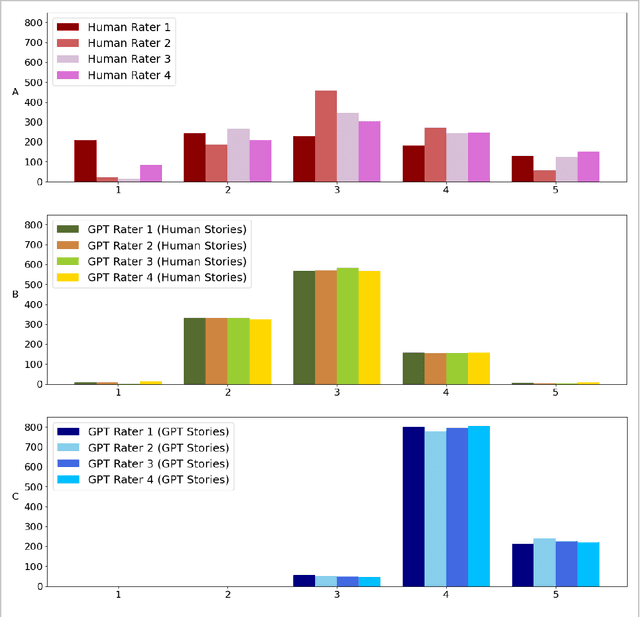
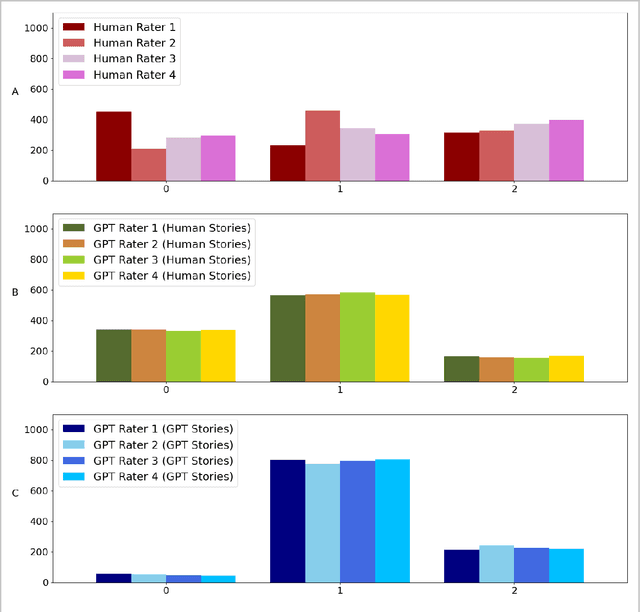
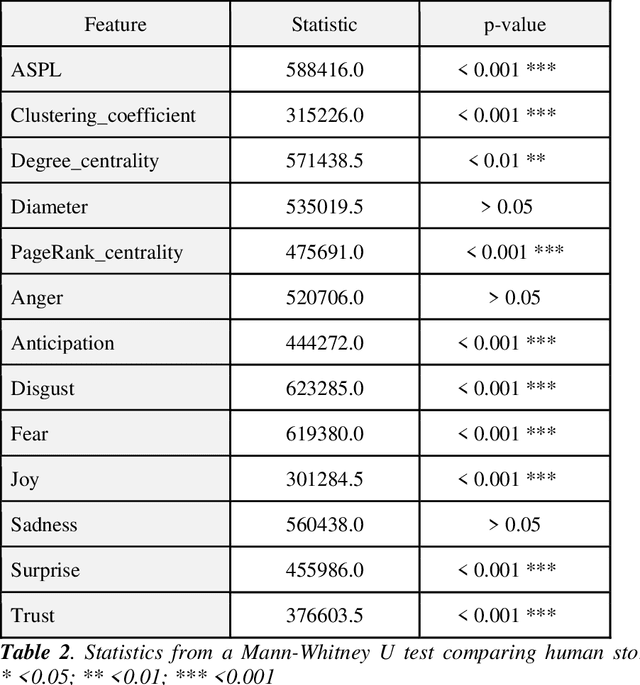
Creativity is a fundamental skill of human cognition. We use textual forma mentis networks (TFMN) to extract network (semantic/syntactic associations) and emotional features from approximately one thousand human- and GPT3.5-generated stories. Using Explainable Artificial Intelligence (XAI), we test whether features relative to Mednick's associative theory of creativity can explain creativity ratings assigned by humans and GPT-3.5. Using XGBoost, we examine three scenarios: (i) human ratings of human stories, (ii) GPT-3.5 ratings of human stories, and (iii) GPT-3.5 ratings of GPT-generated stories. Our findings reveal that GPT-3.5 ratings differ significantly from human ratings not only in terms of correlations but also because of feature patterns identified with XAI methods. GPT-3.5 favours 'its own' stories and rates human stories differently from humans. Feature importance analysis with SHAP scores shows that: (i) network features are more predictive for human creativity ratings but also for GPT-3.5's ratings of human stories; (ii) emotional features played a greater role than semantic/syntactic network structure in GPT-3.5 rating its own stories. These quantitative results underscore key limitations in GPT-3.5's ability to align with human assessments of creativity. We emphasise the need for caution when using GPT-3.5 to assess and generate creative content, as it does not yet capture the nuanced complexity that characterises human creativity.