 Add to Chrome
 Add to Firefox
 Add to Edge
LakeQA: An Exploratory QA Benchmark over a Million-Scale Data Lake
Jun 09, 2026
Recent large language models (LLMs) have shown rapid progress in reading-based question answering (QA), where evidence is explicitly provided or can be trivially retrieved. In contrast, real-world questions are often not paired with accurate evidence documents. The useful evidence resides in massive data lakes, making search a prerequisite for answering. However, there is a lack of comprehensive benchmarks that require both searching and reasoning over large data lakes. To this end, we introduce LakeQA, a comprehensive benchmark for search-centric question answering over data lakes that jointly emphasizes searching and reasoning capabilities. LakeQA is built on a heterogeneous collection of approximately 9.5 TB of text resources from Wikipedia and open-source government data, spanning structured and unstructured data. To ensure task quality, each sample is annotated by at least one Ph.D.-level expert. Each task requires long-horizon multi-hop reasoning with implicit intermediate steps: agents need to discover the correct documents and then compose evidence across sources to produce the answer. Experimental results on seven frontier LLMs demonstrate that LakeQA is challenging. For instance, GPT-5.2 achieves only an exact-match score of 18.37% on LakeQA. Overall, LakeQA provides a realistic testbed for developing LLM agents that can both find and analyze data in modern data lakes.

BDIViz in Action: Interactive Curation and Benchmarking for Schema Matching Methods
Apr 12, 2026Schema matching remains fundamental to data integration, yet evaluating and comparing matching methods is hindered by limited benchmark diversity and lack of interactive validation frameworks. BDIViz, recently published at IEEE VIS 2025, is an interactive visualization system for schema matching with LLM-assisted validation. Given source and target datasets, BDIViz applies automatic matching methods and visualizes candidates in an interactive heatmap with hierarchical navigation, zoom, and filtering. Users validate matches directly in the heatmap and inspect ambiguous cases using coordinated views that show attribute descriptions, example values, and distributions. An LLM assistant generates structured explanations for selected candidates to support decision-making. This demonstration showcases a new extension to BDIViz that addresses a critical need in data integration research: human-in-the-loop benchmarking and iterative matcher development. New matchers can be integrated through a standardized interface, while user validations become evolving ground truth for real-time performance evaluation. This enables benchmarking new algorithms, constructing high-quality ground-truth datasets through expert validation, and comparing matcher behavior across diverse schemas and domains. We demonstrate two complementary scenarios: (i) data harmonization, where users map a large tabular dataset to a target schema with value-level inspection and LLM-generated explanations; and (ii) developer-in-the-loop benchmarking, where developers integrate custom matchers, observe performance metrics, and refine their algorithms.
Magneto: Combining Small and Large Language Models for Schema Matching
Dec 11, 2024
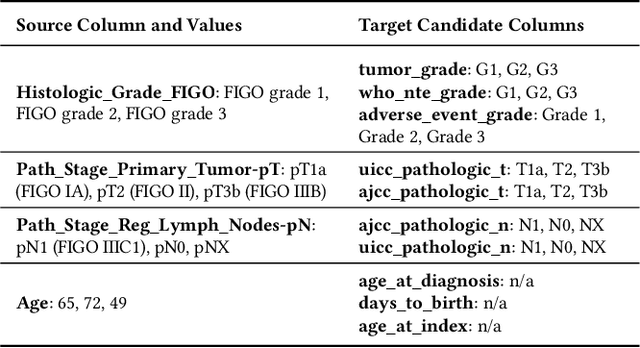


Recent advances in language models opened new opportunities to address complex schema matching tasks. Schema matching approaches have been proposed that demonstrate the usefulness of language models, but they have also uncovered important limitations: Small language models (SLMs) require training data (which can be both expensive and challenging to obtain), and large language models (LLMs) often incur high computational costs and must deal with constraints imposed by context windows. We present Magneto, a cost-effective and accurate solution for schema matching that combines the advantages of SLMs and LLMs to address their limitations. By structuring the schema matching pipeline in two phases, retrieval and reranking, Magneto can use computationally efficient SLM-based strategies to derive candidate matches which can then be reranked by LLMs, thus making it possible to reduce runtime without compromising matching accuracy. We propose a self-supervised approach to fine-tune SLMs which uses LLMs to generate syntactically diverse training data, and prompting strategies that are effective for reranking. We also introduce a new benchmark, developed in collaboration with domain experts, which includes real biomedical datasets and presents new challenges to schema matching methods. Through a detailed experimental evaluation, using both our new and existing benchmarks, we show that Magneto is scalable and attains high accuracy for datasets from different domains.