 Add to Chrome
 Add to Firefox
 Add to Edge
Robust In-Hand Manipulation via Priors in Reinforcement Learning and Mechanical Design
Jul 13, 2026
In-hand manipulation without external sensing is challenging due to uncertainties from finger-object contacts and disturbances by gravity. While reinforcement learning has shown promise in learning complex finger gaiting, existing approaches do not prioritize maintaining well-conditioned grasps for sustained manipulation. We introduce two complementary physics priors for robust in-hand rolling: a global grasp-quality prior derived from classical grasp analysis and a local contact-geometry prior based on fingertip curvature. The grasp-quality prior is used as a dense reward-shaping term that encourages well-distributed contacts with improved worst-case wrench resistance. The contact-geometry prior is expressed in the fingertip geometry that mechanically shapes the contact interface toward task-aligned rolling while reducing off-axis drift. We evaluate the effect of these priors on learning in-hand rolling manipulation for a multifingered robotic hand manipulating three different objects at four palm orientations. Results show significant improvement in rotation efficiency, grasp stability, and disturbance rejection, suggesting that physics priors embedded in both learning and fingertip morphology improve task robustness and sim-to-real transfer. An overview video can be found at https://youtu.be/pdd1wHxQnJM?si=dM-U5kiiPTYsk3Pk.

A Game Benchmark for Real-Time Human-Swarm Control
Oct 28, 2022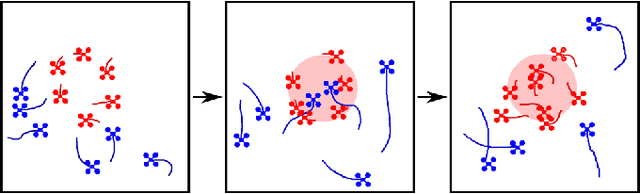
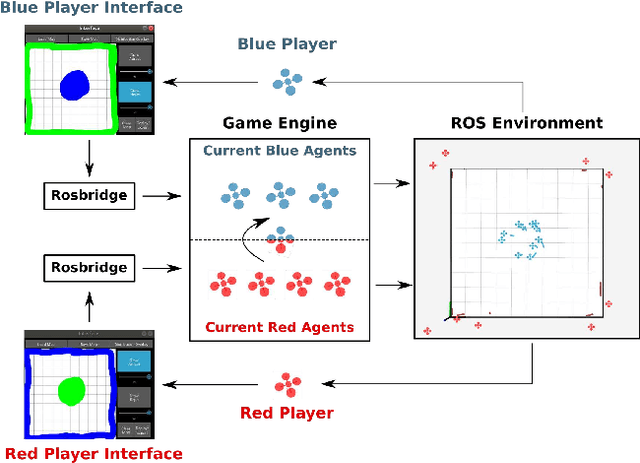
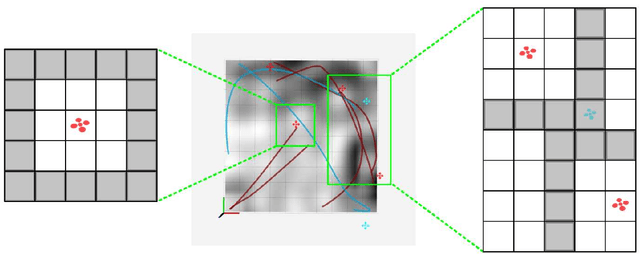
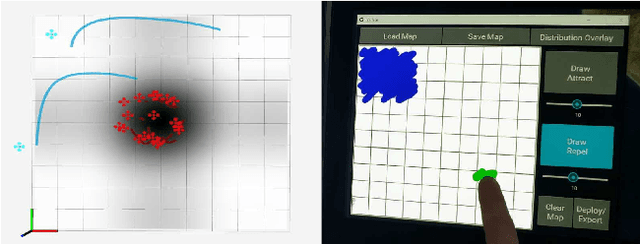
We present a game benchmark for testing human-swarm control algorithms and interfaces in a real-time, high-cadence scenario. Our benchmark consists of a swarm vs. swarm game in a virtual ROS environment in which the goal of the game is to capture all agents from the opposing swarm; the game's high-cadence is a result of the capture rules, which cause agent team sizes to fluctuate rapidly. These rules require players to consider both the number of agents currently at their disposal and the behavior of their opponent's swarm when they plan actions. We demonstrate our game benchmark with a default human-swarm control system that enables a player to interact with their swarm through a high-level touchscreen interface. The touchscreen interface transforms player gestures into swarm control commands via a low-level decentralized ergodic control framework. We compare our default human-swarm control system to a flocking-based control system, and discuss traits that are crucial for swarm control algorithms and interfaces operating in real-time, high-cadence scenarios like our game benchmark. Our game benchmark code is available on Github; more information can be found at https://sites.google.com/view/swarm-game-benchmark.