 Add to Chrome
 Add to Firefox
 Add to Edge
Modeling Human-Like Color Naming Behavior in Context
Apr 28, 2026
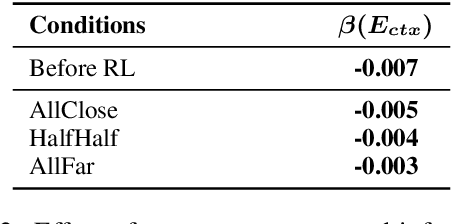
Modeling the emergence of human-like lexicons in computational systems has advanced through the use of interacting neural agents, which simulate both learning and communicative pressures. The NeLLCom-Lex framework (Zhang et al., 2025) allows neural agents to develop pragmatic color naming behavior and human-like lexicons through supervised learning (SL) from human data and reinforcement learning (RL) in referential games. Despite these successes, the lexicons that emerge diverge systematically from human color categories, producing highly non-convex regions in color space, which contrast with the convexity typical of human categories. To address this, we introduce two factors, upsampling rare color terms during SL and multi-listener RL interactions, and adopt a convexity measure to quantify geometric coherence. We find that upsampling improves lexical diversity and system-level informativeness of the color lexicon, while many-listener setups promote more convex color categories. The combination of moderate upsampling and multiple listeners produces lexicons most similar to human systems.

NeLLCom-Lex: A Neural-agent Framework to Study the Interplay between Lexical Systems and Language Use
Sep 26, 2025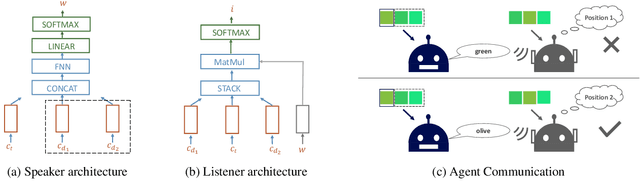
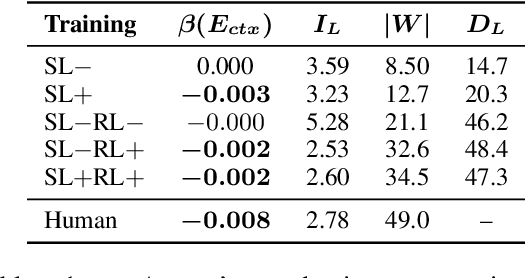
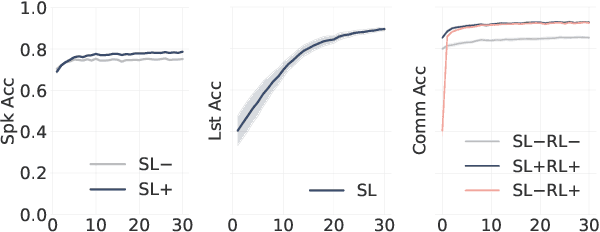
Lexical semantic change has primarily been investigated with observational and experimental methods; however, observational methods (corpus analysis, distributional semantic modeling) cannot get at causal mechanisms, and experimental paradigms with humans are hard to apply to semantic change due to the extended diachronic processes involved. This work introduces NeLLCom-Lex, a neural-agent framework designed to simulate semantic change by first grounding agents in a real lexical system (e.g. English) and then systematically manipulating their communicative needs. Using a well-established color naming task, we simulate the evolution of a lexical system within a single generation, and study which factors lead agents to: (i) develop human-like naming behavior and lexicons, and (ii) change their behavior and lexicons according to their communicative needs. Our experiments with different supervised and reinforcement learning pipelines show that neural agents trained to 'speak' an existing language can reproduce human-like patterns in color naming to a remarkable extent, supporting the further use of NeLLCom-Lex to elucidate the mechanisms of semantic change.