 Add to Chrome
 Add to Firefox
 Add to Edge
Weak-to-Strong Generalization is Nearly Inevitable (in Linear Models)
May 07, 2026
Weak-to-strong generalization is a phenomenon in post-training whereby a strong student model, when finetuned solely with feedback from a weaker teacher, can not only surpass the teacher, but can improve upon its own capabilities. Recent work of Burns et al. (2023) demonstrated that this can occur in the setting of frontier language models, and subsequently there has been a flurry of both empirical work trying to exploit this phenomenon, as well as theoretical work attempting to understand it. In this work, we demonstrate that weak-to-strong generalization occurs in standard linear logistic regression, under mild distributional assumptions on the data. In fact, we show that this happens for most student-teacher pairs, suggesting that weak-to-strong generalization is in fact \emph{almost inevitable}, even in this basic setting. Notably, our setting does not require the student to be more expressive or have more model capacity in any way compared to the teacher, which runs contrary to the prevailing theoretical belief that a mismatch in model capacity is a central mechanism to weak-to-strong generalization.

When is Multicalibration Post-Processing Necessary?
Jun 10, 2024
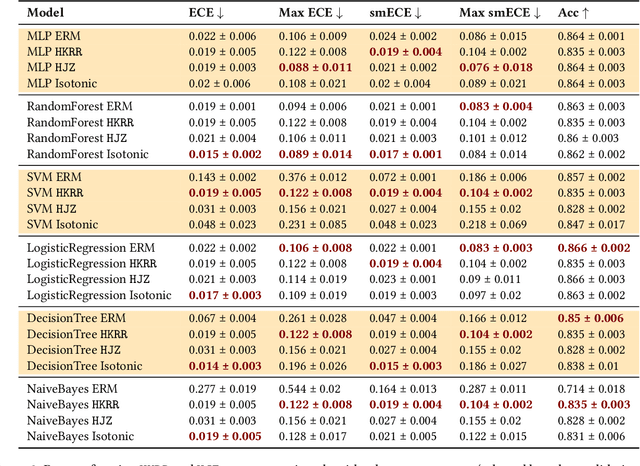
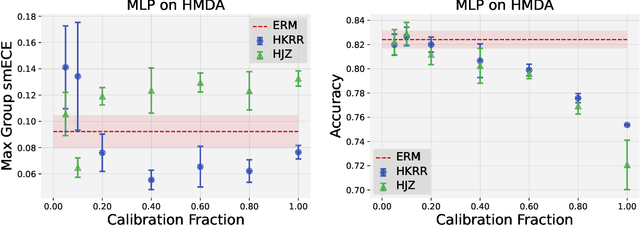
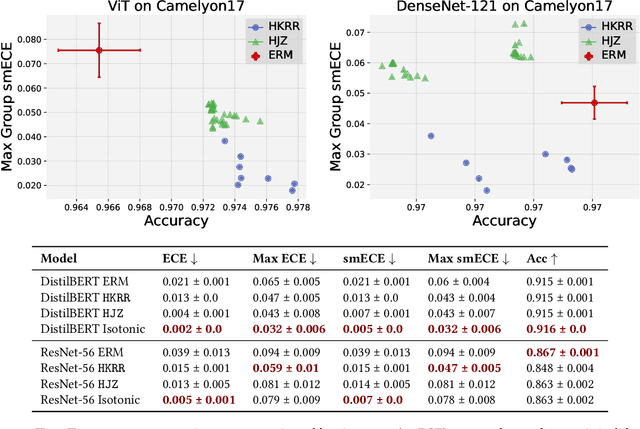
Calibration is a well-studied property of predictors which guarantees meaningful uncertainty estimates. Multicalibration is a related notion -- originating in algorithmic fairness -- which requires predictors to be simultaneously calibrated over a potentially complex and overlapping collection of protected subpopulations (such as groups defined by ethnicity, race, or income). We conduct the first comprehensive study evaluating the usefulness of multicalibration post-processing across a broad set of tabular, image, and language datasets for models spanning from simple decision trees to 90 million parameter fine-tuned LLMs. Our findings can be summarized as follows: (1) models which are calibrated out of the box tend to be relatively multicalibrated without any additional post-processing; (2) multicalibration post-processing can help inherently uncalibrated models; and (3) traditional calibration measures may sometimes provide multicalibration implicitly. More generally, we also distill many independent observations which may be useful for practical and effective applications of multicalibration post-processing in real-world contexts.