 Add to Chrome
 Add to Firefox
 Add to Edge
Cross-Domain Data Selection and Augmentation for Automatic Compliance Detection
Apr 23, 2026
Automating the detection of regulatory compliance remains a challenging task due to the complexity and variability of legal texts. Models trained on one regulation often fail to generalise to others. This limitation underscores the need for principled methods to improve cross-domain transfer. We study data selection as a strategy to mitigate negative transfer in compliance detection framed as a natural language inference (NLI) task. Specifically, we evaluate four approaches for selecting augmentation data from a larger source domain: random sampling, Moore-Lewis's cross-entropy difference, importance weighting, and embedding-based retrieval. We systematically vary the proportion of selected data to analyse its effect on cross-domain adaptation. Our findings demonstrate that targeted data selection substantially reduces negative transfer, offering a practical path toward scalable and reliable compliance automation across heterogeneous regulations.

Evaluating Assurance Cases as Text-Attributed Graphs for Structure and Provenance Analysis
Apr 22, 2026An assurance case is a structured argument document that justifies claims about a system's requirements or properties, which are supported by evidence. In regulated domains, these are crucial for meeting compliance and safety requirements to industry standards. We propose a graph diagnostic framework for analysing the structure and provenance of assurance cases. We focus on two main tasks: (1) link prediction, to learn and identify connections between argument elements, and (2) graph classification, to differentiate between assurance cases created by a state-of-the-art large language model and those created by humans, aiming to detect bias. We compiled a publicly available dataset of assurance cases, represented as graphs with nodes and edges, supporting both link prediction and provenance analysis. Experiments show that graph neural networks (GNNs) achieve strong link prediction performance (ROC-AUC 0.760) on real assurance cases and generalise well across domains and semi-supervised settings. For provenance detection, GNNs effectively distinguish human-authored from LLM-generated cases (F1 0.94). We observed that LLM-generated assurance cases have different hierarchical linking patterns compared to human-authored cases. Furthermore, existing GNN explanation methods show only moderate faithfulness, revealing a gap between predicted reasoning and the true argument structure.
Physics-Informed Machine Learning for Vessel Shaft Power and Fuel Consumption Prediction: Interpretable KAN-based Approach
Feb 25, 2026Accurate prediction of shaft rotational speed, shaft power, and fuel consumption is crucial for enhancing operational efficiency and sustainability in maritime transportation. Conventional physics-based models provide interpretability but struggle with real-world variability, while purely data-driven approaches achieve accuracy at the expense of physical plausibility. This paper introduces a Physics-Informed Kolmogorov-Arnold Network (PI-KAN), a hybrid method that integrates interpretable univariate feature transformations with a physics-informed loss function and a leakage-free chained prediction pipeline. Using operational and environmental data from five cargo vessels, PI-KAN consistently outperforms the traditional polynomial method and neural network baselines. The model achieves the lowest mean absolute error (MAE) and root mean squared error (RMSE), and the highest coefficient of determination (R^2) for shaft power and fuel consumption across all vessels, while maintaining physically consistent behavior. Interpretability analysis reveals rediscovery of domain-consistent dependencies, such as cubic-like speed-power relationships and cosine-like wave and wind effects. These results demonstrate that PI-KAN achieves both predictive accuracy and interpretability, offering a robust tool for vessel performance monitoring and decision support in operational settings.
Estimation and Optimization of Ship Fuel Consumption in Maritime: Review, Challenges and Future Directions
Feb 25, 2026To reduce carbon emissions and minimize shipping costs, improving the fuel efficiency of ships is crucial. Various measures are taken to reduce the total fuel consumption of ships, including optimizing vessel parameters and selecting routes with the lowest fuel consumption. Different estimation methods are proposed for predicting fuel consumption, while various optimization methods are proposed to minimize fuel oil consumption. This paper provides a comprehensive review of methods for estimating and optimizing fuel oil consumption in maritime transport. Our novel contributions include categorizing fuel oil consumption \& estimation methods into physics-based, machine-learning, and hybrid models, exploring their strengths and limitations. Furthermore, we highlight the importance of data fusion techniques, which combine AIS, onboard sensors, and meteorological data to enhance accuracy. We make the first attempt to discuss the emerging role of Explainable AI in enhancing model transparency for decision-making. Uniquely, key challenges, including data quality, availability, and the need for real-time optimization, are identified, and future research directions are proposed to address these gaps, with a focus on hybrid models, real-time optimization, and the standardization of datasets.
* 23 pages, 4 figures. Published in Journal of Marine Science and Technology (2026)
Physics-guided Neural Network-based Shaft Power Prediction for Vessels
Dec 23, 2025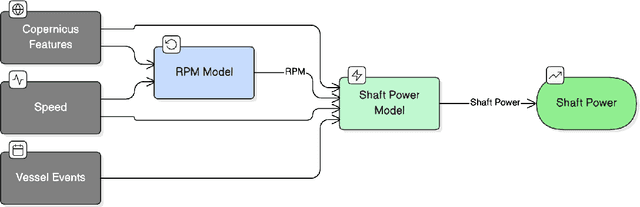
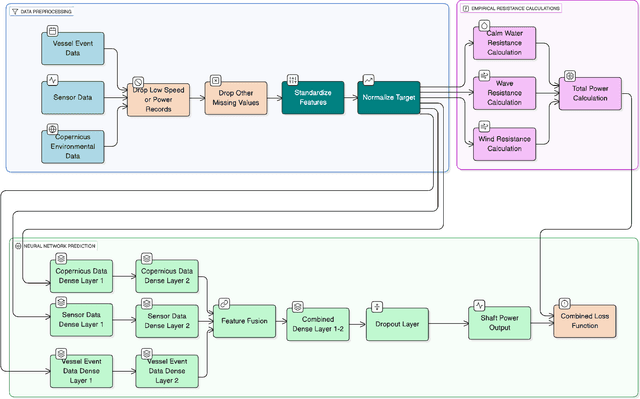
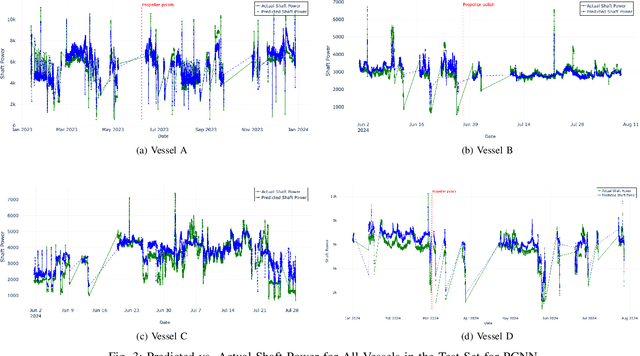

Optimizing maritime operations, particularly fuel consumption for vessels, is crucial, considering its significant share in global trade. As fuel consumption is closely related to the shaft power of a vessel, predicting shaft power accurately is a crucial problem that requires careful consideration to minimize costs and emissions. Traditional approaches, which incorporate empirical formulas, often struggle to model dynamic conditions, such as sea conditions or fouling on vessels. In this paper, we present a hybrid, physics-guided neural network-based approach that utilizes empirical formulas within the network to combine the advantages of both neural networks and traditional techniques. We evaluate the presented method using data obtained from four similar-sized cargo vessels and compare the results with those of a baseline neural network and a traditional approach that employs empirical formulas. The experimental results demonstrate that the physics-guided neural network approach achieves lower mean absolute error, root mean square error, and mean absolute percentage error for all tested vessels compared to both the empirical formula-based method and the base neural network.
Explainable Compliance Detection with Multi-Hop Natural Language Inference on Assurance Case Structure
Jun 10, 2025Ensuring complex systems meet regulations typically requires checking the validity of assurance cases through a claim-argument-evidence framework. Some challenges in this process include the complicated nature of legal and technical texts, the need for model explanations, and limited access to assurance case data. We propose a compliance detection approach based on Natural Language Inference (NLI): EXplainable CompLiance detection with Argumentative Inference of Multi-hop reasoning (EXCLAIM). We formulate the claim-argument-evidence structure of an assurance case as a multi-hop inference for explainable and traceable compliance detection. We address the limited number of assurance cases by generating them using large language models (LLMs). We introduce metrics that measure the coverage and structural consistency. We demonstrate the effectiveness of the generated assurance case from GDPR requirements in a multi-hop inference task as a case study. Our results highlight the potential of NLI-based approaches in automating the regulatory compliance process.
Detecting Intentional AIS Shutdown in Open Sea Maritime Surveillance Using Self-Supervised Deep Learning
Oct 24, 2023In maritime traffic surveillance, detecting illegal activities, such as illegal fishing or transshipment of illicit products is a crucial task of the coastal administration. In the open sea, one has to rely on Automatic Identification System (AIS) message transmitted by on-board transponders, which are captured by surveillance satellites. However, insincere vessels often intentionally shut down their AIS transponders to hide illegal activities. In the open sea, it is very challenging to differentiate intentional AIS shutdowns from missing reception due to protocol limitations, bad weather conditions or restricting satellite positions. This paper presents a novel approach for the detection of abnormal AIS missing reception based on self-supervised deep learning techniques and transformer models. Using historical data, the trained model predicts if a message should be received in the upcoming minute or not. Afterwards, the model reports on detected anomalies by comparing the prediction with what actually happens. Our method can process AIS messages in real-time, in particular, more than 500 Millions AIS messages per month, corresponding to the trajectories of more than 60 000 ships. The method is evaluated on 1-year of real-world data coming from four Norwegian surveillance satellites. Using related research results, we validated our method by rediscovering already detected intentional AIS shutdowns.
ReMAV: Reward Modeling of Autonomous Vehicles for Finding Likely Failure Events
Aug 28, 2023Autonomous vehicles are advanced driving systems that are well known for being vulnerable to various adversarial attacks, compromising the vehicle's safety, and posing danger to other road users. Rather than actively training complex adversaries by interacting with the environment, there is a need to first intelligently find and reduce the search space to only those states where autonomous vehicles are found less confident. In this paper, we propose a blackbox testing framework ReMAV using offline trajectories first to analyze the existing behavior of autonomous vehicles and determine appropriate thresholds for finding the probability of failure events. Our reward modeling technique helps in creating a behavior representation that allows us to highlight regions of likely uncertain behavior even when the baseline autonomous vehicle is performing well. This approach allows for more efficient testing without the need for computational and inefficient active adversarial learning techniques. We perform our experiments in a high-fidelity urban driving environment using three different driving scenarios containing single and multi-agent interactions. Our experiment shows 35%, 23%, 48%, and 50% increase in occurrences of vehicle collision, road objects collision, pedestrian collision, and offroad steering events respectively by the autonomous vehicle under test, demonstrating a significant increase in failure events. We also perform a comparative analysis with prior testing frameworks and show that they underperform in terms of training-testing efficiency, finding total infractions, and simulation steps to identify the first failure compared to our approach. The results show that the proposed framework can be used to understand existing weaknesses of the autonomous vehicles under test in order to only attack those regions, starting with the simplistic perturbation models.
Measuring the Effect of Causal Disentanglement on the Adversarial Robustness of Neural Network Models
Aug 21, 2023Causal Neural Network models have shown high levels of robustness to adversarial attacks as well as an increased capacity for generalisation tasks such as few-shot learning and rare-context classification compared to traditional Neural Networks. This robustness is argued to stem from the disentanglement of causal and confounder input signals. However, no quantitative study has yet measured the level of disentanglement achieved by these types of causal models or assessed how this relates to their adversarial robustness. Existing causal disentanglement metrics are not applicable to deterministic models trained on real-world datasets. We, therefore, utilise metrics of content/style disentanglement from the field of Computer Vision to measure different aspects of the causal disentanglement for four state-of-the-art causal Neural Network models. By re-implementing these models with a common ResNet18 architecture we are able to fairly measure their adversarial robustness on three standard image classification benchmarking datasets under seven common white-box attacks. We find a strong association (r=0.820, p=0.001) between the degree to which models decorrelate causal and confounder signals and their adversarial robustness. Additionally, we find a moderate negative association between the pixel-level information content of the confounder signal and adversarial robustness (r=-0.597, p=0.040).
Software Testing for Machine Learning
Apr 30, 2022Machine learning has become prevalent across a wide variety of applications. Unfortunately, machine learning has also shown to be susceptible to deception, leading to errors, and even fatal failures. This circumstance calls into question the widespread use of machine learning, especially in safety-critical applications, unless we are able to assure its correctness and trustworthiness properties. Software verification and testing are established technique for assuring such properties, for example by detecting errors. However, software testing challenges for machine learning are vast and profuse - yet critical to address. This summary talk discusses the current state-of-the-art of software testing for machine learning. More specifically, it discusses six key challenge areas for software testing of machine learning systems, examines current approaches to these challenges and highlights their limitations. The paper provides a research agenda with elaborated directions for making progress toward advancing the state-of-the-art on testing of machine learning.