 Add to Chrome
 Add to Firefox
 Add to Edge
Modeling X-ray photon pile-up with a normalizing flow
Nov 14, 2025
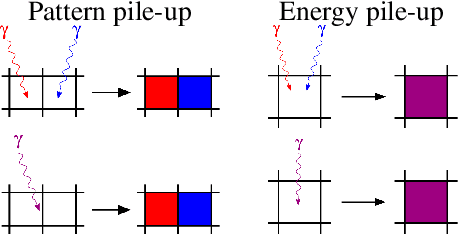
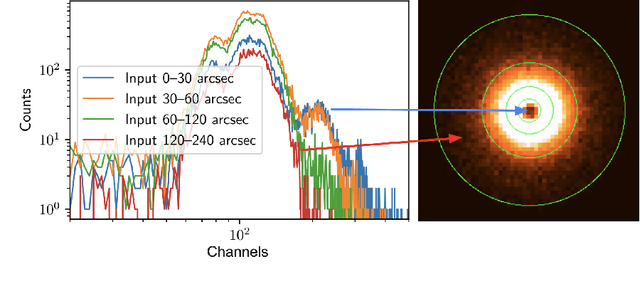
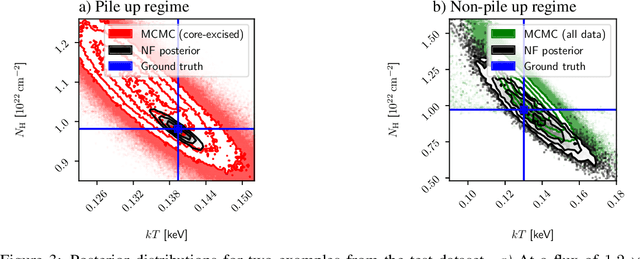
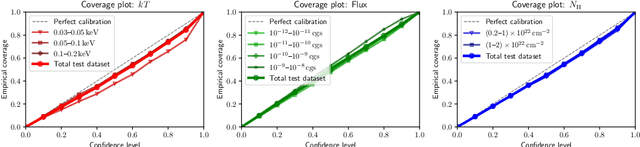
The dynamic range of imaging detectors flown on-board X-ray observatories often only covers a limited flux range of extrasolar X-ray sources. The analysis of bright X-ray sources is complicated by so-called pile-up, which results from high incident photon flux. This nonlinear effect distorts the measured spectrum, resulting in biases in the inferred physical parameters, and can even lead to a complete signal loss in extreme cases. Piled-up data are commonly discarded due to resulting intractability of the likelihood. As a result, a large number of archival observations remain underexplored. We present a machine learning solution to this problem, using a simulation-based inference framework that allows us to estimate posterior distributions of physical source parameters from piled-up eROSITA data. We show that a normalizing flow produces better-constrained posterior densities than traditional mitigation techniques, as more data can be leveraged. We consider model- and calibration-dependent uncertainties and the applicability of such an algorithm to real data in the eROSITA archive.

Hyperspectral shadow removal with Iterative Logistic Regression and latent Parametric Linear Combination of Gaussians
Dec 24, 2023Shadow detection and removal is a challenging problem in the analysis of hyperspectral images. Yet, this step is crucial for analyzing data for remote sensing applications like methane detection. In this work, we develop a shadow detection and removal method only based on the spectrum of each pixel and the overall distribution of spectral values. We first introduce Iterative Logistic Regression (ILR) to learn a spectral basis in which shadows can be linearly classified. We then model the joint distribution of the mean radiance and the projection coefficients of the spectra onto the above basis as a parametric linear combination of Gaussians. We can then extract the maximum likelihood mixing parameter of the Gaussians to estimate the shadow coverage and to correct the shadowed spectra. Our correction scheme reduces correction artefacts at shadow borders. The shadow detection and removal method is applied to hyperspectral images from MethaneAIR, a precursor to the satellite MethaneSAT.