 Add to Chrome
 Add to Firefox
 Add to Edge
Variational Autoencoder with Normalizing flow for X-ray spectral fitting
Jan 12, 2026
Black hole X-ray binaries (BHBs) can be studied with spectral fitting to provide physical constraints on accretion in extreme gravitational environments. Traditional methods of spectral fitting such as Markov Chain Monte Carlo (MCMC) face limitations due to computational times. We introduce a probabilistic model, utilizing a variational autoencoder with a normalizing flow, trained to adopt a physical latent space. This neural network produces predictions for spectral-model parameters as well as their full probability distributions. Our implementations result in a significant improvement in spectral reconstructions over a previous deterministic model while performing three orders of magnitude faster than traditional methods.

Modeling X-ray photon pile-up with a normalizing flow
Nov 14, 2025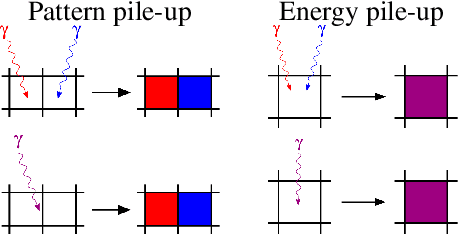
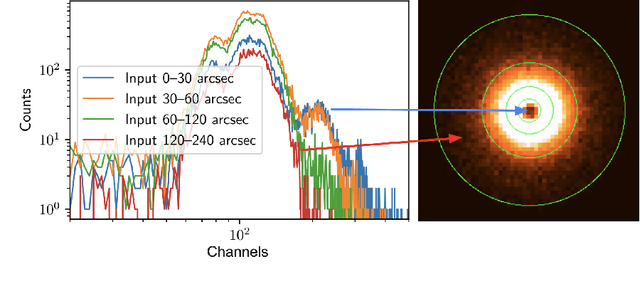
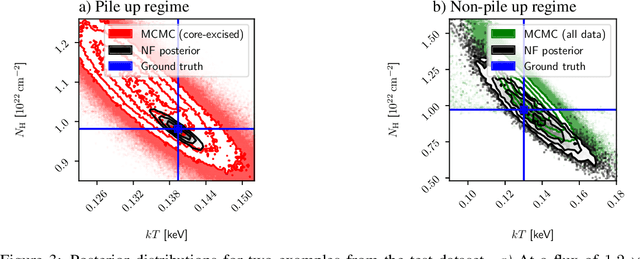
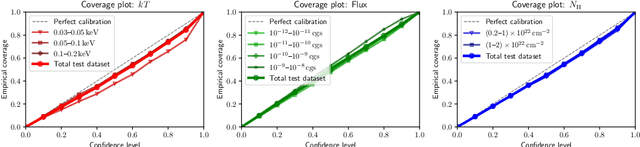
The dynamic range of imaging detectors flown on-board X-ray observatories often only covers a limited flux range of extrasolar X-ray sources. The analysis of bright X-ray sources is complicated by so-called pile-up, which results from high incident photon flux. This nonlinear effect distorts the measured spectrum, resulting in biases in the inferred physical parameters, and can even lead to a complete signal loss in extreme cases. Piled-up data are commonly discarded due to resulting intractability of the likelihood. As a result, a large number of archival observations remain underexplored. We present a machine learning solution to this problem, using a simulation-based inference framework that allows us to estimate posterior distributions of physical source parameters from piled-up eROSITA data. We show that a normalizing flow produces better-constrained posterior densities than traditional mitigation techniques, as more data can be leveraged. We consider model- and calibration-dependent uncertainties and the applicability of such an algorithm to real data in the eROSITA archive.