 Add to Chrome
 Add to Firefox
 Add to Edge
Horizon3D: Sparse Radar-Camera Fusion for Long-Range 3D Perception in Autonomous Driving
Jun 30, 2026
Long-range 3D object detection is critical for safe autonomous driving at highway speeds, yet existing radar-camera fusion methods remain limited at extended ranges. BEV-based methods capture scene-level context but incur rapidly growing computation and often lose fine-grained object detail, while query-based methods are efficient but provide limited scene-level context. Temporal fusion further requires both multi-frame accumulation for sparse distant observations and object-level motion modeling for fast-moving objects. We propose Horizon3D, a sparse radar-camera fusion framework for long-range 3D object detection that combines Gaussian primitives with sparse BEV features. Horizon3D initializes Gaussian primitives at radar- and camera-estimated object keypoints using Keypoint-Guided Gaussian Initialization, refines them through Object-Centric Sparse Fusion, and splats them onto the BEV plane to fuse object-level detail with sparse radar BEV context. It further introduces Dual-Path Temporal Fusion, which aggregates temporal cues through a BEV path for scene-level accumulation and a Gaussian path for object-level motion propagation. Experiments on TruckScenes show that Horizon3D achieves state-of-the-art radar-camera 3D detection performance. On the validation set, it outperforms the previous best method by +3.0 NDS and +1.6 mAP while maintaining competitive inference speed.

CarPLAN: Context-Adaptive and Robust Planning with Dynamic Scene Awareness for Autonomous Driving
Mar 13, 2026Imitation learning (IL) is widely used for motion planning in autonomous driving due to its data efficiency and access to real-world driving data. For safe and robust real-world driving, IL-based planning requires capturing the complex driving contexts inherent in real-world data and enabling context-adaptive decision-making, rather than relying solely on expert trajectory imitation. In this paper, we propose CarPLAN, a novel IL-based motion planning framework that explicitly enhances driving context understanding and enables adaptive planning across diverse traffic scenarios. Our contributions are twofold: We introduce Displacement-Aware Predictive Encoding (DPE) to improve the model's spatial awareness by predicting future displacement vectors between the Autonomous Vehicle (AV) and surrounding scene elements. This allows the planner to account for relational spacing when generating trajectories. In addition to the standard imitation loss, we incorporate an augmented loss term that captures displacement prediction errors, ensuring planning decisions consider relative distances from other agents. To improve the model's ability to handle diverse driving contexts, we propose Context-Adaptive Multi-Expert Decoder (CMD), which leverages the Mixture of Experts (MoE) framework. CMD dynamically selects the most suitable expert decoders based on scene structure at each Transformer layer, enabling adaptive and context-aware planning in dynamic environments. We evaluate CarPLAN on the nuPlan benchmark and demonstrate state-of-the-art performance across all closed-loop simulation metrics. In particular, CarPLAN exhibits robust performance on challenging scenarios such as Test14-Hard, validating its effectiveness in complex driving conditions. Additional experiments on the Waymax benchmark further demonstrate its generalization capability across different benchmark settings.
ProtoOcc: Accurate, Efficient 3D Occupancy Prediction Using Dual Branch Encoder-Prototype Query Decoder
Dec 11, 2024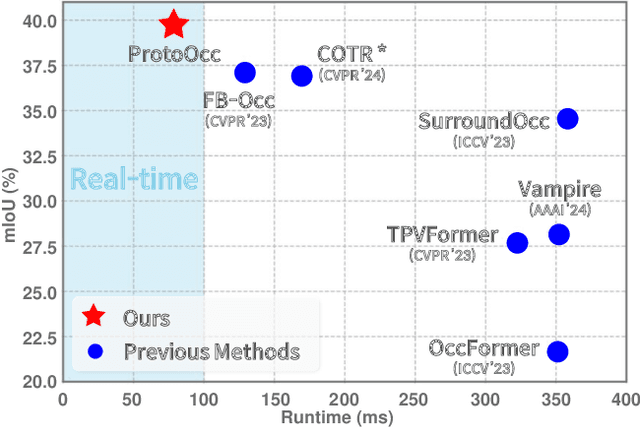
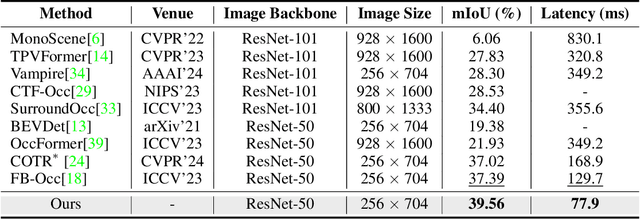
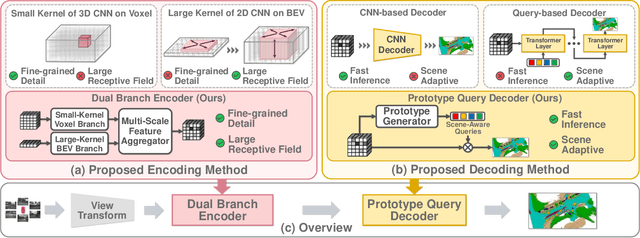
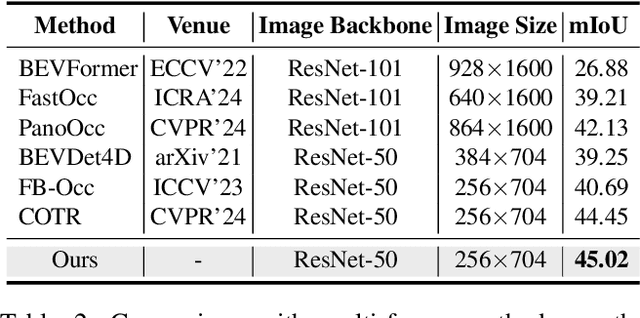
In this paper, we introduce ProtoOcc, a novel 3D occupancy prediction model designed to predict the occupancy states and semantic classes of 3D voxels through a deep semantic understanding of scenes. ProtoOcc consists of two main components: the Dual Branch Encoder (DBE) and the Prototype Query Decoder (PQD). The DBE produces a new 3D voxel representation by combining 3D voxel and BEV representations across multiple scales through a dual branch structure. This design enhances both performance and computational efficiency by providing a large receptive field for the BEV representation while maintaining a smaller receptive field for the voxel representation. The PQD introduces Prototype Queries to accelerate the decoding process. Scene-Adaptive Prototypes are derived from the 3D voxel features of input sample, while Scene-Agnostic Prototypes are computed by applying Scene-Adaptive Prototypes to an Exponential Moving Average during the training phase. By using these prototype-based queries for decoding, we can directly predict 3D occupancy in a single step, eliminating the need for iterative Transformer decoding. Additionally, we propose the Robust Prototype Learning, which injects noise into prototype generation process and trains the model to denoise during the training phase. ProtoOcc achieves state-of-the-art performance with 45.02% mIoU on the Occ3D-nuScenes benchmark. For single-frame method, it reaches 39.56% mIoU with an inference speed of 12.83 FPS on an NVIDIA RTX 3090. Our code can be found at https://github.com/SPA-junghokim/ProtoOcc.