 Add to Chrome
 Add to Firefox
 Add to Edge
Joint Knowledge Base Completion and Question Answering by Combining Large Language Models and Small Language Models
Apr 07, 2026
Knowledge Bases (KBs) play a key role in various applications. As two representative KB-related tasks, knowledge base completion (KBC) and knowledge base question answering (KBQA) are closely related and inherently complementary with each other. Thus, it will be beneficial to solve the task of joint KBC and KBQA to make them reinforce each other. However, existing studies usually rely on the small language model (SLM) to enhance them jointly, and the large language model (LLM)'s strong reasoning ability is ignored. In this paper, by combining the strengths of the LLM with the SLM, we propose a novel framework JCQL, which can make these two tasks enhance each other in an iterative manner. To make KBC enhance KBQA, we augment the LLM agent-based KBQA model's reasoning paths by incorporating an SLM-trained KBC model as an action of the agent, alleviating the LLM's hallucination and high computational costs issue in KBQA. To make KBQA enhance KBC, we incrementally fine-tune the KBC model by leveraging KBQA's reasoning paths as its supplementary training data, improving the ability of the SLM in KBC. Extensive experiments over two public benchmark data sets demonstrate that JCQL surpasses all baselines for both KBC and KBQA tasks.
* 20 pages, 11 figures

OntoTKGE: Ontology-Enhanced Temporal Knowledge Graph Extrapolation
Apr 07, 2026Temporal knowledge graph (TKG) extrapolation is an important task that aims to predict future facts through historical interaction information within KG snapshots. A key challenge for most existing TKG extrapolation models is handling entities with sparse historical interaction. The ontological knowledge is beneficial for alleviating this sparsity issue by enabling these entities to inherit behavioral patterns from other entities with the same concept, which is ignored by previous studies. In this paper, we propose a novel encoder-decoder framework OntoTKGE that leverages the ontological knowledge from the ontology-view KG (i.e., a KG modeling hierarchical relations among abstract concepts as well as the connections between concepts and entities) to guide the TKG extrapolation model's learning process through the effective integration of the ontological and temporal knowledge, thereby enhancing entity embeddings. OntoTKGE is flexible enough to adapt to many TKG extrapolation models. Extensive experiments on four data sets demonstrate that OntoTKGE not only significantly improves the performance of many TKG extrapolation models but also surpasses many SOTA baseline methods.
Deep Learning Accelerated Quantum Transport Simulations in Nanoelectronics: From Break Junctions to Field-Effect Transistors
Nov 13, 2024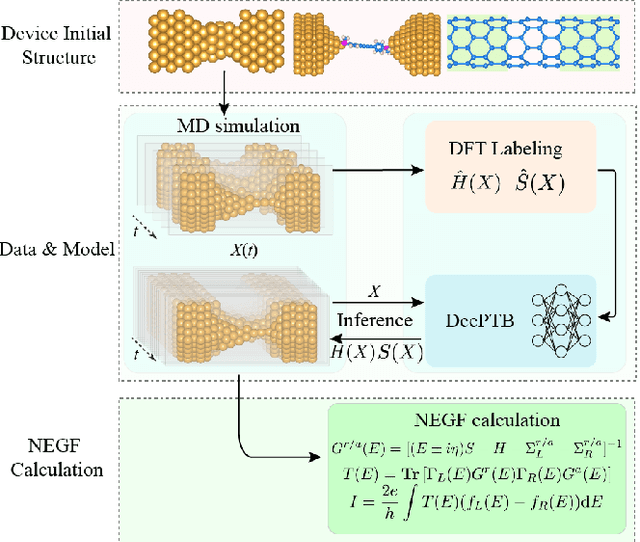
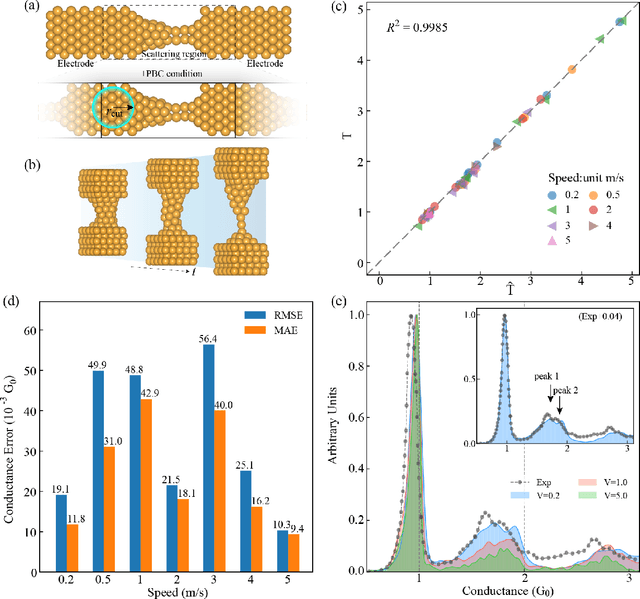
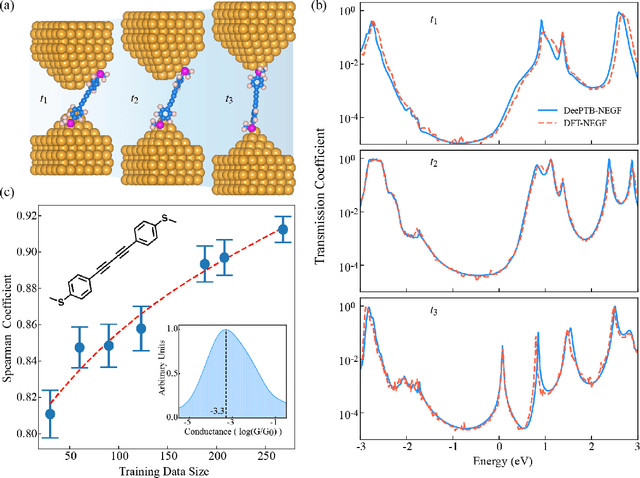
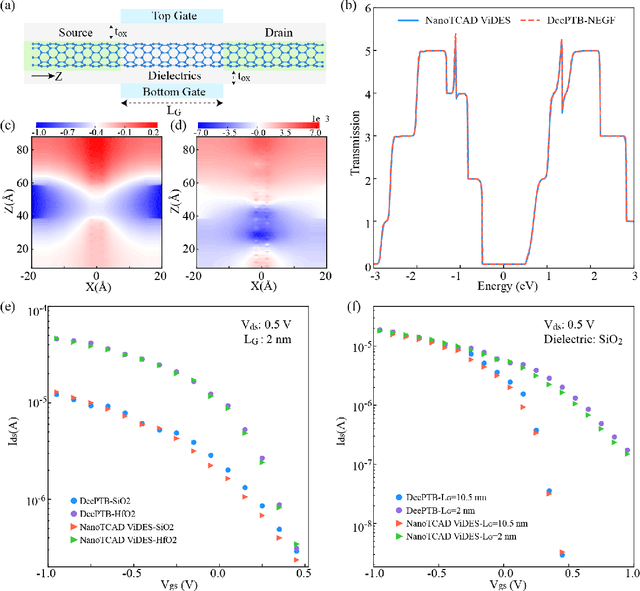
Quantum transport calculations are essential for understanding and designing nanoelectronic devices, yet the trade-off between accuracy and computational efficiency has long limited their practical applications. We present a general framework that combines the deep learning tight-binding Hamiltonian (DeePTB) approach with the non-equilibrium Green's Function (NEGF) method, enabling efficient quantum transport calculations while maintaining first-principles accuracy. We demonstrate the capabilities of the DeePTB-NEGF framework through two representative applications: comprehensive simulation of break junction systems, where conductance histograms show good agreement with experimental measurements in both metallic contact and single-molecule junction cases; and simulation of carbon nanotube field effect transistors through self-consistent NEGF-Poisson calculations, capturing essential physics including the electrostatic potential and transfer characteristic curves under finite bias conditions. This framework bridges the gap between first-principles accuracy and computational efficiency, providing a powerful tool for high-throughput quantum transport simulations across different scales in nanoelectronics.