 Add to Chrome
 Add to Firefox
 Add to Edge
The Yes-Man Syndrome: Benchmarking Abstention in Embodied Robotic Agents
May 19, 2026
Vision-language models (VLMs) are used as high-level planners for embodied agents, translating natural language instructions and visual observations into action plans. While prior work has studied abstention in LLMs, existing benchmarks are largely text-only and do not capture the perceptual grounding and physical constraints inherent to embodied robotics environments. In such settings, abstention requires recognizing when instructions are ambiguous, physically infeasible, based on false premises, or otherwise unresolvable given the available sensory modalities and context. To address this gap, we introduce a taxonomy to categorize abstention in the context of embodied robotics and present RoboAbstention, a scalable and auditable framework for generating abstention instructions grounded in images gathered from five robotics datasets. RoboAbstention instantiates the taxonomy through a three-phase pipeline: (1) structured visual grounding, (2) deterministic constraint derivation, and (3) controlled instruction generation via category-specific templates. This enables the construction of a diverse dataset with verifiable abstention conditions. We evaluate several frontier VLMs and find that all models exhibit significant weaknesses in abstention, including those with advanced reasoning capabilities. The best-performing model, Gemini 2.5 Flash, abstains on only 39.0% of our 6,069 benchmark instructions, while the embodied planner Gemini Robotics ER 1.6 Preview abstains on just 16.5%. We further explore methods for improving abstention in VLM planners, such as defensive prompting and in-context learning, and find that these interventions substantially improve performance, reaching 93.6% abstention rate for Gemini Robotics ER 1.6 Preview and 88.6% for GPT 5.4 Mini, yet no approach fully solves the problem. We open-source RoboAbstention at https://purseclab.github.io/RoboAbstention/.

Stable GFlowNets with Probabilistic Guarantees
May 03, 2026Generative Flow Networks (GFlowNets) learn to sample states proportional to an unnormalized reward. Despite their theoretical promise, practical training is often unstable, exhibiting severe loss spikes and mode collapse. To tackle this, we first assess the sensitivity of GFlowNet objectives, demonstrating that a small Total Variation (TV) distance between the learned and target distributions does not preclude unbounded training loss. Motivated by this mismatch, we establish converse guarantees by deriving loss-to-TV bounds that certify global fidelity from bounded trajectory balance losses. Lastly, we propose Stable GFlowNets, an algorithm that leverages our theoretical results to stabilize training, and empirically demonstrate improved training behavior and superior distributional fidelity.
Redundancy-Free UAV Sensor Fault Isolation And Recovery
Nov 30, 2018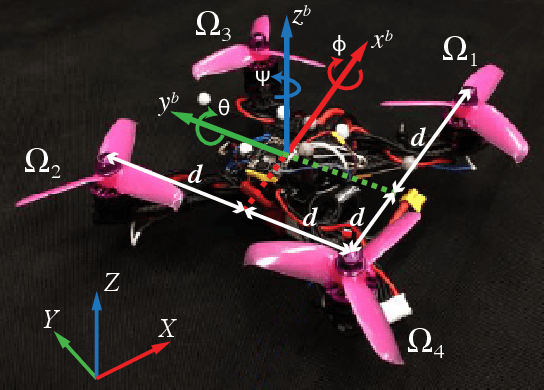
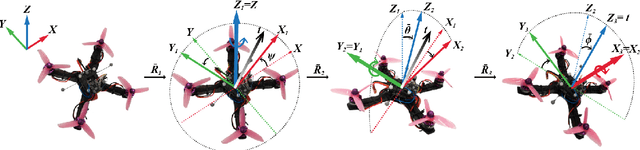
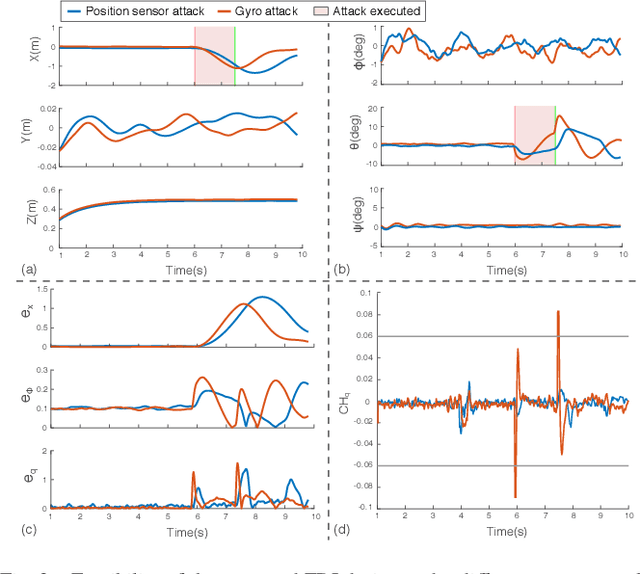

The sensory system of unmanned aerial vehicles (UAVs) plays an important role in flight safety. Thus, any sensor fault/failure can have potentially catastrophic effects on vehicle control. The recent advance in adversarial studies demonstrated successful sensing fault generation by targeting the physical vulnerabilities of the sensors. It poses new security challenges for sensor fault detection and isolation (FDI) and fault recovery (FR) research because the conventional redundancy-based fault-tolerant design is not effective against such faults. To address these challenges, we present a redundancy-free method for UAV sensor FDI and FR. In the FDI design, we used a basic state estimator for a rough early warning of faults. We then refine the design by considering the unmeasurable actuator state and modeling uncertainties. Under such novel strategies, the proposed method achieves fine-grained fault isolation. Based on this method, we further designed a redundancy-free FR method by using complementary sensor estimations. In particular, position and attitude feedback can provide backup feedback for each other through geometric correlation. The effectiveness of our approach is validated through simulation of several challenging sensor failure scenarios. The recovery performance is experimentally demonstrated by a challenging flight tasks-restoring control after completely losing attitude sensory feedback. With the protection of FDI and FR, flight safety is ensured. This UAV security enhancement method is promising to be generalized for other types of vehicles and can serve as a compensation to other fault-tolerant methodologies.