 Add to Chrome
 Add to Firefox
 Add to Edge
What to Remove, What to Preserve: Dual-Ambiguity Rectification for All-in-One Image Restoration
Jul 30, 2026
All-in-one image restoration aims to handle diverse degradations within a unified framework. Existing methods commonly encode heterogeneous degradation conditions in a shared latent space, where degradation-related cues and scene content can remain entangled. We characterize the resulting challenge as dual ambiguity: semantic ambiguity in channel-wise modulation and spatial ambiguity in restoration responses, which can lead to content corruption and residual artifacts. To mitigate this issue, we propose DAR-Net, a Dual-Ambiguity Rectification Network for all-in-one image restoration. DAR-Net first introduces a Degradation Archetype Representation (DAR) module to construct a structured degradation state through simplex-constrained archetype mixture modeling. Based on this state, a Semantic Ambiguity Rectification (SeAR) module generates degradation-aware prompts to improve channel-wise conditioning in the decoder. A Spatial Ambiguity Rectification (SpAR) module further regularizes degradation-aware and complementary features toward orthogonal response subspaces, reducing spatial interference between removal and preservation cues. Extensive experiments on standard all-in-one restoration benchmarks show that DAR-Net achieves the best overall performance under both three-degradation and five-degradation settings, improving the average PSNR over the strongest competitor by 0.14 dB and 0.34 dB, respectively; it additionally shows superior performance on CDD-11 and WeatherBench.

OMoE: Diversifying Mixture of Low-Rank Adaptation by Orthogonal Finetuning
Jan 17, 2025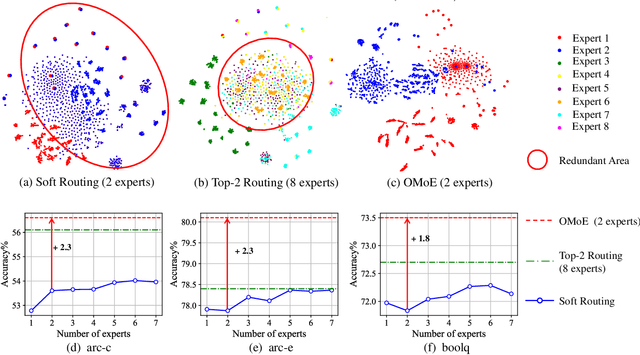
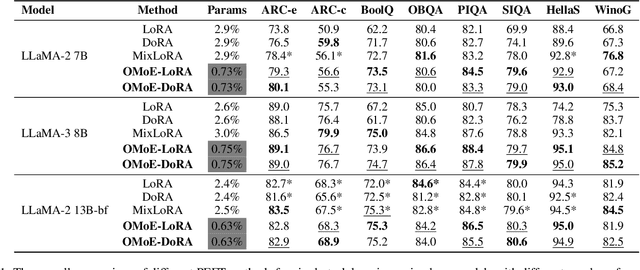
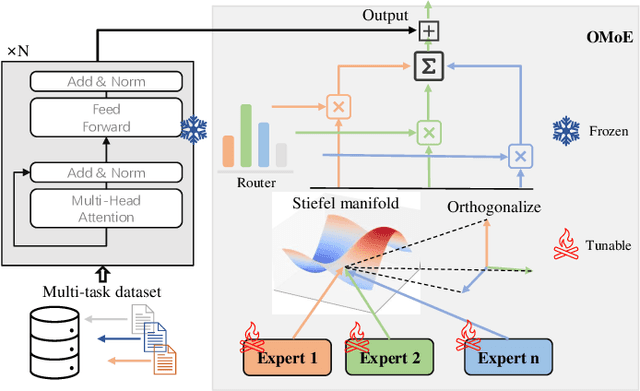
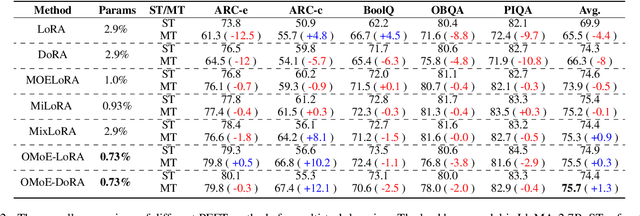
Building mixture-of-experts (MoE) architecture for Low-rank adaptation (LoRA) is emerging as a potential direction in parameter-efficient fine-tuning (PEFT) for its modular design and remarkable performance. However, simply stacking the number of experts cannot guarantee significant improvement. In this work, we first conduct qualitative analysis to indicate that experts collapse to similar representations in vanilla MoE, limiting the capacity of modular design and computational efficiency. Ulteriorly, Our analysis reveals that the performance of previous MoE variants maybe limited by a lack of diversity among experts. Motivated by these findings, we propose Orthogonal Mixture-of-Experts (OMoE), a resource-efficient MoE variant that trains experts in an orthogonal manner to promote diversity. In OMoE, a Gram-Schmidt process is leveraged to enforce that the experts' representations lie within the Stiefel manifold. By applying orthogonal constraints directly to the architecture, OMoE keeps the learning objective unchanged, without compromising optimality. Our method is simple and alleviates memory bottlenecks, as it incurs minimal experts compared to vanilla MoE models. Experiments on diverse commonsense reasoning benchmarks demonstrate that OMoE can consistently achieve stable and efficient performance improvement when compared with the state-of-the-art methods while significantly reducing the number of required experts.