 Add to Chrome
 Add to Firefox
 Add to Edge
AI_LectureNote: A Retrospective Pilot Study of a Post-ASR Workflow for English-Script Rendering and Semantic Drift in Korean-English Medical Lectures
Jul 19, 2026
AI_LectureNote is a historical, readability-oriented post-ASR workflow for Korean-English medical lectures. It rewrites speech-to-text output into study transcripts while restoring Latin-script medical terms rather than Korean phonetic transliterations. We retrospectively evaluate the workflow on four author-recorded lectures across five conditions. In this pilot, post-processing raised the macro English-script rendering rate from 0.39 to 0.71 on the whisper-1 path and from 0.26 to 0.65 when applied to 3-minute chunked gpt-4o-transcribe output. However, English-script rendering did not imply semantic faithfulness: the two post-processed conditions showed semantic drift in 34 and 36 of 282 reference sentences and polarity failures in 11 and 13 of 101 polarity-cue rows. A descriptive cross-input comparison suggested different candidate failure patterns: polarity-failure sets overlapped more strongly across front-ends (Jaccard 0.60; 9 shared of 15 unioned failures) than general semantic-drift sets (Jaccard 0.23; 13 shared of 57 unioned drifts). This single-annotator pilot documents concrete failure modes rather than population rates and supports evaluating surface accuracy, term-script rendering, chunk-level script consistency, and medical-meaning preservation separately.

Multi-lane Detection Using Instance Segmentation and Attentive Voting
Jan 01, 2020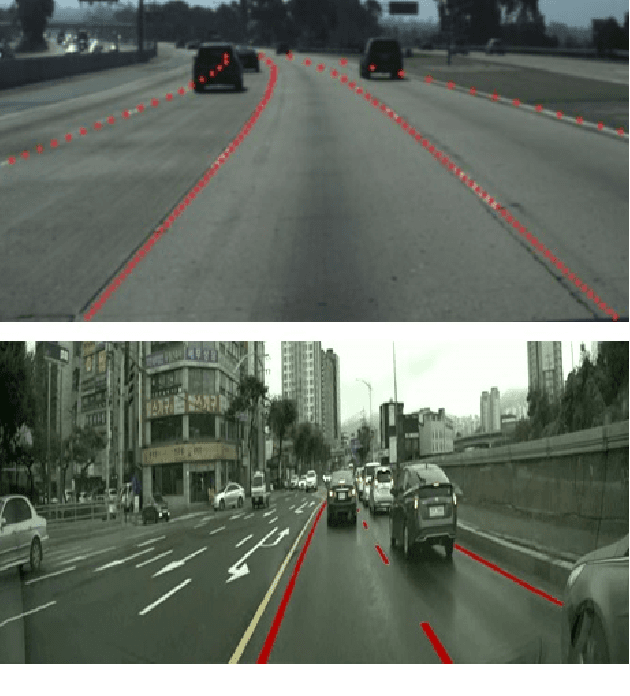
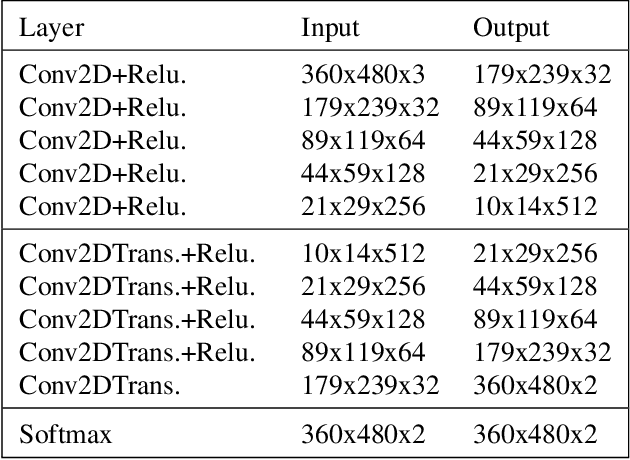
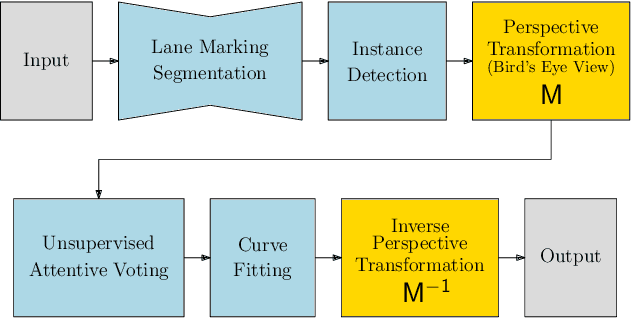
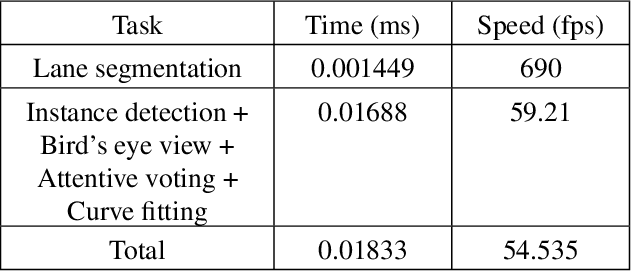
Autonomous driving is becoming one of the leading industrial research areas. Therefore many automobile companies are coming up with semi to fully autonomous driving solutions. Among these solutions, lane detection is one of the vital driver-assist features that play a crucial role in the decision-making process of the autonomous vehicle. A variety of solutions have been proposed to detect lanes on the road, which ranges from using hand-crafted features to the state-of-the-art end-to-end trainable deep learning architectures. Most of these architectures are trained in a traffic constrained environment. In this paper, we propose a novel solution to multi-lane detection, which outperforms state of the art methods in terms of both accuracy and speed. To achieve this, we also offer a dataset with a more intuitive labeling scheme as compared to other benchmark datasets. Using our approach, we are able to obtain a lane segmentation accuracy of 99.87% running at 54.53 fps (average).