 Add to Chrome
 Add to Firefox
 Add to Edge
A2RL V\textsubscript{max}: The A2RL autonomous racing dataset for long-range, high-speed perception and multi-vehicle interaction
Jul 20, 2026
In autonomous driving development, a perception dataset is crucial, as it provides fundamental data for training, testing, and validating algorithms for an autonomous vehicle's multimodal perception systems. So far, most research has concentrated on providing datasets for well-structured urban environments. This work introduces the A2RL V\textsubscript{max} open-source dataset, specifically designed for perception tasks in high-speed autonomous driving and multi-vehicle interaction. The dataset was captured during the 2024 Abu Dhabi Autonomous Racing League (A2RL), held at the Yas Marina F1 Circuit, with participation from all competing teams. It contains diverse scenarios, including single-vehicle data at varying speeds, multi-vehicle sessions, and the full final four-vehicle race. The dataset contains almost 30,000 professionally annotated LiDAR point clouds, along with RADAR point clouds. In particular, it is the first large-scale dataset in autonomous racing to feature professionally annotated LiDAR point clouds, enabling deep learning-based perception research. The data is provided in a developer-friendly format, enabling easy implementation and evaluation in future research. We provide implementation and evaluation for off-the-shelf 3D detection and tracking methods. Although baseline methods show promising results for both 3D detection and tracking, specialized methods are required to address the unique challenges of high-speed autonomous driving. For a detailed description of the dataset, please visit the \href{https://tum-avs.github.io/A2RL_Dataset_website/}{A2RL V\textsubscript{max} Dataset Website}

SPARK: Low Latency Single-Camera 3D Pose Estimation for Autonomous Racing using Keypoints
Jun 16, 2026In autonomous racing, fast detection of other participants' movements is required to plan safe, collision-free trajectories with non-cooperative opponents. LiDAR detection is inherently slower and harder to deploy on edge devices than vision methods, causing delayed detections that limit object tracking performance during high-dynamic maneuvering. Utilizing monocular 3D detection enables an easy-to-deploy, low-latency detection of other participants on the racetrack. We present SPARK, a single-camera pose-estimation algorithm for autonomous racing using keypoint detection. It achieves long-range detection with high accuracy, exceeding the performance of state-of-the-art monocular camera detection algorithms while maintaining lower latency. By employing well-optimized YOLO models and leveraging the fixed geometry in the autonomous racing domain, the algorithm also exhibits low latency and resource usage. We evaluate the performance of our approach on real-world autonomous racing data and compare it to state-of-the-art LiDAR and camera detection algorithms. The source code is available at: https://github.com/TUMFTM/SPARK-camera-det
Head-to-Head autonomous racing at the limits of handling in the A2RL challenge
Feb 09, 2026Autonomous racing presents a complex challenge involving multi-agent interactions between vehicles operating at the limit of performance and dynamics. As such, it provides a valuable research and testing environment for advancing autonomous driving technology and improving road safety. This article presents the algorithms and deployment strategies developed by the TUM Autonomous Motorsport team for the inaugural Abu Dhabi Autonomous Racing League (A2RL). We showcase how our software emulates human driving behavior, pushing the limits of vehicle handling and multi-vehicle interactions to win the A2RL. Finally, we highlight the key enablers of our success and share our most significant learnings.
Approaching Current Challenges in Developing a Software Stack for Fully Autonomous Driving
Apr 17, 2025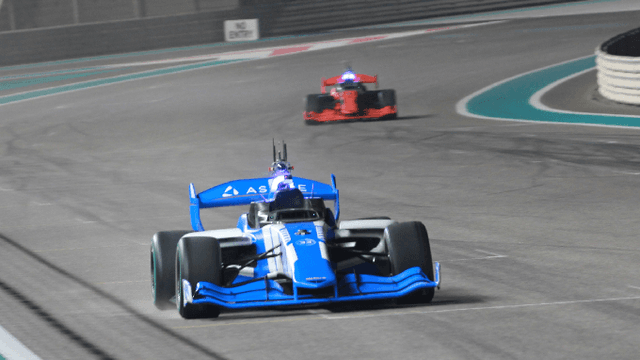
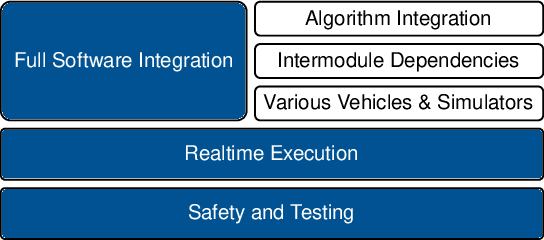
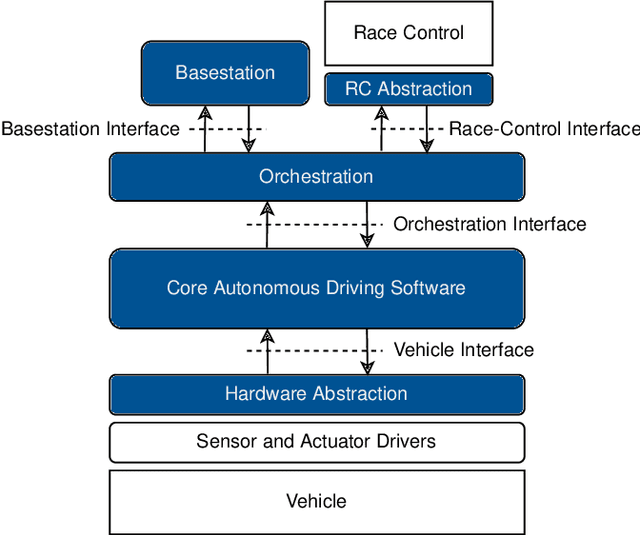
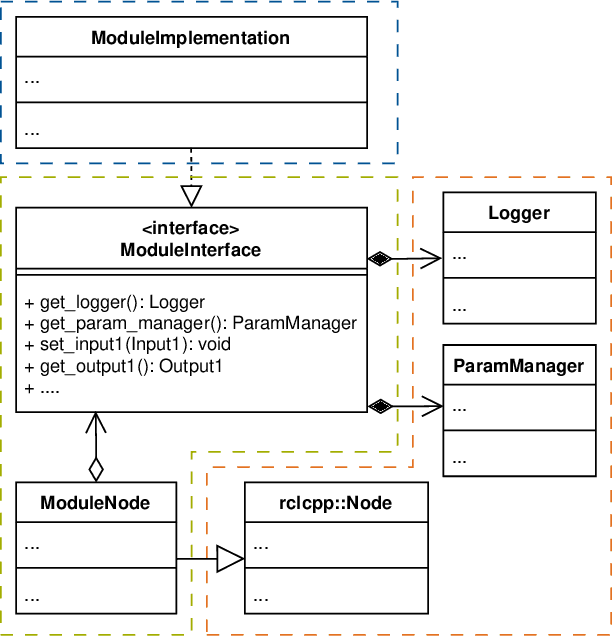
Autonomous driving is a complex undertaking. A common approach is to break down the driving task into individual subtasks through modularization. These sub-modules are usually developed and published separately. However, if these individually developed algorithms have to be combined again to form a full-stack autonomous driving software, this poses particular challenges. Drawing upon our practical experience in developing the software of TUM Autonomous Motorsport, we have identified and derived these challenges in developing an autonomous driving software stack within a scientific environment. We do not focus on the specific challenges of individual algorithms but on the general difficulties that arise when deploying research algorithms on real-world test vehicles. To overcome these challenges, we introduce strategies that have been effective in our development approach. We additionally provide open-source implementations that enable these concepts on GitHub. As a result, this paper's contributions will simplify future full-stack autonomous driving projects, which are essential for a thorough evaluation of the individual algorithms.