 Add to Chrome
 Add to Firefox
 Add to Edge
Control-Informed Constraint Adaptation in Minimum-Time Trajectory Planning for Autonomous Racing
Aug 14, 2026
Autonomous racecars operate at the limits of vehicle dynamics, where small control errors translate into safety-critical behavior and lost performance. Trajectory planners assume perfect tracking and remain blind to execution errors. To guarantee safety, trajectory planners therefore restrict themselves to conservative spatial margins, leaving usable track space untapped. To overcome these issues, we introduce a control-informed online trajectory planning framework that learns from its own execution errors. By measuring systematic tracking deviations during runtime, we dynamically adapt spatial track constraints and iteratively expand the free-space planning area. The planner remains time-optimal while compensating for accumulated execution errors. This method was analyzed in a high-fidelity closed-loop simulation environment with autonomous racecars. The results demonstrate that our approach reduces lap time by 1.8\,s without increasing computational burden, maintaining a median runtime of 25 ms. Our finding indicates that feeding control-induced deviations back into the planning layer unlocks performance previously inaccessible to modular architectures and enables autonomous vehicles to exploit track limits systematically.

A Hybrid Sampling-Based Trajectory Planner with Game-Theoretic Guidance for Autonomous Racing
Jul 15, 2026Autonomous racing demands planning algorithms that balance vehicle dynamics at the limits of handling with strategic decision-making in competitive multi-agent scenarios. Game theory provides a mathematical framework for modeling these interactions, enabling interactive trajectory planning and strategic behaviors, such as blocking. However, directly solving full dynamic games online is computationally prohibitive and challenging to integrate into robust, high-frequency autonomous software stacks. This paper proposes a hybrid architecture that integrates game-theoretic reasoning into a sampling-based motion planner, combining strategic interactions with robust trajectory generation. Building upon an $α$-potential game formulation, we utilize an offline-learned potential function to capture multi-agent interactions. During online operation, a gradient-based optimization dynamically refines interaction parameters to generate an \textit{Interaction Reference Path}. This path serves as a dynamic cost bias within a high-frequency sampling planner. We evaluate our approach in a high-fidelity simulation environment on the Yas Marina Circuit. Qualitative and quantitative results demonstrate that our approach successfully induces defensive behaviors like blocking without carrying the computational burden of full dynamic game solvers.
Head-to-Head autonomous racing at the limits of handling in the A2RL challenge
Feb 09, 2026Autonomous racing presents a complex challenge involving multi-agent interactions between vehicles operating at the limit of performance and dynamics. As such, it provides a valuable research and testing environment for advancing autonomous driving technology and improving road safety. This article presents the algorithms and deployment strategies developed by the TUM Autonomous Motorsport team for the inaugural Abu Dhabi Autonomous Racing League (A2RL). We showcase how our software emulates human driving behavior, pushing the limits of vehicle handling and multi-vehicle interactions to win the A2RL. Finally, we highlight the key enablers of our success and share our most significant learnings.
Online Velocity Profile Generation and Tracking for Sampling-Based Local Planning Algorithms in Autonomous Racing Environments
May 08, 2025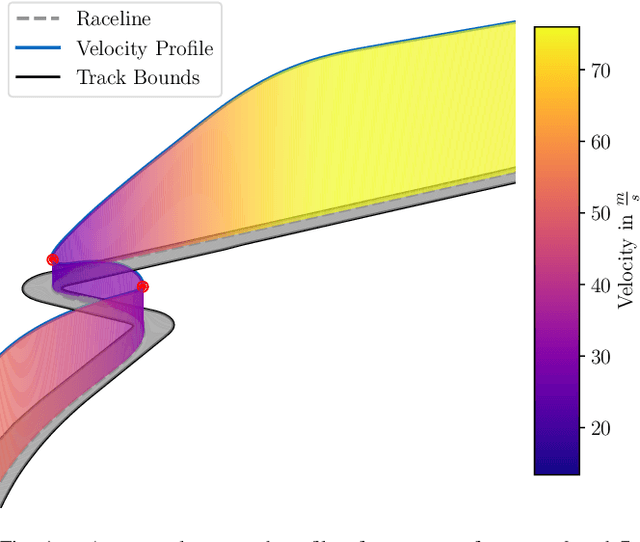
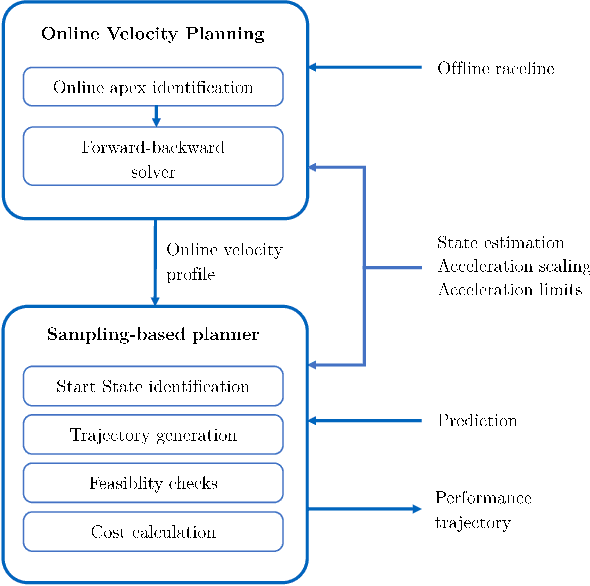
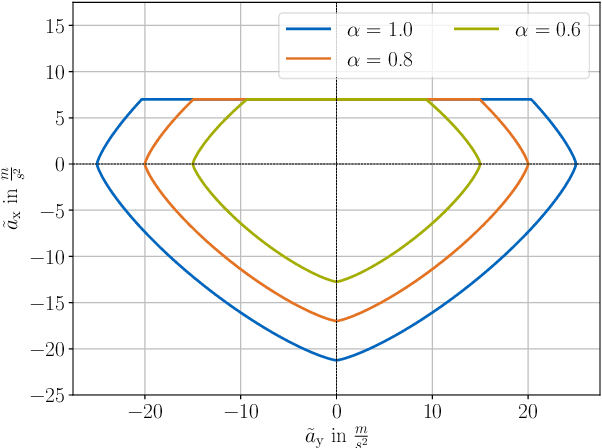
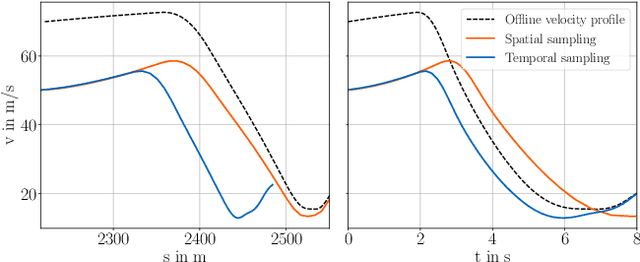
This work presents an online velocity planner for autonomous racing that adapts to changing dynamic constraints, such as grip variations from tire temperature changes and rubber accumulation. The method combines a forward-backward solver for online velocity optimization with a novel spatial sampling strategy for local trajectory planning, utilizing a three-dimensional track representation. The computed velocity profile serves as a reference for the local planner, ensuring adaptability to environmental and vehicle dynamics. We demonstrate the approach's robust performance and computational efficiency in racing scenarios and discuss its limitations, including sensitivity to deviations from the predefined racing line and high jerk characteristics of the velocity profile.
Open-Loop and Feedback Nash Trajectories for Competitive Racing with iLQGames
Feb 02, 2024Interaction-aware trajectory planning is crucial for closing the gap between autonomous racing cars and human racing drivers. Prior work has applied game theory as it provides equilibrium concepts for non-cooperative dynamic problems. With this contribution, we formulate racing as a dynamic game and employ a variant of iLQR, called iLQGames, to solve the game. iLQGames finds trajectories for all players that satisfy the equilibrium conditions for a linear-quadratic approximation of the game and has been previously applied in traffic scenarios. We analyze the algorithm's applicability for trajectory planning in racing scenarios and evaluate it based on interaction awareness, competitiveness, and safety. With the ability of iLQGames to solve for open-loop and feedback Nash equilibria, we compare the behavioral outcomes of the two equilibrium concepts in simple scenarios on a straight track section.