 Add to Chrome
 Add to Firefox
 Add to Edge
PRAGMA: Revolut Foundation Model
Apr 09, 2026
Modern financial systems generate vast quantities of transactional and event-level data that encode rich economic signals. This paper presents PRAGMA, a family of foundation models for multi-source banking event sequences. Our approach pre-trains a Transformer-based architecture with masked modelling on a large-scale, heterogeneous banking event corpus using a self-supervised objective tailored to the discrete, variable-length nature of financial records. The resulting model supports a wide range of downstream tasks such as credit scoring, fraud detection, and lifetime value prediction: strong performance can be achieved by training a simple linear model on top of the extracted embeddings and can be further improved with lightweight fine-tuning. Through extensive evaluation on downstream tasks, we demonstrate that PRAGMA achieves superior performance across multiple domains directly from raw event sequences, providing a general-purpose representation layer for financial applications.

Efficient Mixed Dimension Embeddings for Matrix Factorization
May 18, 2022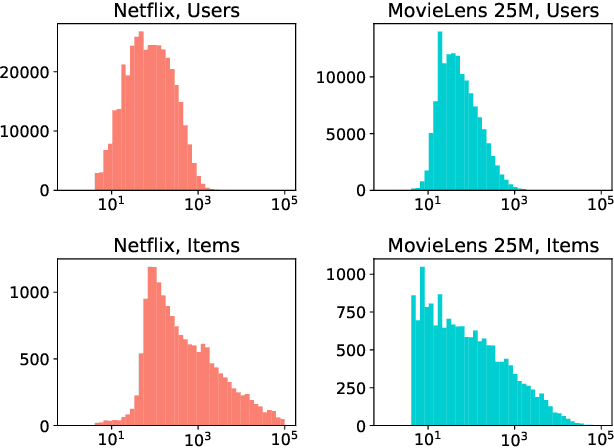
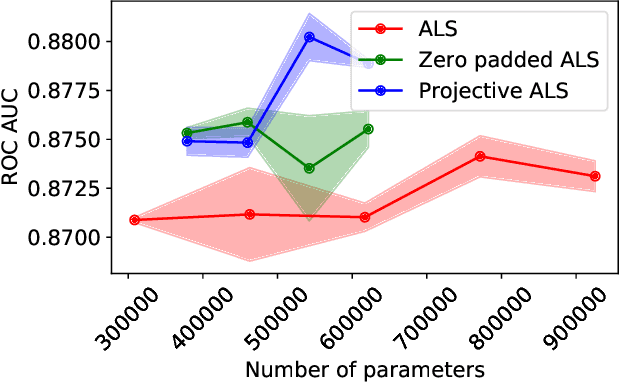
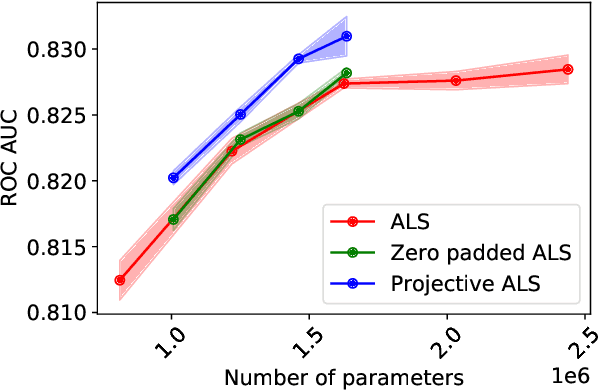
Despite the prominence of neural network approaches in the field of recommender systems, simple methods such as matrix factorization with quadratic loss are still used in industry for several reasons. These models can be trained with alternating least squares, which makes them easy to implement in a massively parallel manner, thus making it possible to utilize billions of events from real-world datasets. Large-scale recommender systems need to account for severe popularity skew in the distributions of users and items, so a lot of research is focused on implementing sparse, mixed dimension or shared embeddings to reduce both the number of parameters and overfitting on rare users and items. In this paper we propose two matrix factorization models with mixed dimension embeddings, which can be optimized in a massively parallel fashion using the alternating least squares approach.
Reinforcement Learning Enhanced Quantum-inspired Algorithm for Combinatorial Optimization
Feb 14, 2020
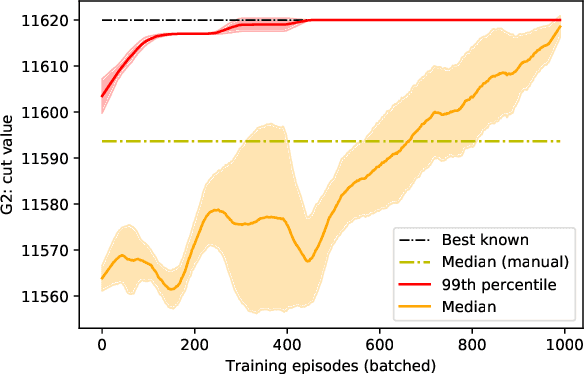

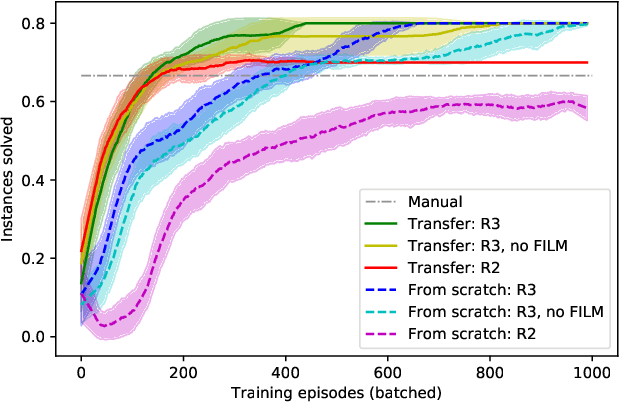
Quantum hardware and quantum-inspired algorithms are becoming increasingly popular for combinatorial optimization. However, these algorithms may require careful hyperparameter tuning for each problem instance. We use a reinforcement learning agent in conjunction with a quantum-inspired algorithm to solve the Ising energy minimization problem, which is equivalent to the Maximum Cut problem. The agent controls the algorithm by tuning one of its parameters with the goal of improving recently seen solutions. We propose a new Rescaled Ranked Reward (R3) method that enables stable single-player version of self-play training that helps the agent to escape local optima. The training on any problem instance can be accelerated by applying transfer learning from an agent trained on randomly generated problems. Our approach allows sampling high-quality solutions to the Ising problem with high probability and outperforms both baseline heuristics and a black-box hyperparameter optimization approach.