 Add to Chrome
 Add to Firefox
 Add to Edge
Wireless Center of Pressure Feedback System for Humanoid Robot Balance Control using ESP32-C3
Dec 24, 2025
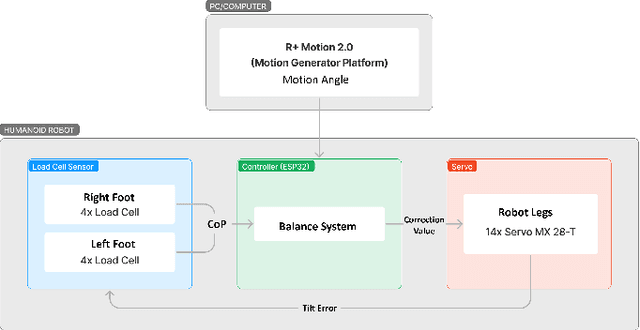
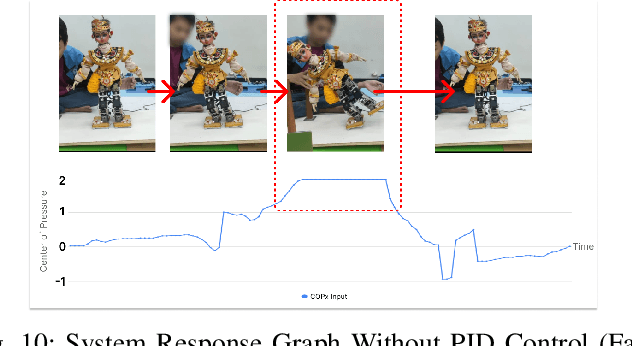
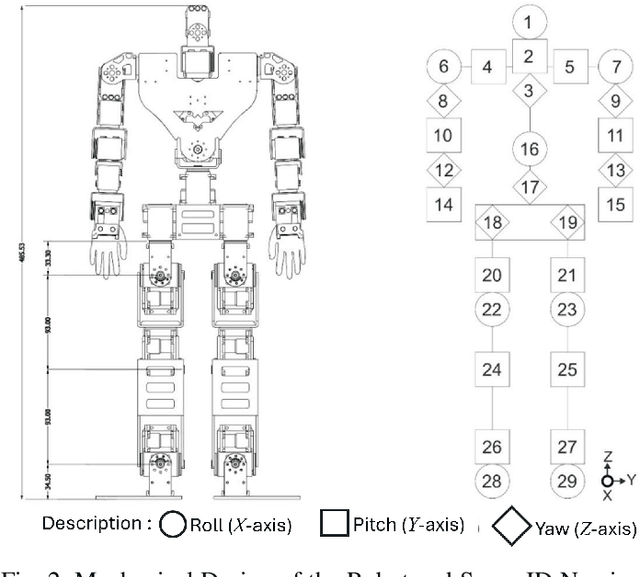
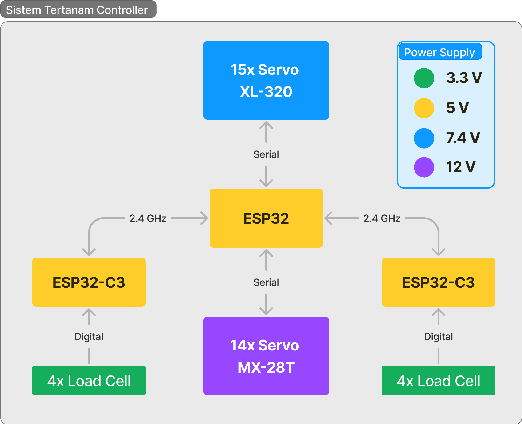
Maintaining stability during the single-support phase is a fundamental challenge in humanoid robotics, particularly in dance robots that require complex maneuvers and high mechanical freedom. Traditional tethered sensor configurations often restrict joint movement and introduce mechanical noises. This study proposes a wireless embedded balance system designed to maintain stability on uneven surfaces. The system utilizes a custom-designed foot unit integrated with four load cells and an ESP32-C3 microcontroller to estimate the Center of Pressure (CoP) in real time. The CoP data were transmitted wirelessly to the main controller to minimize the wiring complexity of the 29-DoF VI-ROSE humanoid robot. A PID control strategy is implemented to adjust the torso, hip, and ankle roll joints based on CoP feedback. Experimental characterization demonstrated high sensor precision with an average measurement error of 14.8 g. Furthermore, the proposed control system achieved a 100% success rate in maintaining balance during single-leg lifting tasks at a 3-degree inclination with optimized PID parameters (Kp=0.10, Kd=0.005). These results validate the efficacy of wireless CoP feedback in enhancing the postural stability of humanoid robots, without compromising their mechanical flexibility.

Experimental Study of Through-the-Wall Respiration Sign Detection Using Ultra-wideband Impulse Radar
Dec 20, 2020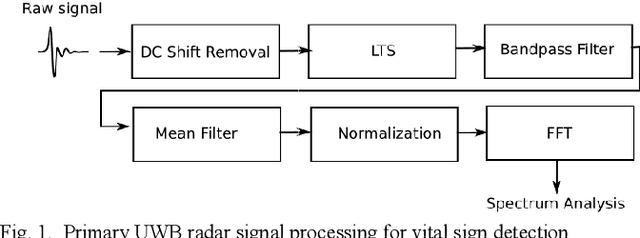
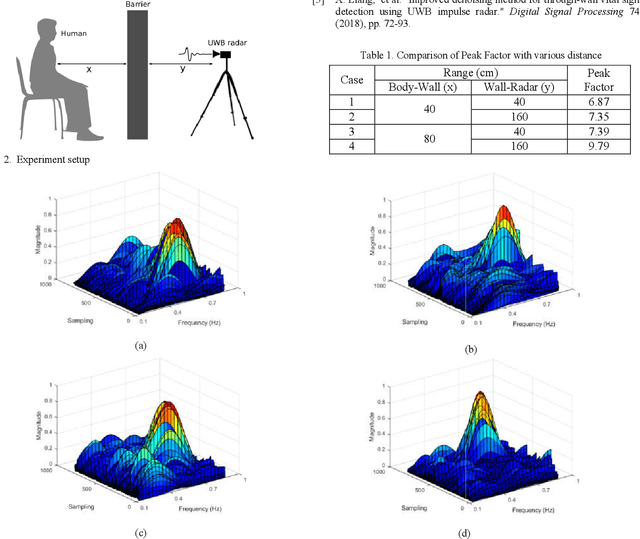
The through-the-wall human being detection and localization in the complex environments by using the radar system has many possible applications such as for law enforcement, and search and rescue missions in disaster-stricken areas. This paper discusses the experimental study of ultra-wideband impulse radar for obscured human respiration detection through spectrum analysis. We investigate the effect of the range of human-wall and radar-wall to the peak factor value of human respiration sign power spectrum. This result will be useful as a reference for analyzing the possibility of the sign to be detected by the radar with respect to the distance from both sides. According to the experimental results, longer both distance increases gradually the peak factor value. However, the peak became narrower. Besides, at a very short distance between areas and walls, the peak factor became very small because of the strong reflection of both objects. Therefore, an adaptive threshold technique and background suppression are needed in order to maintain the detection performance against any possible conditions.