 Add to Chrome
 Add to Firefox
 Add to Edge
Wireless Center of Pressure Feedback System for Humanoid Robot Balance Control using ESP32-C3
Dec 24, 2025
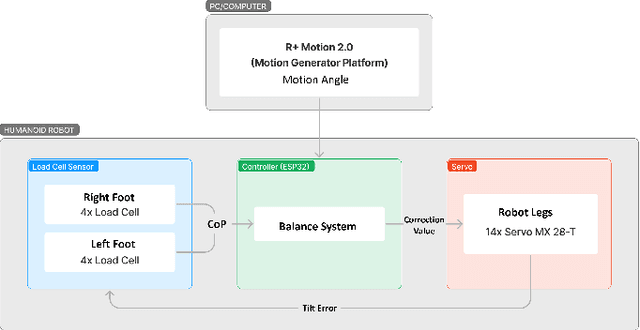
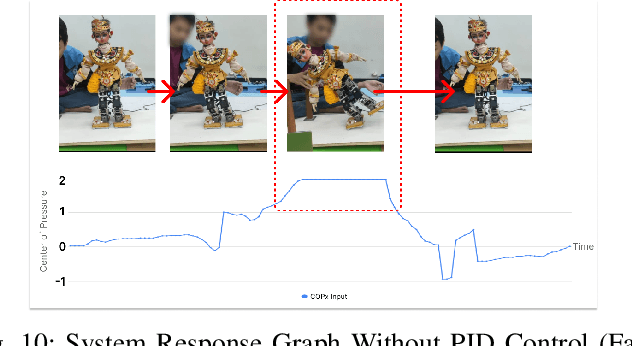
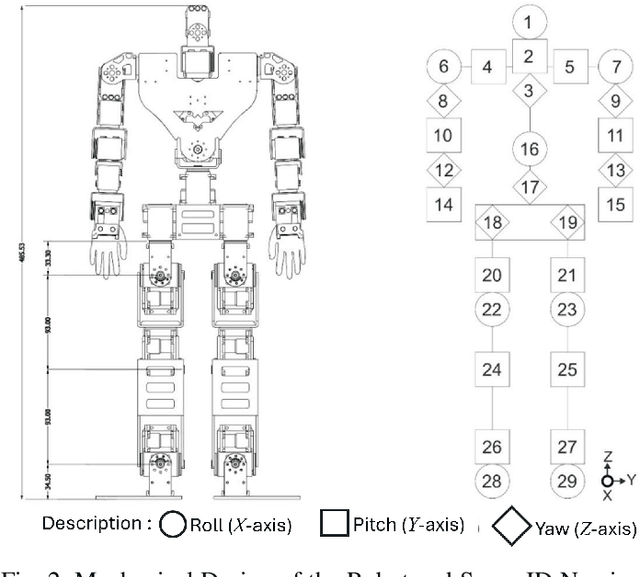
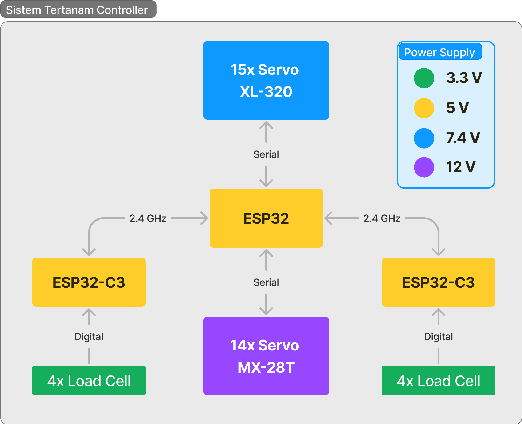
Maintaining stability during the single-support phase is a fundamental challenge in humanoid robotics, particularly in dance robots that require complex maneuvers and high mechanical freedom. Traditional tethered sensor configurations often restrict joint movement and introduce mechanical noises. This study proposes a wireless embedded balance system designed to maintain stability on uneven surfaces. The system utilizes a custom-designed foot unit integrated with four load cells and an ESP32-C3 microcontroller to estimate the Center of Pressure (CoP) in real time. The CoP data were transmitted wirelessly to the main controller to minimize the wiring complexity of the 29-DoF VI-ROSE humanoid robot. A PID control strategy is implemented to adjust the torso, hip, and ankle roll joints based on CoP feedback. Experimental characterization demonstrated high sensor precision with an average measurement error of 14.8 g. Furthermore, the proposed control system achieved a 100% success rate in maintaining balance during single-leg lifting tasks at a 3-degree inclination with optimized PID parameters (Kp=0.10, Kd=0.005). These results validate the efficacy of wireless CoP feedback in enhancing the postural stability of humanoid robots, without compromising their mechanical flexibility.

Quadrupped-Legged Robot Movement Plan Generation using Large Language Model
Dec 24, 2025Traditional control interfaces for quadruped robots often impose a high barrier to entry, requiring specialized technical knowledge for effective operation. To address this, this paper presents a novel control framework that integrates Large Language Models (LLMs) to enable intuitive, natural language-based navigation. We propose a distributed architecture where high-level instruction processing is offloaded to an external server to overcome the onboard computational constraints of the DeepRobotics Jueying Lite 3 platform. The system grounds LLM-generated plans into executable ROS navigation commands using real-time sensor fusion (LiDAR, IMU, and Odometry). Experimental validation was conducted in a structured indoor environment across four distinct scenarios, ranging from single-room tasks to complex cross-zone navigation. The results demonstrate the system's robustness, achieving an aggregate success rate of over 90\% across all scenarios, validating the feasibility of offloaded LLM-based planning for autonomous quadruped deployment in real-world settings.