 Add to Chrome
 Add to Firefox
 Add to Edge
Experimental Study of Through-the-Wall Respiration Sign Detection Using Ultra-wideband Impulse Radar
Paper and Code
Dec 20, 2020
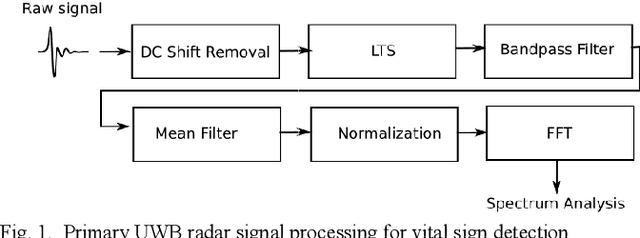
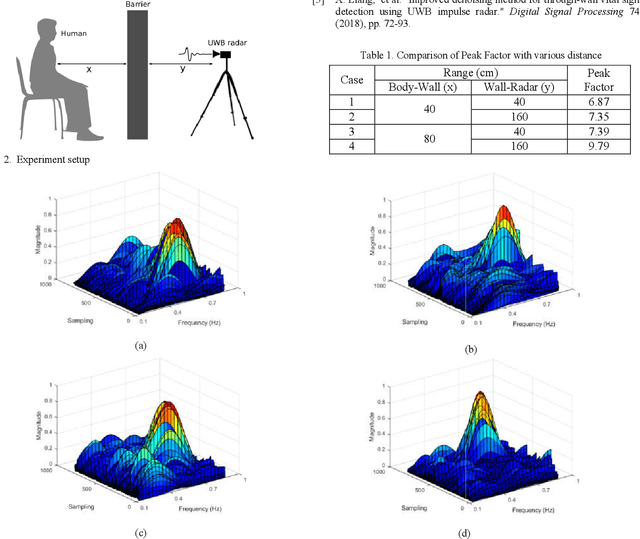
The through-the-wall human being detection and localization in the complex environments by using the radar system has many possible applications such as for law enforcement, and search and rescue missions in disaster-stricken areas. This paper discusses the experimental study of ultra-wideband impulse radar for obscured human respiration detection through spectrum analysis. We investigate the effect of the range of human-wall and radar-wall to the peak factor value of human respiration sign power spectrum. This result will be useful as a reference for analyzing the possibility of the sign to be detected by the radar with respect to the distance from both sides. According to the experimental results, longer both distance increases gradually the peak factor value. However, the peak became narrower. Besides, at a very short distance between areas and walls, the peak factor became very small because of the strong reflection of both objects. Therefore, an adaptive threshold technique and background suppression are needed in order to maintain the detection performance against any possible conditions.
