 Add to Chrome
 Add to Firefox
 Add to Edge
Convergence analysis of a family of Zermelo-type iterations for the Bradley--Terry model
Jul 24, 2026
Zermelo's algorithm is a classical method for computing the maximum likelihood estimator in the Bradley--Terry (BT) model, but its convergence can be slow in practice. To accelerate computation, Newman introduced a family of Zermelo-type fixed-point iterations parameterized by $α$, with Zermelo's algorithm recovered at $α=1$. Empirical evidence suggests that the choice $α=0$ often converges substantially faster, making it a promising alternative, yet the mechanism underlying this acceleration remains elusive. This paper provides theoretical insight into this phenomenon through a systematic local convergence analysis. We derive closed-form expressions for local convergence factors under synchronous and asynchronous updates and analyze their dependence on $α$ via spectral analysis of the associated Jacobian matrices. For synchronous updates, we show that the algorithm may fail to converge when $α<1$, and its local convergence factor is quasi-convex in $α$ under the population BT model. In contrast, asynchronous updates are always locally convergent, and their local convergence factor is provably monotonically increasing in $α$ under the population BT model of consistently ordered bipartite comparison graphs, establishing the optimality of $α=0$ in this setting. We further establish asymptotic approximation results for the population convergence factors under the BT model, justifying their practical relevance. Numerical experiments on synthetic and real-world datasets confirm the theory. Our analysis complements existing convergence results and shows that the acceleration of $α=0$ arises not only from the parameter choice but, more importantly, from the use of asynchronous updates.

Scalable Spectral Clustering with Group Fairness Constraints
Oct 28, 2022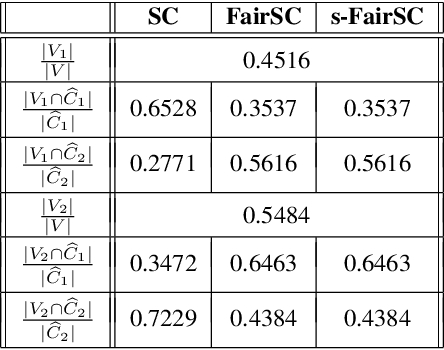
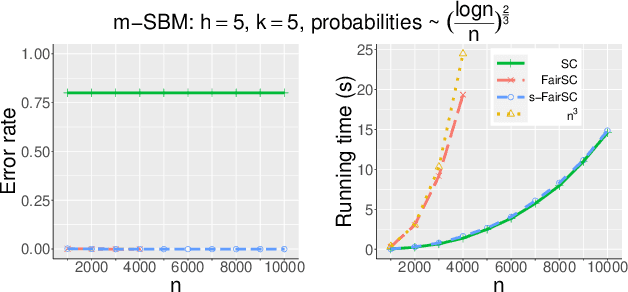
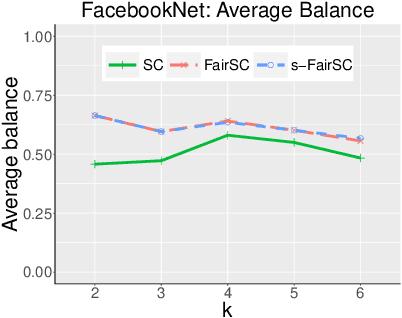
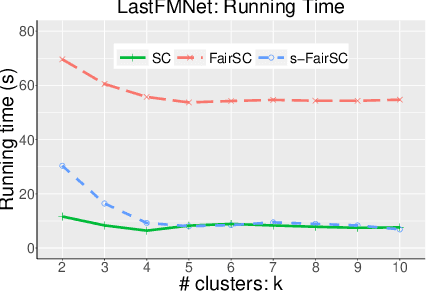
There are synergies of research interests and industrial efforts in modeling fairness and correcting algorithmic bias in machine learning. In this paper, we present a scalable algorithm for spectral clustering (SC) with group fairness constraints. Group fairness is also known as statistical parity where in each cluster, each protected group is represented with the same proportion as in the entirety. While FairSC algorithm (Kleindessner et al., 2019) is able to find the fairer clustering, it is compromised by high costs due to the kernels of computing nullspaces and the square roots of dense matrices explicitly. We present a new formulation of underlying spectral computation by incorporating nullspace projection and Hotelling's deflation such that the resulting algorithm, called s-FairSC, only involves the sparse matrix-vector products and is able to fully exploit the sparsity of the fair SC model. The experimental results on the modified stochastic block model demonstrate that s-FairSC is comparable with FairSC in recovering fair clustering. Meanwhile, it is sped up by a factor of 12 for moderate model sizes. s-FairSC is further demonstrated to be scalable in the sense that the computational costs of s-FairSC only increase marginally compared to the SC without fairness constraints.
Multi-scale prediction for robust hand detection and classification
Apr 23, 2018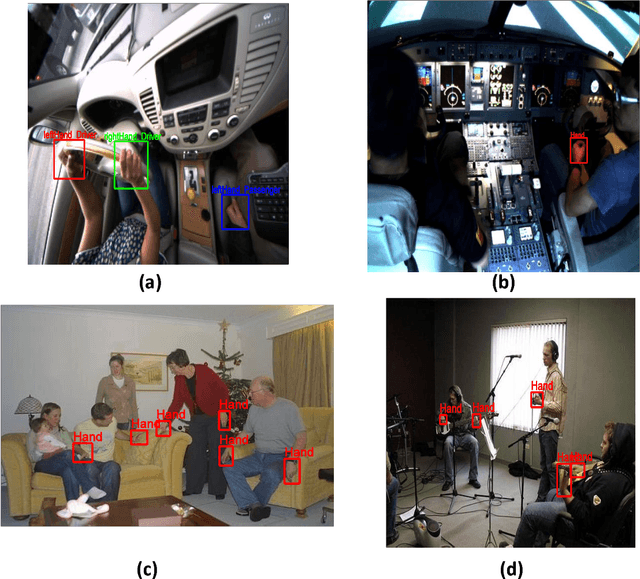
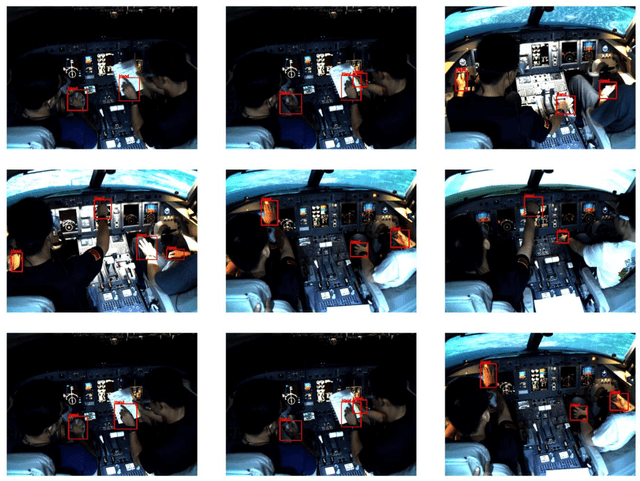

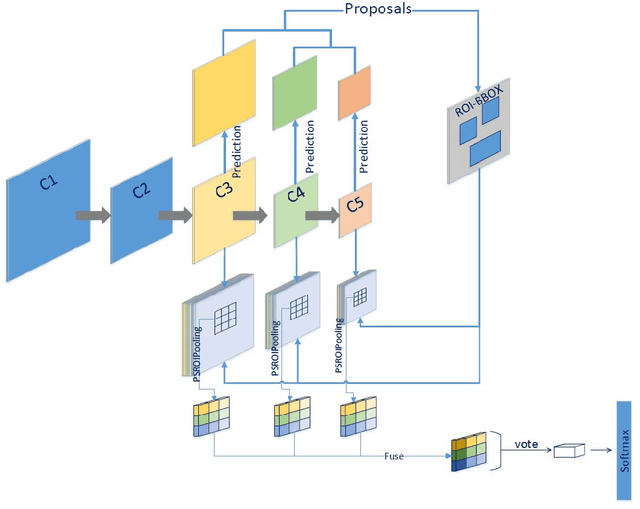
In this paper, we present a multi-scale Fully Convolutional Networks (MSP-RFCN) to robustly detect and classify human hands under various challenging conditions. In our approach, the input image is passed through the proposed network to generate score maps, based on multi-scale predictions. The network has been specifically designed to deal with small objects. It uses an architecture based on region proposals generated at multiple scales. Our method is evaluated on challenging hand datasets, namely the Vision for Intelligent Vehicles and Applications (VIVA) Challenge and the Oxford hand dataset. It is compared against recent hand detection algorithms. The experimental results demonstrate that our proposed method achieves state-of-the-art detection for hands of various sizes.