 Add to Chrome
 Add to Firefox
 Add to Edge
Fraud Detection in Cryptocurrency Markets with Spatio-Temporal Graph Neural Networks
Apr 27, 2026
Technological advancements in cryptocurrency markets have increased accessibility for investors, but concurrently exposed them to the risks of market manipulations. Existing fraud detection mechanisms typically rely on machine learning methods that treat each financial asset (i.e., token) and its related transactions independently. However, market manipulation strategies are rarely isolated events, but are rather characterized by coordination, repetition, and frequent transfers among related assets. This suggests that relational structure constitutes an integral component of the signal and can be effectively represented through graphical means. In this paper, we propose three graph construction methods that rely on aggregated hourly market data. The proposed graphs are processed by a unified spatio-temporal Graph Neural Network (GNN) architecture that combines attention-based spatial aggregation with temporal Transformer encoding. We evaluate our methodology on a real-world dataset comprised of pump-and-dump schemes in cryptocurrency markets, spanning a period of over three years. Our comparative results showcase that our graph-based models achieve significant improvements over standard machine learning baselines in detecting anomalous events. Our work highlights that learned market connectivity provides substantial gains for detecting coordinated market manipulation schemes.

$K$-way $p$-spectral clustering on Grassmann manifolds
Aug 30, 2020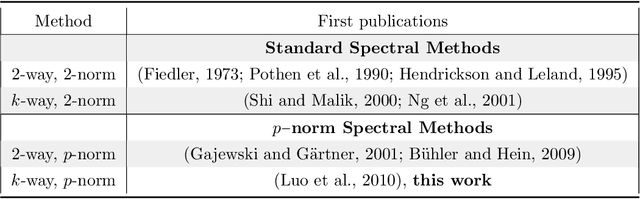
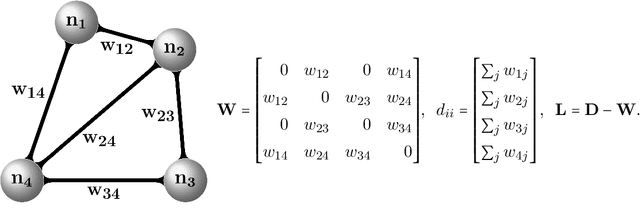
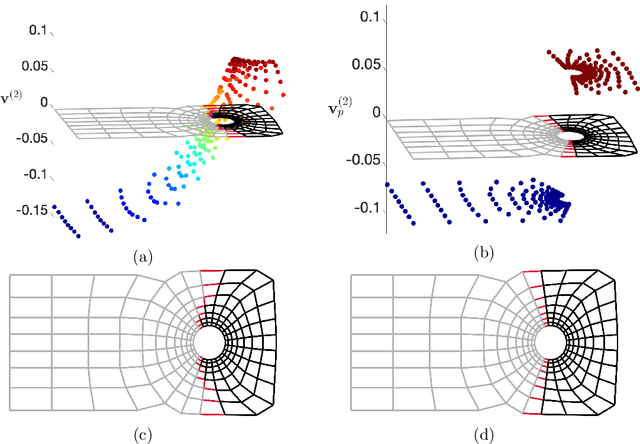
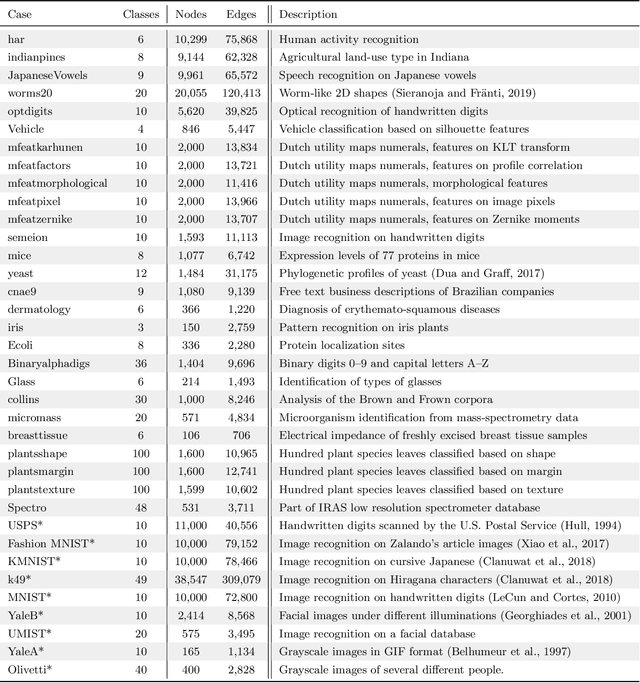
Spectral methods have gained a lot of recent attention due to the simplicity of their implementation and their solid mathematical background. We revisit spectral graph clustering, and reformulate in the $p$-norm the continuous problem of minimizing the graph Laplacian Rayleigh quotient. The value of $p \in (1,2]$ is reduced, promoting sparser solution vectors that correspond to optimal clusters as $p$ approaches one. The computation of multiple $p$-eigenvectors of the graph $p$-Laplacian, a nonlinear generalization of the standard graph Laplacian, is achieved by the minimization of our objective function on the Grassmann manifold, hence ensuring the enforcement of the orthogonality constraint between them. Our approach attempts to bridge the fields of graph clustering and nonlinear numerical optimization, and employs a robust algorithm to obtain clusters of high quality. The benefits of the suggested method are demonstrated in a plethora of artificial and real-world graphs. Our results are compared against standard spectral clustering methods and the current state-of-the-art algorithm for clustering using the graph $p$-Laplacian variant.